Home

It’s been six weeks. They’ve had some bitter arguments, teary-eyed, face-slapping, pinching arguments. They’ve fought over toys, bread, milk. They’ve had fleeting comments about one place, friend, family member, or taste that they miss from back home.

But they have not once said, “I wish we didn’t come.”

Instead they have filled their time with: week one–decorating their rooms with paper torn from one of the notebooks we brought, colored pencils from Wal-mart, drawing pictures of flowers, pretty little girls, rainbows, and taping them up all over the white walls. Week two–preparing for school and getting their feet ready to walk miles in a day, gushing about the beauty of the harbor, trying out different kinds of foods, commenting on all the similarities and differences between this country and theirs. Week three–adjusting to school, crying a bit, laughing a bit, bragging over short hours, casual clothes, a variety of subjects that they’ve never experienced before. Week four–perfecting their hideouts in the park, being chased after by boys and girls, loving the festival’s parade, carnival, and ginormous cotton candies. Week five–wanting only uniforms to conform, they asked for nothing else, not more money, a desire to own a car, be free, to speak better Spanish. Week six–curling in their rooms with books in the iPad, playing games with Zoobles and the cars they spent six euros on today, blowing bubbles and living in a world that is completely different from home, a world in which they are completely at home.

How I love my girls. How amazing they are, to come here, to do this with me, and never for one moment think this is not where we should be. They are my strength, my dream, my hope for wherever we go in this life.

Bleeding Through

just as i miss the news,
don’t have to hear about
who won the football game,
and find myself falling further and further
into this new world of mine,

i almost lost sight of the day
my family came together
to put my grandmother’s ashes
next to my grandpa,
her home, house, and store
ever-present in my childhood memories

the funeral i swore
i’d never miss.

but oceans can run deep,
and i’ll never swim across
the distance that puts me here,
that makes me unlike
all i’ve known, all i’ve ever been,
into the new form that still bleeds
with my grandmother’s blood

What I Miss

There are things I miss so fiercely that my heart aches. A good long, cold and isolated bike ride, breath steaming out of my lungs, coming across the deer along the fence, the perfect mountain view tinted by rays of morning sun, everything just coming into the dawn of a new day. My mornings, solitude and strength building me up for whatever I might face, knowing that I could face the world after that ride.

My recliner. Chosen by me, ridiculed for being too large, but so thick, soft, a perfect armrest I once used to nurse all my babies, it leaned back perfectly, laptop in lap, movie on screen, book in hand, the perfect piece of furniture for every situation.

My Hyundai. Not the car itself, its junky no-lights-on-interior nothing to brag about. Just the freedom it provided, piling the kids in on our latest adventure, trekking across town to the museum, the zoo, the reservoir… how I miss the ability to go anywhere, anytime, for them to share that freedom with me, to be able to explore the world without limitations of bus schedules, car rental fees, and finances.

The telephone. Being able to pick it up and call my friends, my parents, my sister, anyone, without having to worry about an eight-hour time difference, without thinking, what a fucking shitty day, I need to talk, and knowing that I can’t talk to anyone, any time, about all the things in life I need to talk about. That it really is just us, the five of us, and we have to figure out a way to be everything for each other in every moment, whether it’s my girls’ fierce insistence on me spending my last dollar on school uniforms I can’t afford because they already stand out enough, and they need to fit in, or Bruce hating his inability to communicate anything, or me running into one problem after another with the principal (what IS it with me and principals???).

Wal-mart. God, I never thought I’d say that. Wal-mart, I miss you! I know I cursed you every time I walked in, ridiculed your inability to keep items in stock, criticized your exploitation of Chinese products, your destruction of the natural environment. But I wish you were here to save me when I can’t find a decent store to buy what my girls need, to be open when I need to print out a bus ticket or make copies for lessons, to take back all my items without a receipt!! TO BE OPEN ALL THE TIME!! Even Sundays!

Microbrews. I don’t think any description needs to follow the smooth taste of a home-brewed Hefeweizen straight out of the tap from Dry Dock.

My oven!! AN oven. No homemade pizzas. No baking chicken or potatoes. No broiling steak. But above all and everything, never a chance, for a whole year, to make a single batch of brownies. I can almost feel the melted chips sticking to my tongue, the tiny crumbs at the bottom of the pan pinched between my fingers, the smell that filled the house for hours…

Again, my words, my beautiful words. Trapped here in this blog, lost to everyone here who thinks I’m just some stupid American who’s timid and speechless. Oh, how I miss my words.

Dear Spain: I Have a Plan for Your Instability!!

Yes, I know, walking down these brightly lit, tiled-sidewalk streets with the happening cafes, shops, and panaderias, you think you have it all. But are you forgetting about your poor people who can’t afford to pay 653€ for a stroller? There are people here without jobs, and your solution is to raise taxes on children’s textbooks and raise gas prices?

I have a better idea. Why don’t you copy America and sell things. USED.

Yes, I know it’s a foreign concept (hence the America part). But my husband and I went into the only two shops in this city we could find that offer used products, what we would call back home pawn shops, and were able to buy a like-new scooter for our girls for 9.50€, when we saw the exact same one at the Chinese store for 28€! Why would anyone in their right mind pay 28€ when they can pay 9.50€?

But that isn’t the point. The point is, that pawn shop was PACKED. Every time we’ve walked by, when it’s closed, people are waiting outside for it to open. And everyone in Spain was there this morning trying to find something used. Or sell something to make a little extra money.

These people have a plan, but it isn’t complete. I know you’re obsessed with your clothing here (don’t tell me different–I’ve seen the coordinated, designer-clad two-year-olds walking about), but it’s time to market that desire. Have you ever heard of a consignment shop? A used furniture store? Play-it-Again Sports? You people are missing out on a market that could turn this country around!! Everyone benefits! People sell, people buy, the business takes a cut, we all get a good deal and have more money to pour into your small cafes, panaderias, and the like.

Forget your government corruption, your doomed banks. Find some savvy investors and open just one shop. Start with baby and children’s items. It’s a win-win. Everyone here loves families, and everyone here wants a bargain. I guarantee that within a few months you’ll turn a beautiful profit, enough to open an adjacent shop selling clothing… you get the idea. Screw your instability. As we always say in teaching, no sense in reinventing the wheel. It wouldn’t be the first time you copied an idea from America, nor the last…

Hey, I’m no business major, but a girl’s gotta survive. A country’s gotta survive. What do you think, España??

Carthagineses y Romanos

We walked the four miles it takes to make it down to the harbor and back. So easy of a commute for adult legs, so arduous with three girls in tow. No one who ever wrote an expatriate web site, who ever published an expatriate book, who offers advice for traveling across Europe, who romanticizes the reality of everyday life, gave up a steady job, a home with a yard, and a debt-free life for one year in Spain with an English-only husband and three daughters in tow.

Let me write the blog post for you. The book for you. It will begin with staying up late and sleeping in, like all Spaniards do. We might throw in a siesta strewn with screaming girls who are today fighting over the fort they are wholly incapable of completing without our assistance, who beg to go on a bike ride, to go to the park where the three small boys in matching outfits will chase them and call them “ingleses“.

We will have a Spanish tortilla for dinner, made in our newly-purchased 10€ sarten, and eat at the usual hour of Americans after our four-mile journey to the center of town where we thought we were witnessing a children’s festival and came across, instead, a Lion King-esque display of Roman dressed tribes holding up babes in togas, presentations to the emperor and empress, the formal announcement of each family like a baptism of a new generation that we can’t quite understand or be a part of.

There were no bouncy castles. No face painting. Just women presenting gift baskets of fruit, throwing candy that my nine-year-old snatched up and filled her pockets with, asking me later how to say candy in Spanish so she could offer it to the four-year-old boy on the playground. We are reminded, again, that we don’t have a car, that we can’t pile in and own our weekend, but must give in to what this city has to offer us, whether it be a strange historical reenactment, a walk that six small legs no longer endear to endure, or an evening where we settle in, once again, to the solitude of this life we have chosen, no friends, no family outside the small circle we create for ourselves in the midst of a language none of us wholly understand.

This is my Spanish Sunday. It ends with me listening to a book so descriptive of a white Christmas that I ache for this endless summer to be over, the hot drought of Colorado bleeding through to palm trees and no breeze on a late September Spain, the beach like a taunting ghost, hovering before us but not quite within our reach as we stand before the replica of the first ship to circumnavigate the world, our feet foreign, our faces, hands, mouths foreign, in a place we have chosen to make our home.

20120924-085009.jpg

Our Latest Spain Adventure

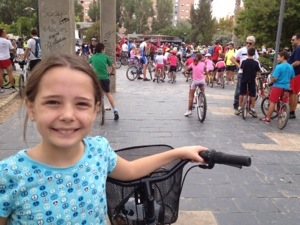
With handlebars barely within her reach, a bike seat that doesn’t allow her feet to touch the ground like she’s used to, and hand brakes only (also new), it is a bumpy one-mile ride to the beginning of our latest Spain adventure. Isabella, nine, is anxious to be a part of something here, both with me and the people of this city. She lives to belong.

This is the cheap bicycle we bought for Bruce at Carrefour, the one with crooked handlebars and a pedal that already fell off and is now on somewhat crookedly as well, its bearings stripped after a single repair. We move along side streets until we reach the bike lane, having to stop only a few times for hazard-lit cars whose drivers are greeting friends, delivering fruit, or just not in a hurry.

No one here is ever in a hurry. After a fall and a few precarious turns by Isabella, we are ten minutes late to the park. However, as cyclists of all ages continue to stream in, it becomes clear to me, once again, that this is not America. There is no liability form to sign, no registration fee, no separate event for kids and adults. And there is certainly no reason we should begin on time!

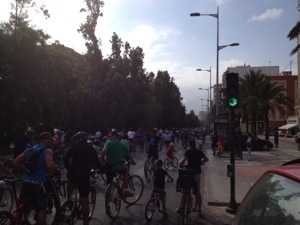
After another twenty-five minutes of waiting, we begin, five hundred or more, to stream out of the park. We fill the street with trailers, tagalongs, training wheels, baby bike seats, and a speed slow enough to walk. North to the first roundabout, over to the main Alameda, where we move along the palm trees toward the harbor, our safety enforced by neon-green uniformed policemen who stand at each corner. “It’s like being in a parade, just like the one last night!” Isabella announces, reminiscing the 11:00 p.m. march across town of people dressed in B.C.E. Roman and Carthagenian robes, kilts, skins, helmets, and furs. (Yes, I said 11 PM, where every age from little Roman toga-bearing babies and seventy-year-old crowned queens lit up the streets with their drums and song).

I am a cyclist. I have ridden three thousand miles in eight months, regularly ride my bike twenty-five miles to and from work each day, and have participated in a cycling event that took me over two mountain passes in the depths of the San Juans. But I certainly have never seen anything like this.

Like a slow-motion mob, we “ride” across town, weaving in and out of kids ranging in age from two to seventy (kind of like the parade!). There is no finish line, no lineup of booths promoting muscle milk or the latest carbon bike, no giant banners bragging about sponsorship. There are freestyle cyclists showing off, juegos tadicionales like hopskotch and jump rope, and all the families in Cartagena, gathered here at the city center to cycle their way to a sacred Saturday of family time.

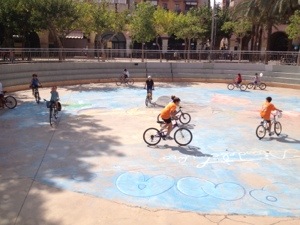
I watch my daughter, who has mastered control of her handlebars, who leads me along what she calls “the Italian street” into and out of narrow “alleys”, who rides in circles with the other kids on the concrete at the center of a park, who asks to ride the long way home. We weave in and out of pedestrians, meander along the bike path past all the now-dispersed cyclists, and make our way back.

She has completed her first cycling event. I have completed my first cycling event in Spain. In our latest Spain adventure, where nothing is the same and everything is the same, we arrive home, unscathed, barely sweating, eight miles behind us, and all the miles ahead of us paved in love, in beauty, in the connectedness of belonging to a culture that cherishes their children far more than riding a bike over two mountain passes.

20120922-154714.jpg

20120922-154800.jpg

20120922-154904.jpg

20120922-154931.jpg

Spain Is…

bedtime at midnight or later
(every day of the week).
sunrise beyond 7:30
hidden behind persian blinds
that block out all hopes of light.
clocks that read 24 hours.
stores closing for siesta
and reopening when Americans eat dinner.
big men wearing pink shirts,
pushing strollers, walking little dogs
(machismo? machismo??).
families, families everywhere.
streets burning bright with diesel engines,
cars and buses never stopping.
cafes with sidewalk tables,
aluminum chairs, no menu,
fresh-made mariscos and salads,
always full, day or night.
roundabouts of insanity
(choose your lane! now!).
hazard lights and double parking
(are there no laws?).
fountains that intermittently
function (a choice? a flaw?).
kids pulling backpacks on wheels,
parents carrying boxes of textbooks.
kisses on cheeks and smiles
as bright as homecoming
(yes, we just met).
crosswalks and cart-carriers
carrying groceries home
(stop… stop… stop…)
tile sidewalks too slick
for my baby-bike’s tires
in a rare rain and zamboni-washed morning.
dumpsters divided, color-coded
for the good of all.
Spaniards who hear two Spanish words
from my mouth
and reply with long paragraphs
i don’t understand.
forty days to process an ID card
(patience is what makes us).
endless stores, all the same products
(charcutería, carnicería, panadería, frutería)
and one person behind each counter
six days a week, all hours,
trying to make it
(just like us).

My Grandmother’s Stories

My daughter, Mythili, has come home from school for two days with tears streaming down her face. She has locked herself in her room, needing a while to adjust to what the afternoon, and its homely comforts, could offer her. Yesterday she cried because she wasn’t returning the homework due, and her teacher stood outside of the school and told me that she needed to bring it, and that she didn’t seem particularly happy at the school, though he’d seen her sisters adjusting quite well. Today, it was his insistence on her using cursive for writing out her numbers, a form of writing that is foreign to her. Kind of like the language that is foreign to her.

We are in Spain. I have picked up my family and moved in the opposite direction of progress, to a country with a 20% unemployment rate and a government that can’t decide what to do with itself. Mythili, like me, is struggling with understanding all that is asked of her, and just like I couldn’t get the phone line installed when I wanted, she didn’t know when to turn in her homework.

These moments that I have omitted from my Facebook posts, that I have mostly kept quiet, these are the moments that I think about my grandmother’s story. She told it to me more than once, a bright line from Heaven shining down on her faith, her childhood, her way of looking at this world.

There are so many things that I could write about my grandmother. It could begin with the two weeks we used to spend with her every summer, where she’d take us to the beach (we all had to carry a chair and a towel, to take turns holding handles of the cooler), to the bargain shops to pick out new outfits for school, to church where she would pray and introduce us to her priest, to the small pond in Bethany where we swam and played on the playground. Those visits were the highlight of my childhood summers, and as an adult, when I planned visits, she still did everything in her power to make it special, calling me a week in advance to ask what meal she should prepare, asking me what show in New York we should go see, driving across states to visit Bob or Willow.

But it is the childhood stories, the ones she told me on long road trips or train rides, that I will remember most distinctly. To this day, I cannot allow my children to carry a spoon, a stick, a straw, or anything in their mouths as they walk around, for pure fear of what might happen to them as my grandmother reiterated many times the tragic loss of her twenty-one-month-old baby sister, who died from an infection in her throat after tripping with a lollipop stick in her mouth. The time when she went with her father, at age nine, to go look for an apartment across town because her mother was so heartbroken over losing her baby that she couldn’t live there any more. I can still hear my grandmother’s voice: “I looked out the window of the apartment down below. There was an empty lot. And a little boy was taking his car and making tracks in the dirt. He looked up for just a moment and waved at me… that was the first time I saw your grandfather.”

The story that stands out the most for me I have replayed in my mind many times over the past five months. In a period of two days, I found out that I was accepted into a teaching program in Spain, that my grandmother was entering hospice care, and that I would have to quit the job that I loved so much rather than taking a leave of absence.

I kept thinking about my grandmother’s childhood journey, and the one of her mother before her, coming to a country she’d never seen. My grandmother told me that when she came back to the United States at age eight, even though she’d been born in America, she only spoke Italian. She had much difficulty understanding English in school. All the kids at school picked on her and called her a guinea. She talked about how her father, “in his broken English,” went down to the school and told the teachers that they needed to help her, but that no one would help her.

At her wit’s end, she went to church. She knelt on a pew and prayed to God to help her, to help her learn English so that she could be a part of her new country, so that she could be educated. She prayed and cried, and soon a nice Irish woman came over to her and asked her what was wrong. She tried to explain, and the woman took her in, helped her learn English, introduced her to the man that she would one day marry. “And I knew,” she told me, “I knew that God had heard me, and that God was looking out for me.”

I will never forget those words and what the story meant to my grandmother. Her experiences, her stories, have trickled down four generations, and I feel my family living a life very similar to hers now. All along this arduous journey of sacrifice I have made to bring my family to Spain and fulfill a lifelong dream, I have thought about what my grandmother would have told me to do. And what my grandmother’s parents did; the risks they took.

So when I see my daughter step into her room and cry because she is so frustrated, because she doesn’t quite fit in, because everyone in her class knows her name though she knows none of theirs (“Why do they know your name?” “Because they talk about me all the time since I’m American,” she replies), I think about my grandmother. I think about her story, about her struggles growing up in the Depression, and then moving on to a better life, raising the four children she loved so much, doting on the seven grandchildren whose visits she cherished.

I will always remember our visits. The memories will dance like a filmstrip through my mind, sweet and melodic. But it is her words, her stories, that will trickle down and make me, and all the generations her soul has touched, the people that we were meant to be.

Just Another Day in Spain

The first day of first, third, and fourth grade! In SPAIN!
It begins at dawn, though the remainder of the world would not consider 7:30 a.m. dawn. Perhaps the sun setting at 21:00 in mid-September and not rising till 7:30 is just one of the reasons Spaniards wander the streets till the middle of the night, why they sleep in the middle of the afternoon.

I rise and get myself ready, everything about my movements pins and needles. The first day of school is always nerve-wreaking to mothers, but for my girls to start school (and not the one I wanted) that will be wholly in a new language, in a foreign country, where none of us know a soul? It’s no wonder I didn’t sleep.

They don’t particularly want to go, either, but are happy to put on regular clothes rather than the silly uniforms required by their charter school in the States. Before I know it, dawn has passed, dishes are washed, and we’re walking down the six flights of stairs to the street, where we see other mothers and children walking. This brings instant relief to my girls, who love pointing out all the children, noticing their backpack types, their shoes, their clothing.

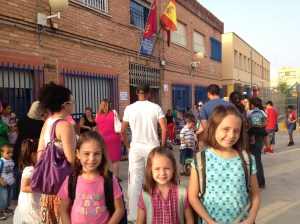
We stand outside the gates of the school with the other parents, taking pictures like we always do on the first day… until we realize that we are the only ones taking pictures. Of course, let’s put a spotlight on our Americanism. Soon a nice mother comes up and speaks in English (albeit broken), telling us what to do as they open the doors and letting us stand on the patio. In a few moments, a siren-like bell rings, and all the kids shuffle in the school, parents left outside. Bruce and I exchange looks of panic. We don’t even know what classes the girls are in. How will they? But before we know it, the secretary comes out and allows us in, only for us to discover the school is so tiny that there is only one section per grade! (And I thought we were lucky at their class size limitation of twenty-three!)

We look through the doorways at all our girls’ apprehensive faces, wave goodbye, and head onto our day of adventure.

All I need to do is make copies, pick up my debit card at the bank (26€!!—must everything cost an arm and a leg??), and spread out flyers advertising my English tutoring. We are interrupted in front of the copy shop by a huge strike moving along in front of the Ayuntamiento, men in blue uniforms holding signs about the government robbing them, all plugging their ears at optimal moments before letting loose cannon-like firecrackers in the streets, their voices and faces a mixture of jubilation and angst. The fluorescent-green uniformed police stand on the outskirts of their demonstration, their raucous and cannons just a part of their day.

We move on into the busy morning of Cartagena, taping up flyers and stopping at the grocery store where everyone in Spain is shopping before school gets out. We tear off giant pieces of French-style bread on our way back to the apartment, and before we know it, the arduous four hours of school are over, and we stand again with the rest of the parents outside of the gate.

The same siren releases our girls, who come out with giant smiles and tales of their day so similar to the tales from home, relief washes over all of us. Mythili made four friends, has multiplication homework with four numbers on top, and is adamant about us buying her books and supplies by morning. Riona admits that she understood only some of what her teacher said, but she made a friend who shared crayons with her. Isabella, sentence by sentence, tells me all the grammatical errors and vocabulary she fixed for her English teacher, pointing out that she could teach that class (I have no idea where a daughter of mine would get an idea like that!!).

I then set out on an adventure of my own: shopping for the infamous libros de texto I’d been told would cost a fortune. I ride the bike across town, Mythili’s school supply list in tow, to Carrefour, Spain’s Wal-mart. It is only when I enter the store and begin looking at her school supply list that I realize, again, that I don’t speak Spanish. Libreta? Carpeta? Caseras? As if school supply shopping isn’t difficult enough, I am searching for items that I have no clue what they are! Can Mexico and Spain make an agreement and share the same language, puuhh–leeez!!

Then the books. NONE are on the shelf. Lined up behind the counter are all the organized-people-in-the-world’s preordered, boxed-beautifully libros de texto. I start to panic, and take out my iPhone, quickly typing in the ISBN numbers the school provided, hoping Amazon will save me as always. After four entries of “No disponible,” I begin to realize the truth behind what my Spaniards had warned me was a huge publishing scam. No one can buy these books on discount or order them online. We are victims to overpriced bullshit!!

I send a Skype chat to Bruce that just repeats FUCK four times, then finally have my place in line fulfilled. Giving the sales associate my iPhone and Mythili’s list, he disappears into the back to retrieve my books. Well… two-thirds of my books. The remainder he doesn’t have, and as usual, I don’t know the right words to ask him if they’ll order more, and I’m running late anyway, so I book it out of there, penniless in my pursuit (ummm. 5€ for a NOTEBOOK??)

I fill my backpack and two saddlebags with all the supplies, patting myself on the back for at least having the adamancy to bring my bike! What a relief! I rush up the six flights of stairs with all that in tow, thinking, I sure as hell don’t need a gym this year. Then shower, dress, off to my first appointment with potential clients, who meet me in front of the giant JCPenney (AKA Corte Inglés, twelve stories in the making), and of COURSE we go to a café. Ironically, I order my Spain-usual café con leche, and they each order a Coke.

We talk for more than an hour, and somehow manage, with my broken Spanish, to arrange tutoring with their three- and six-year-old sons for four hours a week! (No need to mention I have no idea what I’ll be doing, and I think it’s just glorified babysitting in English, but whatever!)

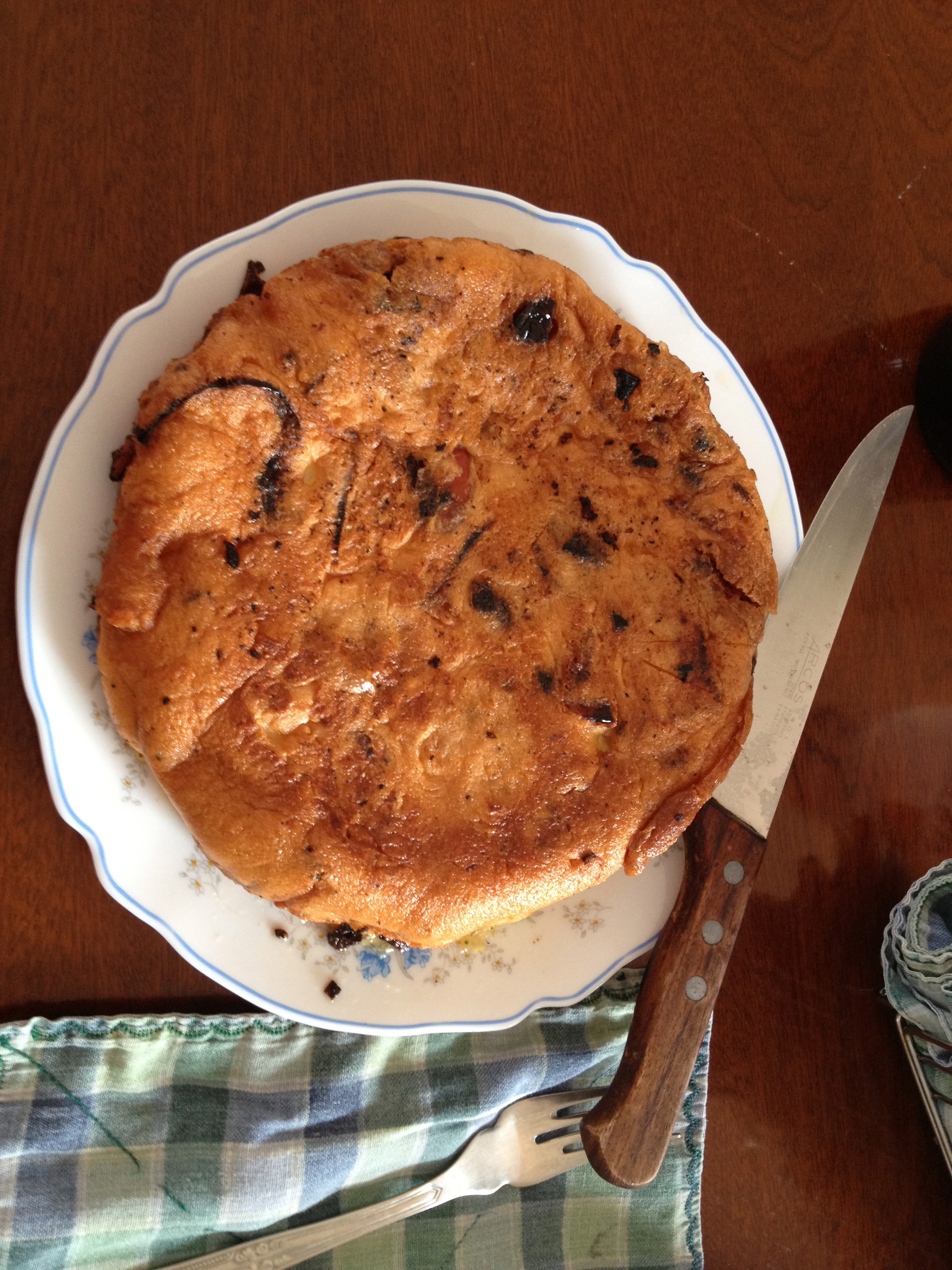
Then Bruce and I make our first Spanish tortilla, for the most part successfully interpreting the Spanish directions on the baking powder package, and it’s a hit with all the girls, who BEG to go to the park after dinner as those are the hours that kids will actually BE there. And they’re right. It’s party time at the park, and Isabella makes a friend who comes up to her parents on the adjacent bench bragging about her American friend, with her parents’ response being, “Que suerte.”

We are lucky. While in the park I receive four emails inquiring about tutoring!! On the walk home at eight-thirty, Mythili has switched her ever-imaginary talk with dolls to Spanish, and we put the kids to bed so I can head to Corte Inglés for one more attempt at books… to no avail.

But it’s just another day in Spain. There’s always tomorrow between nine and two, where I can witness a strike, have a café, and make the most of every moment.

The Spanish Siesta is NOT a Myth

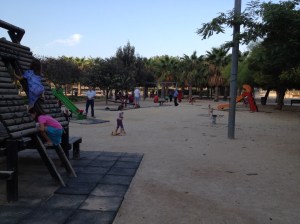
Today I left my girls in the park with Daddy, ready to ride across town (it’s only a mile) so I could put up flyers advertising my English tutoring. The park was new to us still, a dirt ground, a paseo of palm trees, bougainvillea, and hibiscus bushes intermittently spread among playground equipment. It was empty, totally empty, at 3:30 in the afternoon. The Spanish siesta is NOT a myth.

I pedaled across the ghost town of my city, seeing only a few cars. All the garage doors and persianas were closed up, waiting for tomorrow or the five o-clock hour. Only a few cafés were open and bustling with activity. I rode through the neighborhood adjacent to the harbor, at a slow pace as I still found myself mesmerized by all the shops, cafés, and architectural varieties. I managed to find fifteen poles/phone boxes to tape up my flyers, and came across the small park with the lorikeets that was close to one of the first apartments we looked at. Everything here, I realized, is becoming familiar to me. Soon I will know all the street names in my neighborhood, the major interchanges in other areas, and all the bus numbers we could possibly take to get across town. I won’t have to question which roundabout to turn left at, or which direction La Plaza de España is.

And while it is a relief, a burden lifted, at the familiarity of it all, there is also a sense of loss. Of fear. Eleven days into this new adventure, this almost still feels like a vacation. Yes, the four months of hell and paperwork beforehand kind of tainted the vacation feeling, but once we arrived, we’ve been eating tapas, spending the day at the beach, meandering around mesmerized by the warmth of the Spaniards, the intricacies of their city planning, and taking everything in with new eyes.

But tomorrow? Reality sets in for sure as the girls have their first day of school in their new country. Soon I’ll be working part-time and filling in the extra hours with tutoring sessions, and I will be traveling all over our city. And it will be ours, to keep, for a year.

So why am I afraid? Feel like I am losing something? Because I fear that with the newness wearing off, the vacation-like feeling disappearing, I won’t be so enthralled. I will be irritated with the deserted park at three, the dinner I don’t want to wait till nine to have, the cafés we can never afford to visit. And it might be just us. No family. No friends. Just the five of us, the girls getting into fights as they’re trapped in the apartment alone playing with the same old ten toys we lugged across the ocean, Bruce and I, trying to manage a lifestyle in a country neither of us are familiar with or accustomed to, the language barrier a thick wall that sometimes feels insurmountable.

It’s scary, isn’t it? Strange, unreal, many words creep up into my pedals as I take in the salty air, as the breeze from the Mediterranean pushes me up hill beside the Roman Theatre, as I come across a park, a roundabout, a beautiful view I haven’t seen until this moment. Am I crazy for choosing this, for putting my family in this situation? I’ve asked myself that thousands of times in the past months, and the only answer I can come up with, as we make ourselves at home, is that we’ll never know. There is no going back from the choices we’ve made. I will have to pedal further, see new sights, take in a different view, perhaps, to keep the adrenaline of the past couple of weeks burning in my blood, making me grateful for this amazing place, this amazing experience that I know in my heart we were meant to have.