Two-Sided

The Eritrean immigrants asked me, and then apologized profusely when I told them I turned 41 yesterday, for my ID at the liquor store today.

“Just because I am wearing a high school T-shirt does not mean I am in high school,” I attempted to joke. “I am a teacher at a high school, not a student.”

I tried to reassure them. “You’re just doing your job. Don’t apologize.” I hadn’t pulled in an ounce or a sip of wine yet. I carried my Riesling and 12-pack of Blue Moon the six blocks back home, gathering all my steps and burning all my calories before settling into a flurry of Friday tears.

My puppy and my daughters awaited me, pestering me for kisses (puppy) and dinner (teens). Mythili, as always, took charge, grilling pepper jack and cheddar-with-jam sandwiches, heating up our Friday-cop-out tomato soup while her mother paced the living room with her Riesling and screamed and cried, transcript search coming up empty, Facebook chat verifying that sixteen years into teaching, a master’s degree, thirty-six credits beyond a master’s degree, and a three-day teacher strike, had led her all to a salary less than what she’s making now.

The form to verify my “lost” credentials requires a two-sided copy of a transcript that I hand-carried six years ago and placed in a human resources officer’s hands.

The waiting period for the said transcript, if ordered today (done) from the university is fifteen business days.

The time I have to post a double-sided grievance to my school district is thirty actual days.

On the backside of a transcript is a watermarked imprint of how any given university determines eligibility. A description of credits. A copyright. A promise of authenticity.

But no. Actual. Credits.

Words.

Truths.

My school district, my world, our America, is two-sided.

Get your education… so you can pay loans for the rest of your life. 

Advertise (through movies and media) to the world how attainable the American Dream is… until anyone with a skin tone darker than Northern European comes and realizes that slavery is real, present, and unforgiving. 

Jump through every damn hoop to save a section of your soul with 150 kids every day… just so that bureaucracy can take it away.  

Upload your life into a system so unforgiving that you will wonder why you teach… Until, two sides later, you remember why you teach:

Your daughter dancing with the rainbow of humanity at this high school.

Immigrants’ voices sharing their poetic souls all day long so that even the most disengaged students put their phones away. 
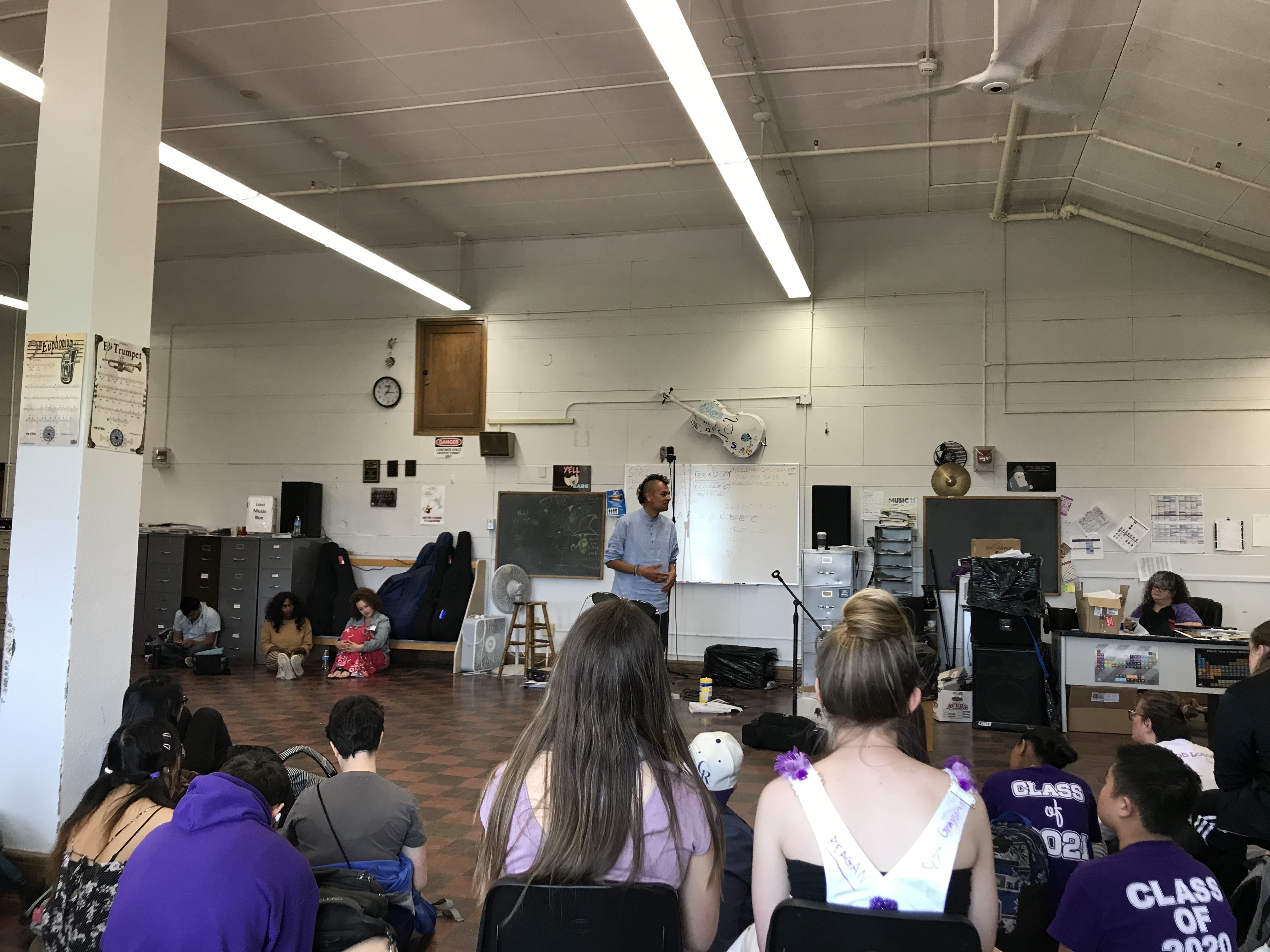
Students celebrating art with as much gusto as cheering on the soccer team.
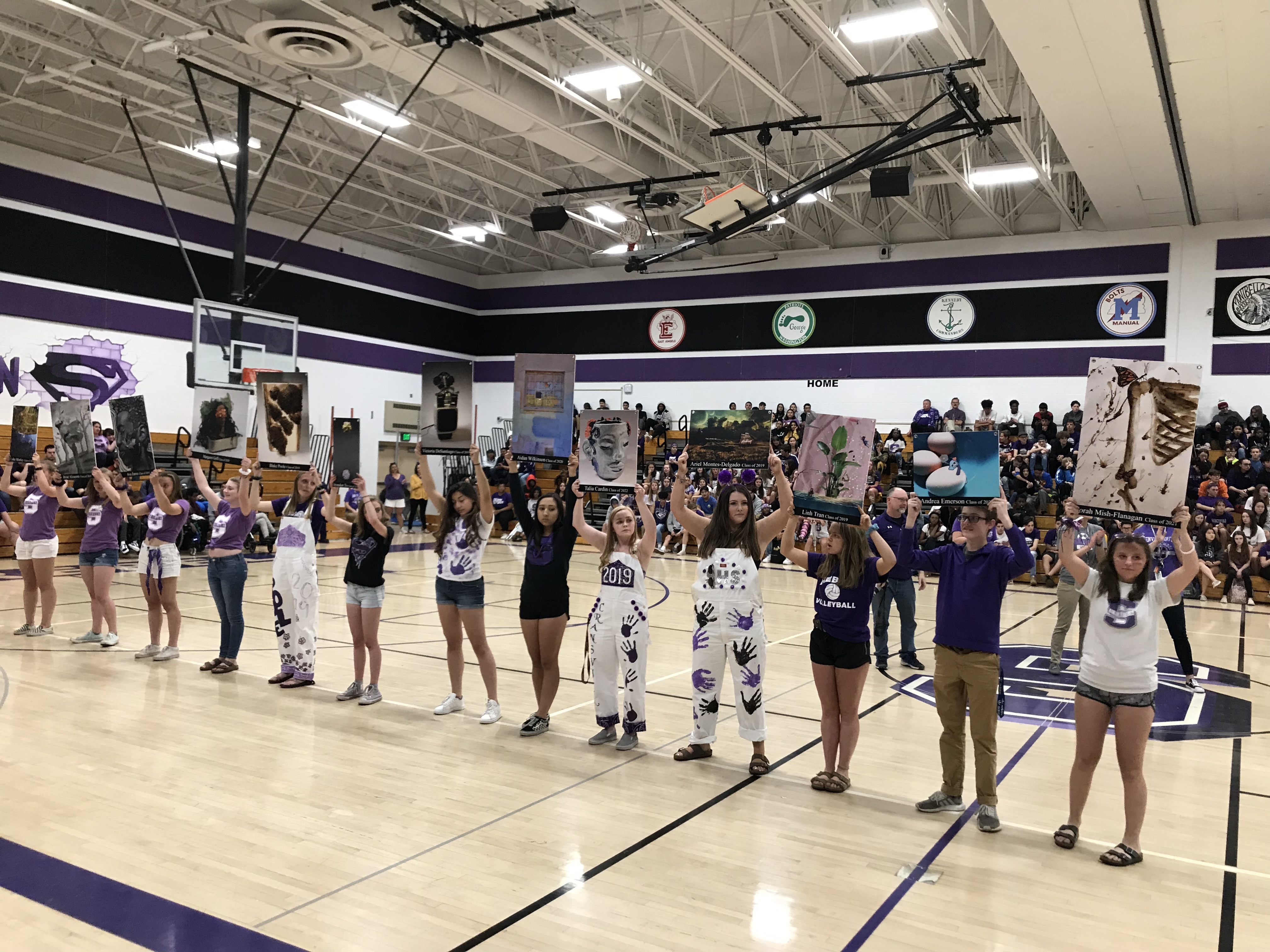
How two-sided the soul becomes when asked, Why do I teach? 

Why do I put myself through this constant criticism?

Why do I accept such a pathetic salary?

The answer is two-sided.

Because I love them more than money.

Because I spent the money to be here with them.

It’s not really a coin or a toss. It’s just the other side of the story.
I Remember Columbine

I remember newspapers for a week filled with grisly details,

journalists  flooding our city like vampires in search of storied blood

I remember crying all day on my twenty-first birthday,

the tears permanent streaks of worry on my cheeks.

I remember thinking, How can I become a teacher now?

and, Nothing could be worse than this.


I remember that it was ten miles from my home,

with faces just like my own now plastered on screens across the world.

I remember thinking that it could never happen again,

that with this media spotlight on the atrocity, it wouldn’t.


I remember my first lockdown, two years later,

kids huddled alongside me under desks like rats in a sewer.

I remember the silent votes of every white man and woman

in charge of our devolving society that grips guns like lifeblood.


I remember clutching my six-year-old child for hours

after twenty of her American peers were murdered

for the love of the Second Amendment.


I remember living in Spain where the scariest sound

was an infantile firecracker celebrating El Día de San Juan

and every door was open for the world to walk into

what it might be like to Not. Be. Afraid.


I remember when I once believed that someone would shout,

Enough is enough! and Congress would listen

instead of filling their pockets with NRA dollars.


I remember my high school in the ‘bad neighborhood,’

before a police officer stood at the door,

before I’d ever heard the word lockdown,

before I even knew what we would become.

A Credible Threat

At 12:39 a.m., my husband’s phone rang. A text message beeped. He rolled over and turned it off, not revealing to me the message, though I tossed and turned for the next fewer-than-five hours of “sleep” until my alarm startled me into a flood of my own messages. Realities of life in America in 2019.

One person, an 18-year-old child, lost and confused, dead before the day was over, shut down every major school district in a massive metropolitan area today.

This child, infatuated with the Columbine massacre that has been the backbone of her school upbringing, made “a credible threat” to “a school” and kept all the parents, teachers, officials, and students in a state of shock for the remainder of the day.

A girl, a lost girl brought up by school lockdowns, a mass shooting every day of her young life (of all of our lives), school shootings that have taken the lives of teens and six-year-olds, schools surrounded by armed police officers and security guards, and social media filled with conspiracy theorists and bullying…

Was she a credible threat, or was it us?

Is it us?

When will guns ever be considered a credible threat? When will gun stores who sell shotguns to 18-year-old out-of-state children be considered a credible threat? When will assault rifles be considered a credible threat? When will her online banterings (cries for help), the banterings of every filled-with-angst teen, be considered a credible threat?

One “shoe bomber” entered a plane. We remove our shoes in security.

Thousands of children died in car accidents. We put them in car seats.

Thirty babies died in baby swings. We recall the swing.

Are these credible threats?

Just as Sol Pais grew up with the Columbine tragedy as a backstory to her school experience, I have grown into my teaching career, my parenting life, with its everyday reality. I was a junior in college when the front pages of both newspapers in Denver were filled for weeks with the news of,  Why? Who? How? All the major networks sent reporters that day for an emergency special. All of America, seeing the horrific scene played out on television, sat in numb disbelief.

Twenty years later, hundreds of school shootings later, there might be a few headlines for a day or two. A growing number of protests. A teary-eyed president’s remarks. An ignorant president’s remarks.

Yet, we have done everything but what we need to do to prevent the credible threat of another mass shooting.

We have lockdowns and lockouts at least four times per school year just for practice. Our kids huddle like rats in cages under desks in a dark corner of the classroom, always acutely unaware if this will or will not be the day they die.

We have more security guards and armed police officers walking the hallways. Some schools even arm teachers.

We watch videos to start the school year showing active shooter training for our district staff.

We have metal detectors, clear backpacks, and every exterior door locked to outsiders.

We have to talk to our kids, all of our kids–our students and our own–on a regular basis about reporting threats to Safe2Tell, about keeping an eye on suspicious students, adults, about what guns can and will do.

But…

The most credible threat in the world, the simplest solution, has never even been considered.

What if we just stopped selling guns? Assault weapons?

What if this 18-year-old child barely knew about Columbine because, after all the horrifying media attention after it occurred, our senators and representatives went back to Congress and represented the victims, rather than the NRA, and passed a bill that could save every credible threat like this from ever happening?

What if, at 12:39 a.m., I could dream a peaceful dream, and not have to think about what I’ll say to my daughters today and my students tomorrow?

There is only one credible threat here, and it is not an 18-year-old child.

It is ourselves. Our government. Our inability to bring the life, liberty, and security that we so proudly proclaim we offer in this “dreamland” of the United States.

Start Here

we will never win
without recognizing hate
buried deep within

and taking the time
to call for a needed change
in every corner

Choose Students, Not Charters

For most of my daughter’s sixth-grade year, I hated 2:00 p.m. Like clockwork, I’d receive a call and an email at 2 telling me that she had to stay after school for some form of detention, euphemistically labeled college prep, mandatory tutoring, or refocus.

My husband and I, both working parents with inflexible schedules, had to scramble to figure out something.

At 4:00, she’d have to sit in a room with all the other misguided students and compose essays about why she forgot her MLA heading on her paper, why her computer wasn’t 80% charged at the start of the school day, why her belt was brown and not black, why she DIDN’T HAVE AN ERASER ON HER PENCIL.

At 5:00, I’d have to fight rush hour traffic, carpool absent because of the delay, trek across town to extract her after a 9-hour school day and sit with her as she cried over ninety minutes of homework.

These are the hoops “involved” parents jump through to get “the best” charter school education.

Imagine these hoops for single parents, parents without this school near their neighborhood, or parents of special needs children who struggle with remembering things.

Imagine students of color being held after more than all the white kids combined as they groom them to obey the norms of white society.

You don’t have to imagine it because the majority of families at these charter schools have helicopter parents whose sole goal is COLLEGE. At any cost. Even the cost of shutting down neighborhood schools, stripping Black and Brown neighborhoods of their sense of community and teachers of a decent salary.

Imagine a typical public school, where we open our doors to every student, and we don’t make parents sign contracts where they agree to last-minute detentions because we work with students on second chances.

Imagine students of every demographic and race, every language, whose family circumstances prevent their parents from being as involved as the parents at these charter schools, finding a teacher who will give them an eraser, a teacher who will forgive their missteps, a teacher who will listen to their whole story and guide them to wherever their future might be, college or elsewhere.

Imagine if there was a regular public school in every neighborhood, some with magnet programs, some with choice-integration bussing, and all with teacher salaries with public pension retirement plans that hold them in the profession years longer than their Teach-for-America counterparts promise.

Imagine if our school board put their vote of confidence in those students who don’t have involved parents instead of putting money into the pockets of charter-bond-selling millionaires and charter CEO salaries.

Imagine if school choice was just one word different: student choice.

Choose students. Not the broken promise and the disruption to our day, our lives, and our public education.

Give Us a Choice, and We’ll Take It from You

Give us a choice, and we’ll take it from you.

This could be the motto of the education reform movement that has gripped Colorado and the nation.

I know because I am part of the problem.

I fell for school choice when the idea was nearly unheard of. In 1991, miserable after two years at Merrill, I heard an announcement that changed my life.

There was going to be a new arts school opening with theatre, creative writing, visual arts, and music. To me, it sounded like a dream.

I spent two weeks preparing for my audition.

And, even though my family thought I was crazy, I took the bus every day that fall and for the next five years to attend Denver School of the Arts, located in the low-income Cole neighborhood.

What did I learn at my school of choice? I learned that it takes a village, led by amazing teachers, to put together a literary magazine. A theatre production. A music concert.

And that village could include kids whose experiences and faces and belief systems looked and sounded nothing like my own. And that art could provide a guttural release of emotion more meaningful to me than anything I’d experienced in education. And that the “low-income” village included the most tenacious, beautiful people I would come to love.

That is why, twelve years after graduating from Denver’s premier school of choice, I bought into the idea of charter schools. An 80/20 bilingual pre-IB program starting as young as kindergarten? Sign my daughters up!

My fifth grader getting bullied at the regular school? Let me put her in the super-structured, flawless-reputation charter network where culture is king. Let her sister follow her.

Let us white privileged parents with the ability to chauffeur our children choose their schools for them.

School choice is all about privilege. I have the privilege, as a highly-educated, middle-class white woman, to send my kids to a charter school. To sift through school ratings. To take over something that was intended to bring better schools into “bad” neighborhoods, and, upon seeing their successes, the privileged flocked to.

And the schools? They run the gamut of success stories piled on top of failures. They pay teachers so minimally that the majority leave the profession within five years. They are plagued with mismanagement of funds and classrooms. They are run by people who have no experience in an educational setting and by people who want “something better.”

But I’ll tell you what’s better.

Not having the choice. A regular public school in every neighborhood that meets the needs of every student. Teachers with decent salaries who love the diversity of where they work and paychecks that help them sustain their families.

And a district willing to see that the phrases education reform, charterization, and school choice are synonyms for privilege.

You gave us a choice. In turn, we privileged took that choice away from those who needed it most.

This needs to stop. Now.

Fly Us Home

Wanting a better life for her family, my mother uprooted us to move to Denver when I was 11. Contrarily, her own parents had ripped her from Park Hill Elementary at the same age 33 years prior in the 1960s “white flight” migration. Always burdened by this blatant racism, my mother told us, “We’re moving straight to Denver, and you girls will learn the value of diversity.”

I attended Merrill and Cole middle schools and Manual High School, the latter two hosting the burgeoning Denver School of the Arts.

Unlike my tiny town in upstate New York, DPS offered me a side of society I’d never seen: racial violence in forced-integration hallways, a Chicano Mathletics coach, and a set of friends from multiple races, language backgrounds, and family dynamics. DSA offered me a spotlight into the world of LGBTQ acceptance and the privilege of the most inspirational teacher anyone could ever imagine–Mrs. Jana Clark.

Mrs. Clark and DPS are the reasons I became a teacher and the reason I came back to this district after teaching stints elsewhere.

Because Denver is my microcosm of what the world could be. What my mother wanted and what I was lucky enough to proclaim: I am a DPS graduate. I am a DPS parent. I am a DPS teacher.

DPS represents our world. Its teachers represent DPS.

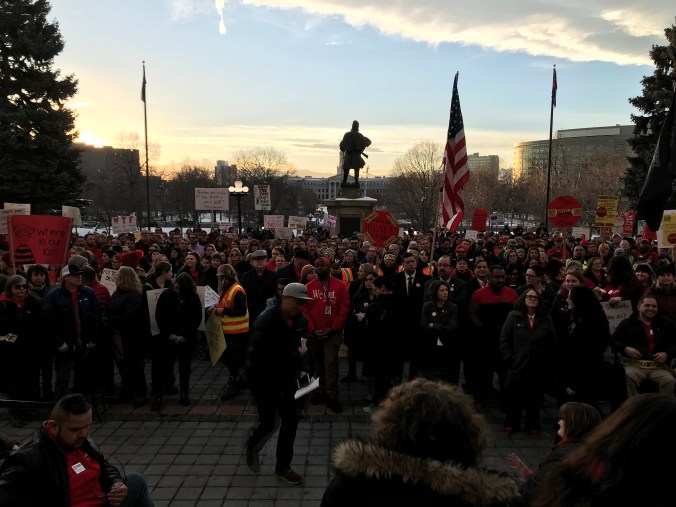
Listen to the teachers. Their right to strike is your right to make this city the one we want to fly to, not fly from.

U9oG15rmSW6k9Ma1CIKt2w

My Livelihood is ‘Political Theater’

I have twenty-eight students with one to two essays due EACH WEEK in my new University of Phoenix class, my second job that pays $225/week on the occasional basis that I am granted a class.

I haven’t taught this particular class in over two years, so of course, they’ve changed the entire syllabus, I have to read two different textbooks, and I need to update all my rubrics. Also, all of the online discussion questions have changed, so I will need to respond to thirty different questions with a new set of thirty 200-300-word responses.

Part of the reason I keep this job is that it’s online, and I can squeeze it into (every possible free moment of) my day.

Another reason I have kept it, at the moment, is to fund the $2000+ I’m paying, in addition to doing hundreds of hours of work, to try to obtain my National Board Certification, which is the only possible way to get a raise at this point in my career without investing thousands of dollars and hours in another degree (I am MA+30).

The disheartening reality of what every teacher I know does to survive, every teacher who isn’t lucky enough to marry rich, or at the very least marry someone with guaranteed job opportunities and a forever-steady income, is that we must jump through every hoop imaginable to make ends meet.

We teach summer school. We do home visits. We spend our own money on advanced degrees and credits with the hope of improving our instruction and earning mediocre raises.

This is on top of the fifty or more hours a week we spend planning lessons, grading papers, counseling students in trauma at lunch and after school, attending meetings, sports events, professional development, and student recruitment events (because we have to sell our schools now).

So when my state, my “blue” but really purple (perhaps leaning red) state, calls us actors on a “political theater” stage, I am at my wit’s end:

“Criticizing the most recent teacher pay bargaining session as ‘political theater,’ the head of the Colorado Department of Labor and Employment urged the Denver school district and its teachers union Monday to work harder to find common ground — even as he expressed skepticism that the two sides would reach a deal” (Chalkbeat).

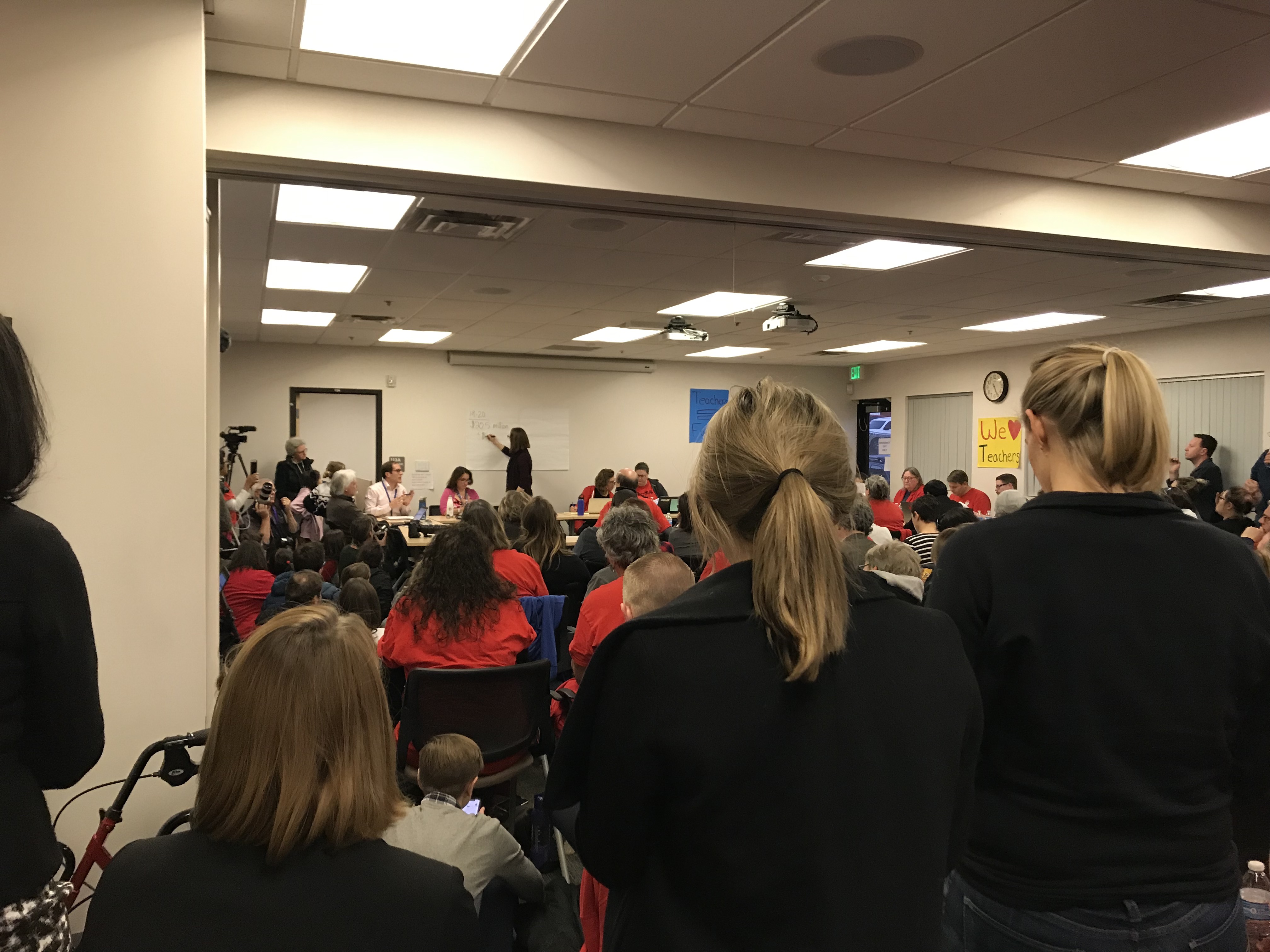
Was it theatrical that we gave up the tenth evening in as many weeknights to wait for our district to come to the table with an actual proposal rather than a cost-of-living increase already in the budget?

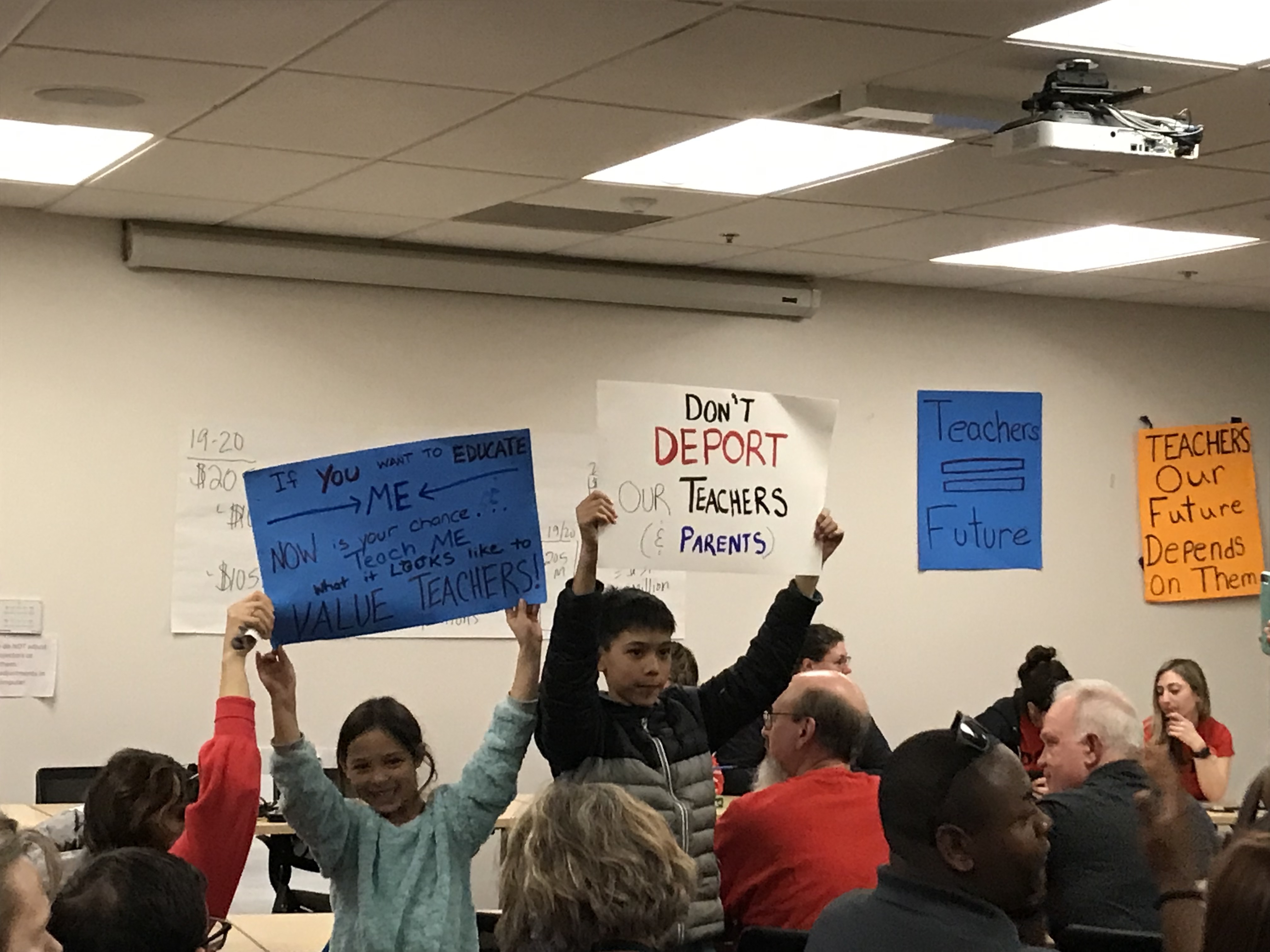
Was it theatrical that young children stood behind the fraudulent superintendent with signs begging her not to deport our teachers after the HR department more or less threatened their right to work?

Was it theatrical that we have negotiated for fifteen months, yes over “philosophy disagreements” because the PHILOSOPHY OF OUR DISTRICT IS TO SHUT DOWN PUBLIC SCHOOLS, TAKE OPPORTUNITIES AWAY FROM STUDENTS OF COLOR, AND GENTRIFY EVERYTHING FROM NEIGHBORHOODS TO CURRICULUM?

And. Just. Like. That.

All the hours. All the years. All the goddamn blood, sweat, and tears have been put on stage for the world to see, chart-paper and all, chants in the background, livelihoods on the line.

For political theater of the worst show you will ever wish you didn’t buy a ticket to see.

Even the Sunset Says So

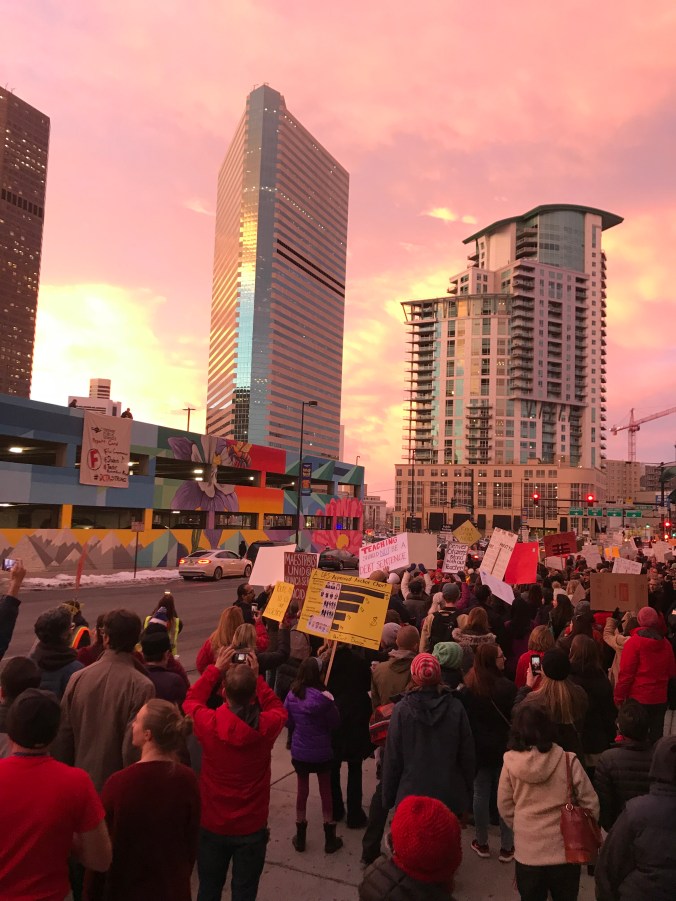
Is there a prettier Denver sunset than this ‘red’ sunset over teachers rallying to strike??

I don’t know what you were thinking, DPS. Did you not realize you are a district in a union-led hotbed of liberals???

Did you think we were going to sit down and shut up??

We’re going to rally. We’re going to win.

Even the sunset says so.

Oh, Susana (Cordova)

Oh, I came from no advancement
with my income on my sleeve
I’m g’wan to leave Denver
my true rate for to see
Oh, it rained all night the day I left
the district it was dry,
the burn so hot I froze to death
Susana, don’t you cry

Oh, Susana, oh don’t you cry for me
I’ve come from no advancement
with my income on my sleeve

I jumped aboard the income gap
And traveled down the schedule
The ‘lectric lie magnified
My college’s credential
The district bargaining went bust,
I really thought I’d die,
I shut my eyes to hold my breath,
Susana, don’t you cry

Oh, Susana, oh don’t you cry for me
I’ve come from no advancement
with my income on my sleeve

I had a dream the other night
When everything was still
I thought I saw Susana,
a-coming down the hill
The ProComp deal was in her cheek,
The tear was in her eye,
Says I am coming for you, meek,
Susana, don’t you cry

Oh, Susana, oh don’t you cry for me
I’ve come from no advancement
with my income on my sleeve

I soon will be without a check,
And then I’ll look all round,
And when I find Susana,
I’ll fall upon the ground,
But if I do not find her,
This bargaining will die,
And when it’s dead and buried,
Susana, don’t you cry.