My Grandmother’s Stories

My daughter, Mythili, has come home from school for two days with tears streaming down her face. She has locked herself in her room, needing a while to adjust to what the afternoon, and its homely comforts, could offer her. Yesterday she cried because she wasn’t returning the homework due, and her teacher stood outside of the school and told me that she needed to bring it, and that she didn’t seem particularly happy at the school, though he’d seen her sisters adjusting quite well. Today, it was his insistence on her using cursive for writing out her numbers, a form of writing that is foreign to her. Kind of like the language that is foreign to her.

We are in Spain. I have picked up my family and moved in the opposite direction of progress, to a country with a 20% unemployment rate and a government that can’t decide what to do with itself. Mythili, like me, is struggling with understanding all that is asked of her, and just like I couldn’t get the phone line installed when I wanted, she didn’t know when to turn in her homework.

These moments that I have omitted from my Facebook posts, that I have mostly kept quiet, these are the moments that I think about my grandmother’s story. She told it to me more than once, a bright line from Heaven shining down on her faith, her childhood, her way of looking at this world.

There are so many things that I could write about my grandmother. It could begin with the two weeks we used to spend with her every summer, where she’d take us to the beach (we all had to carry a chair and a towel, to take turns holding handles of the cooler), to the bargain shops to pick out new outfits for school, to church where she would pray and introduce us to her priest, to the small pond in Bethany where we swam and played on the playground. Those visits were the highlight of my childhood summers, and as an adult, when I planned visits, she still did everything in her power to make it special, calling me a week in advance to ask what meal she should prepare, asking me what show in New York we should go see, driving across states to visit Bob or Willow.

But it is the childhood stories, the ones she told me on long road trips or train rides, that I will remember most distinctly. To this day, I cannot allow my children to carry a spoon, a stick, a straw, or anything in their mouths as they walk around, for pure fear of what might happen to them as my grandmother reiterated many times the tragic loss of her twenty-one-month-old baby sister, who died from an infection in her throat after tripping with a lollipop stick in her mouth. The time when she went with her father, at age nine, to go look for an apartment across town because her mother was so heartbroken over losing her baby that she couldn’t live there any more. I can still hear my grandmother’s voice: “I looked out the window of the apartment down below. There was an empty lot. And a little boy was taking his car and making tracks in the dirt. He looked up for just a moment and waved at me… that was the first time I saw your grandfather.”

The story that stands out the most for me I have replayed in my mind many times over the past five months. In a period of two days, I found out that I was accepted into a teaching program in Spain, that my grandmother was entering hospice care, and that I would have to quit the job that I loved so much rather than taking a leave of absence.

I kept thinking about my grandmother’s childhood journey, and the one of her mother before her, coming to a country she’d never seen. My grandmother told me that when she came back to the United States at age eight, even though she’d been born in America, she only spoke Italian. She had much difficulty understanding English in school. All the kids at school picked on her and called her a guinea. She talked about how her father, “in his broken English,” went down to the school and told the teachers that they needed to help her, but that no one would help her.

At her wit’s end, she went to church. She knelt on a pew and prayed to God to help her, to help her learn English so that she could be a part of her new country, so that she could be educated. She prayed and cried, and soon a nice Irish woman came over to her and asked her what was wrong. She tried to explain, and the woman took her in, helped her learn English, introduced her to the man that she would one day marry. “And I knew,” she told me, “I knew that God had heard me, and that God was looking out for me.”

I will never forget those words and what the story meant to my grandmother. Her experiences, her stories, have trickled down four generations, and I feel my family living a life very similar to hers now. All along this arduous journey of sacrifice I have made to bring my family to Spain and fulfill a lifelong dream, I have thought about what my grandmother would have told me to do. And what my grandmother’s parents did; the risks they took.

So when I see my daughter step into her room and cry because she is so frustrated, because she doesn’t quite fit in, because everyone in her class knows her name though she knows none of theirs (“Why do they know your name?” “Because they talk about me all the time since I’m American,” she replies), I think about my grandmother. I think about her story, about her struggles growing up in the Depression, and then moving on to a better life, raising the four children she loved so much, doting on the seven grandchildren whose visits she cherished.

I will always remember our visits. The memories will dance like a filmstrip through my mind, sweet and melodic. But it is her words, her stories, that will trickle down and make me, and all the generations her soul has touched, the people that we were meant to be.

By My Side

Yes, this is surreal to me. For how long have I pictured my life like this, my family in a situation that is both wholly unique and someone daunting with each moment? Doubt, like the Queen’s Guards, has stood stolidly by my side from the moment I accepted this position. Now it hovers only lightly, more of an irritating mosquito buzzing about my ears at night, continuously waking me and yet impossible to find, to squash. I am here, and things are going well, better than I could have dreamed, with tutoring positions so easy to find that I am at the point of working well into the night (“You know, we Spaniards like to go to bed at twelve or one”) or having to turn people away. So we’re safe, secure, in a better position than we have been in months. We can stop the ticking on our credit card bill, pay for the necessities of life, perhaps even have a bit extra for a weekend trip to Barcelona or a day trip in a rental car to the beach.

It’s the small things, the GIANT small things, that get in the way. My girls’ school, my last choice, with the bars on the windows, the gate that keeps out outsiders, my oldest getting top scores in science and math on day four in a country where the language isn’t her native tongue?? The looks that cross others’ faces when I say the name of the school. When I tell them the part of town we live in. Irony is my best friend. After nine years of teaching ESL to poor immigrants who can’t afford to live in a nice neighborhood, own a car, or go to the best school, I am now one of those poor immigrants. I walk with the “Moors” (as they DO call them here) to the school. I try to argue with the Spaniards about Arabic/Mideastern students I’ve had in the States, how respectful they are, how dedicated to their studies. But no, not these, they respond. These people are poor, uneducated, don’t know Spanish, making the whole school have to dumb everything down… Boy have I heard that one before. Sounds a little like the world works the same no matter where you go. But what, at this point, can I do? Am I putting my girls in a bad situation where they will lose a year of good education? Should I still search for a different school and then lay down another exorbitant stash of cash on books I cannot afford?

Then remorse creeps up… I think about my last month at home, my sheer panic of unemployment, my frantic search for online jobs… that I wasted, all for naught. All the things I could have been doing, the people I could have spent my time with… sometimes I let my inherent sense of responsibility and control get the best of me. But then I play devil’s advocate for myself when I think, I did this to my family, and I had to find a way to make it work… I just wish I could have seen into the future, to know that things would be OK. I didn’t realize I’d be about the only American to step into this city where no one has even HEARD of Colorado, and are all in love with the idea of having an American teach them English!

And fear, fear stands by my side even as I walk around a new block, take in the view of a new apartment building that faces the mountains, see a new beauty I didn’t see the day before… fear is always there. Who is here to be at our back, to look out for us when we’re sad, to catch us when we’re ready to fall? We have done this almost wholly on our own from day one, and it hasn’t been easy. With me being the only one able to communicate, and my Spanish being nowhere near the level it needs to be to complete the most important tasks of setting up a home and getting my children properly educated, I fear what will come next as new challenges creep up. How alone will we find ourselves as time goes on?

I have so many emotions standing by my side, hovering around me as I face the world with the happiness and relief that are also there. All I can hope, as I go through each day, is that the exuberance, the surrealism, will never wear off, that I can pounce out my doubt, remorse, and fear and make this into the dream it was meant to be.

In Four Days

sun shined on every moment
as we walked along the beach
(when life was not a beach)
money and bus schedules
weighing us under water

oblivious,
our girls swam all day,
mermaid Barbies in tow,
searching for seashells

when in one week we were filled
with a box full of activity
registering ourselves as residents
registering our girls for school
registering for a new life

this week we worked a different tack
searching for a new response
to a computer without Internet
phone conversations i couldn’t interpret
and hope for something better

in four days,
the sun sparkling on travertine tile,
the sun sparkling on long walks
between lorikeets
and Roman architecture,
we have moved from survivors
to healthily employed,
dream-fulfilled,
satisfied Spaniards!!

Future in Spain

a brightly lit street
my stolid two-mile walk home
hope holding my hand

Just Another Day in Spain

The first day of first, third, and fourth grade! In SPAIN!

It begins at dawn, though the remainder of the world would not consider 7:30 a.m. dawn. Perhaps the sun setting at 21:00 in mid-September and not rising till 7:30 is just one of the reasons Spaniards wander the streets till the middle of the night, why they sleep in the middle of the afternoon.

I rise and get myself ready, everything about my movements pins and needles. The first day of school is always nerve-wreaking to mothers, but for my girls to start school (and not the one I wanted) that will be wholly in a new language, in a foreign country, where none of us know a soul? It’s no wonder I didn’t sleep.

They don’t particularly want to go, either, but are happy to put on regular clothes rather than the silly uniforms required by their charter school in the States. Before I know it, dawn has passed, dishes are washed, and we’re walking down the six flights of stairs to the street, where we see other mothers and children walking. This brings instant relief to my girls, who love pointing out all the children, noticing their backpack types, their shoes, their clothing.

We stand outside the gates of the school with the other parents, taking pictures like we always do on the first day… until we realize that we are the only ones taking pictures. Of course, let’s put a spotlight on our Americanism. Soon a nice mother comes up and speaks in English (albeit broken), telling us what to do as they open the doors and letting us stand on the patio. In a few moments, a siren-like bell rings, and all the kids shuffle in the school, parents left outside. Bruce and I exchange looks of panic. We don’t even know what classes the girls are in. How will they? But before we know it, the secretary comes out and allows us in, only for us to discover the school is so tiny that there is only one section per grade! (And I thought we were lucky at their class size limitation of twenty-three!)

We look through the doorways at all our girls’ apprehensive faces, wave goodbye, and head onto our day of adventure.

All I need to do is make copies, pick up my debit card at the bank (26€!!—must everything cost an arm and a leg??), and spread out flyers advertising my English tutoring. We are interrupted in front of the copy shop by a huge strike moving along in front of the Ayuntamiento, men in blue uniforms holding signs about the government robbing them, all plugging their ears at optimal moments before letting loose cannon-like firecrackers in the streets, their voices and faces a mixture of jubilation and angst. The fluorescent-green uniformed police stand on the outskirts of their demonstration, their raucous and cannons just a part of their day.

We move on into the busy morning of Cartagena, taping up flyers and stopping at the grocery store where everyone in Spain is shopping before school gets out. We tear off giant pieces of French-style bread on our way back to the apartment, and before we know it, the arduous four hours of school are over, and we stand again with the rest of the parents outside of the gate.

The same siren releases our girls, who come out with giant smiles and tales of their day so similar to the tales from home, relief washes over all of us. Mythili made four friends, has multiplication homework with four numbers on top, and is adamant about us buying her books and supplies by morning. Riona admits that she understood only some of what her teacher said, but she made a friend who shared crayons with her. Isabella, sentence by sentence, tells me all the grammatical errors and vocabulary she fixed for her English teacher, pointing out that she could teach that class (I have no idea where a daughter of mine would get an idea like that!!).

I then set out on an adventure of my own: shopping for the infamous libros de texto I’d been told would cost a fortune. I ride the bike across town, Mythili’s school supply list in tow, to Carrefour, Spain’s Wal-mart. It is only when I enter the store and begin looking at her school supply list that I realize, again, that I don’t speak Spanish. Libreta? Carpeta? Caseras? As if school supply shopping isn’t difficult enough, I am searching for items that I have no clue what they are! Can Mexico and Spain make an agreement and share the same language, puuhh–leeez!!

Then the books. NONE are on the shelf. Lined up behind the counter are all the organized-people-in-the-world’s preordered, boxed-beautifully libros de texto. I start to panic, and take out my iPhone, quickly typing in the ISBN numbers the school provided, hoping Amazon will save me as always. After four entries of “No disponible,” I begin to realize the truth behind what my Spaniards had warned me was a huge publishing scam. No one can buy these books on discount or order them online. We are victims to overpriced bullshit!!

I send a Skype chat to Bruce that just repeats FUCK four times, then finally have my place in line fulfilled. Giving the sales associate my iPhone and Mythili’s list, he disappears into the back to retrieve my books. Well… two-thirds of my books. The remainder he doesn’t have, and as usual, I don’t know the right words to ask him if they’ll order more, and I’m running late anyway, so I book it out of there, penniless in my pursuit (ummm. 5€ for a NOTEBOOK??)

I fill my backpack and two saddlebags with all the supplies, patting myself on the back for at least having the adamancy to bring my bike! What a relief! I rush up the six flights of stairs with all that in tow, thinking, I sure as hell don’t need a gym this year. Then shower, dress, off to my first appointment with potential clients, who meet me in front of the giant JCPenney (AKA Corte Inglés, twelve stories in the making), and of COURSE we go to a café. Ironically, I order my Spain-usual café con leche, and they each order a Coke.

We talk for more than an hour, and somehow manage, with my broken Spanish, to arrange tutoring with their three- and six-year-old sons for four hours a week! (No need to mention I have no idea what I’ll be doing, and I think it’s just glorified babysitting in English, but whatever!)

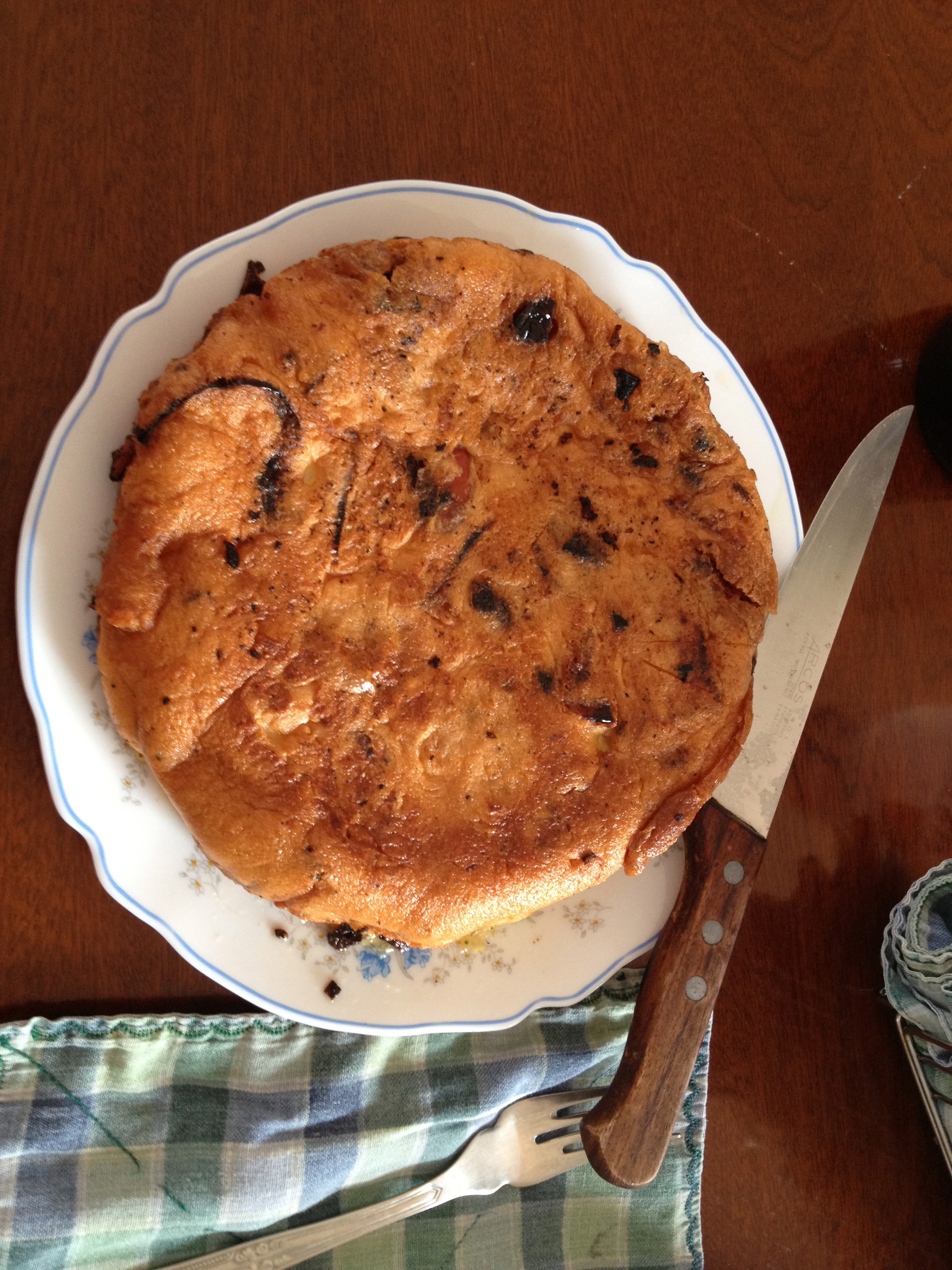
Then Bruce and I make our first Spanish tortilla, for the most part successfully interpreting the Spanish directions on the baking powder package, and it’s a hit with all the girls, who BEG to go to the park after dinner as those are the hours that kids will actually BE there. And they’re right. It’s party time at the park, and Isabella makes a friend who comes up to her parents on the adjacent bench bragging about her American friend, with her parents’ response being, “Que suerte.”

We are lucky. While in the park I receive four emails inquiring about tutoring!! On the walk home at eight-thirty, Mythili has switched her ever-imaginary talk with dolls to Spanish, and we put the kids to bed so I can head to Corte Inglés for one more attempt at books… to no avail.

But it’s just another day in Spain. There’s always tomorrow between nine and two, where I can witness a strike, have a café, and make the most of every moment.

The Spanish Siesta is NOT a Myth

Today I left my girls in the park with Daddy, ready to ride across town (it’s only a mile) so I could put up flyers advertising my English tutoring. The park was new to us still, a dirt ground, a paseo of palm trees, bougainvillea, and hibiscus bushes intermittently spread among playground equipment. It was empty, totally empty, at 3:30 in the afternoon. The Spanish siesta is NOT a myth.

I pedaled across the ghost town of my city, seeing only a few cars. All the garage doors and persianas were closed up, waiting for tomorrow or the five o-clock hour. Only a few cafés were open and bustling with activity. I rode through the neighborhood adjacent to the harbor, at a slow pace as I still found myself mesmerized by all the shops, cafés, and architectural varieties. I managed to find fifteen poles/phone boxes to tape up my flyers, and came across the small park with the lorikeets that was close to one of the first apartments we looked at. Everything here, I realized, is becoming familiar to me. Soon I will know all the street names in my neighborhood, the major interchanges in other areas, and all the bus numbers we could possibly take to get across town. I won’t have to question which roundabout to turn left at, or which direction La Plaza de España is.

And while it is a relief, a burden lifted, at the familiarity of it all, there is also a sense of loss. Of fear. Eleven days into this new adventure, this almost still feels like a vacation. Yes, the four months of hell and paperwork beforehand kind of tainted the vacation feeling, but once we arrived, we’ve been eating tapas, spending the day at the beach, meandering around mesmerized by the warmth of the Spaniards, the intricacies of their city planning, and taking everything in with new eyes.

But tomorrow? Reality sets in for sure as the girls have their first day of school in their new country. Soon I’ll be working part-time and filling in the extra hours with tutoring sessions, and I will be traveling all over our city. And it will be ours, to keep, for a year.

So why am I afraid? Feel like I am losing something? Because I fear that with the newness wearing off, the vacation-like feeling disappearing, I won’t be so enthralled. I will be irritated with the deserted park at three, the dinner I don’t want to wait till nine to have, the cafés we can never afford to visit. And it might be just us. No family. No friends. Just the five of us, the girls getting into fights as they’re trapped in the apartment alone playing with the same old ten toys we lugged across the ocean, Bruce and I, trying to manage a lifestyle in a country neither of us are familiar with or accustomed to, the language barrier a thick wall that sometimes feels insurmountable.

It’s scary, isn’t it? Strange, unreal, many words creep up into my pedals as I take in the salty air, as the breeze from the Mediterranean pushes me up hill beside the Roman Theatre, as I come across a park, a roundabout, a beautiful view I haven’t seen until this moment. Am I crazy for choosing this, for putting my family in this situation? I’ve asked myself that thousands of times in the past months, and the only answer I can come up with, as we make ourselves at home, is that we’ll never know. There is no going back from the choices we’ve made. I will have to pedal further, see new sights, take in a different view, perhaps, to keep the adrenaline of the past couple of weeks burning in my blood, making me grateful for this amazing place, this amazing experience that I know in my heart we were meant to have.

A Simple Plan, Interchangeable Anomalies, and a New Side of the Coin

So this morning I started out my day with a simple plan, telling my husband I’d be back in an hour: I was going to retrieve my girls’ school registration papers from the cultural liaison at the school where I will work, go to the bank, and go to the girls’ school. The cultural liaison was meeting her colleagues at nine for some coffee before work. I pedaled over on my “American” bicycle (a Fuji, I would explain later, made in China like everything else!), and arrived right on time, right on American time. While waiting for the Spaniards to make their usually-tardy appearance, I took a photo of the dumpsters here. Strange, I know, and not typical of a tourist attraction. But the segregated dumpsters that specify glass, plastic, paper, and trash are what make this place special to me. For one thing, all residents have access to them at all times. For another, why can’t America do this–segregate our trash (I mean, we segregate everything else, right)?? Perhaps if more cities adopted this idea, everyone would recycle!

After I took my photo on my iPhone, a nice Spaniard approached me and introduced himself as one of my colleagues. He already knew my name–though I think I blend in quite easily here in my Western clothing, with dark, curly hair, standing next to my fancy bike with my fancy phone make me appear all-American–and of course his name was Carlos (I think there are only four Spanish men’s names!). We were still waiting on Flora, the cultural liaison, so I sat down and ordered another delectable café con leche. All the cafés on all the street corners carry these tiny cups of espresso-like coffee that is quite simply a culinary orgasm with every taste, and I have found myself quite addicted to them.

We sat with two other colleagues who immediately began chatting away with me in fast-paced Spanish. I have learned to nod a LOT. Because all I do is introduce myself in Spanish, say a few simple sentences, and everyone assumes I’m fluent! I picked up most of what they were saying, but by no means all! There were quite a few funny moments over the next hour, especially when I thought they were asking if my bike was made in America, and when I said it was made in China, they laughed and said, “No, did you bring it from America?” to which I affirmed and received the response, “Wow, you brought your husband, three daughters, and a bicycle to Spain? Very unusual!” I would have liked to have responded with, “You will find me unlike most people you know,” but of course with my lack of vocabulary I just nodded and said, “Sí,” my current favorite word.

Finally Flora came, papers in hand, but I was not allowed to leave. No, por supuesto! After a time they all stood up, I discovered the bill had been paid, and we began to walk across the street to the school. Since I don’t officially start my job until October 1st, I was not expecting to follow them. After all, it was already past ten, and the Spanish work day ends at two, and it being Friday, I knew that two meant one, and I had to register my girls in school and go to the bank. But one of them said, “Come with us, Karen,” and before I knew it, they were clearing a space for me at the huge table where all members of the English department were having a meeting.

It was with deflated hopes when I quickly realized that the English department does not hold their meetings in English. Instead, Flora took charge of a fast-paced meeting where everyone began talking at once, sharing ideas, writing down book titles and schedules in these tiny little planners (not a single laptop!!), and throwing my name into every other suggestion. (“Karen knows all about the American culture, she can teach us!” “Karen can make a notebook of different food and clothing of the US!” etc.).

It wasn’t until almost noon when I heard my first English words of the day. Carlos engaged me in a conversation so he could hear how I speak, and broke into a ginormous smile when I began to talk. “Your accent is so easy to understand! I don’t know anything about Colorado, but I like it very much! Last year our native speaker came from Northern Ireland, and no one could understand anything she said! You are our first American, and we are so glad to have you.”

So… I barely made it to the bank, where there was a line out the door (everyone is restrained by the siesta schedule), and by the time we walked over to the school at 1:30, the secretary was locking up the building. All the same, she took my papers, noted to her assistant, “These are the Americans!!” and told us, “See you Monday at nine!”

No matter where I go here, or what I do, it always takes longer than I think, and the people are always nicer than anyone I’ve met anywhere. I am just as much of an anomaly to them as they are to me, bringing our interchangeable experiences to a new side of an old coin.

20120907-201019.jpg

School (not) of Choice

not what i wanted
cuatro santos protect me
i pray this is right

Speechless in Spain

i have no words
in English or Spanish
for the whirlwind of arrangements
(all before 11am)
to put my daughters in school in Spain

i have no words
for one week gone in my life
where all is lost, all is gained
with the turn of a key
a new home
a new country
a new way of looking at life

i have no words
there is not a summary
for besos on cheeks
encontado, encontado
(is my mucho gusto lost in Cartagena??)
for all the words i’ll never know
for the phone calls i try to make
the arrangements i think i understand
the important life choices i put in others’ hands

i have no words
to describe the
palm-tree-café-peluqueria-red-tile-roof
ciudad
now
my
home

20120907-201105.jpg

20120907-201125.jpg

Spanish Arrival List

Just a short list of all I didn’t know before arrival:

1. Grocery shopping is a complicated task. Let me introduce you to every type of seafood you’ve never seen, so stocked up it might take a week to identify each individual fish (hello, Mediterranean diet!). Then we can peruse the store and try to identify pictures that indicate the difference between dish soap and bathroom cleaner. Let’s move on to the dairy section. Wish me luck, because there are so many varieties of milk in this world, we will never be able to decipher which is the one (all unrefrigerated, I might add) that we will bring home. And kilos versus pounds? Help!!

2. Café, peluquería, café, peluquería. Repeat, repeat, repeat. But don’t you dare try to go to either between the hours of three and six. You may or may not receive service. But when you do enter, you will come out with beautiful hair and a belly full of fresh food and about the best coffee on the planet.

3. The world CAN function between the hours of 9 and 2. Set your alarm, strap on some excellent running shoes, and you just might make it to siesta on time. Or enjoy #2.

4. Tagalong to #3, rush hour is in the early afternoon. Watch where you’re driving—or walking—motos speed in between cars, and cars spin around roundabouts like there’s no lane and no tomorrow.

5. Everyone is nice. OK, OK, there might be one mean person in Spain. But I haven’t met him or her yet. They’re all accommodating, competent, know how to use the technology that none of them seem to have, and smile every time they see you stumbling over their native tongue. They will go out of their way to show you where to walk, to tell you how to fill out forms, to guide you along this intricate path of becoming one of them (but you will never be one of them).

6. Bed time for all ages is some time between 10 and 2. Usually more like 2.

7. There is an indescribable beauty to hanging laundry out the window of a courtyard shared by twenty neighbors, whose parrots perch and chirp, whose voices carry across in speedy Spanish that opens up the world to a better place.

8. Don’t buy a car. Gas costs more than you can even fathom, and there will be so many beautiful palm trees to walk under, so many types of architecture to admire, so many beautiful people to see along the street, that you’ll never notice the difference.

9. Make yourself a resident before making yourself a taxpayer. This order suits all.

10. Ayuntamiento: loosely translated: place of help. Courthouse, registration, school information. You will be guided to one ayuntamiento after another, but eventually, just like all things Spanish, you will arrive just where you need to be: Home.

20120907-201257.jpg