We Are the Aspens

It is impossible to say in words, or to describe to students in Spain during my PowerPoint presentation about Colorado, the beauty of aspen trees. They share the same roots, can never grow alone, and plant their seeds in my heart, my home state.

There is a reason people travel hundreds of miles to take that picture in front of the Maroon Bells, the reflective lake picture with the aspens at the base of the two magnificent Fourteeners. It is because of the aspens, their paper-thin trunks, quaking leaves, green-to-gold beauty, their thin branches collecting snow in winter and blossoming in a whisper of shades for spring, summer, and fall.

But I didn’t want the traditional photo. Instead I chose this one, the lens pointed up, our Colorado sky so blue you feel it is a color you can cup into your palm, the leaves at their golden-age pique, ready to burst away from the grove with a gust of mountain air, and the intertwined trunks pointing to the heavens in a singular strength found only in trees.

We are the aspens. All of us, connected at the roots, holding each other up when times are tough, listening to each quake of every leaf, our soft sounds lost to everyone far down in the forest, whose postcard-perfect picture could never capture our connection.

What others see, cameras ready, is the beauty we plainly project: a set of trees along a mountainside, roots clinging to the slope, trying to survive the seasons with the grace that makes us who we are. What they don’t see are the winter nights, the beating-to-the-bone blizzards that shake our interconnected souls, that expose us to each other in a way that a lens could never reproduce.

We are the aspens. We cannot grow individually. We are with each other in this photo, clutching our view of a perfect autumn afternoon. And we are with each other on those dark winter nights when the frost bears down on everything that keeps us alive on this mountainside.

We are the aspens, unlike any other tree in any other forest. Our saplings sprout up around us in a flurry of activity, held tight by our roots that keep us together, that keep us alive, when everything surrounding us would work to tear us apart.

Photo

An Imperfect Crust

I have this apple pie recipe. It is almost as good as my brownie recipe, perhaps a bit better, because it is so time-consumingly tedious to make that its appearance on our table occurs twice, perhaps three times (for extra-special people or occasions), a year. The recipe begins with a crust that is both sweet, flaky, and crispy. The bottom of the pie is lined with a pastry cream so thick and delicious you’d wish you had a bowl to scoop it out and eat it with a spoon. Of course there are apples, the apples of my youth, Granny Smiths grown on the Western Slope of Colorado.

I think about this recipe today as I lay out the refrigerated pie crust on my small Spanish counter. The recipe sits in the room in the basement of my house back in Colorado, the room that hovers like a ghost in the attic of my mind. Ten by ten. Green carpet. One tiny window. All the junk, from sleeping bags, toys, a television that’s not even ours, to cups, magnets, and recipes, that we couldn’t bring to Spain.

Here we are, three months later, living our lives without these things. Without the books I’ve collected for my girls in my ten years of being a parent. Without the tent we would never use. Without my favorite coffee mug, fifteen years back bought at Christmas from Starbucks, Van Gogh’s Starry Night a blur of beauty on my early mornings. Without my recipes.

We have had a functioning oven for two days. I was planning, until now, to let slide my favorite holiday, to give in to the holidays of Spain–the next saint’s day, school break, or puente, and forget that I look forward to Thanksgiving for the whole year. After all, how could I bake a pie without an oven? Without my recipe?

As all things seem to work out in 2012, life of Karen Vittetoe, the oven arrived in our lives just in time. I could make my pie, we could make our Thanksgiving dinner, but at what cost? Moving here, our kitchen contained many items, but not a pie pan, a roasting dish, or a 9×13 baking dish for brownies or candied yams. They don’t sell pure vanilla extract in stores; rather, aroma of vanilla and pure vanilla bean; the combination of buying cocoa, the varieties of vanilla, and chocolate chips, of buying two baking dishes and a pie pan? Our spending money for the week is demolished. Not one penny left for a rolling pin that, perhaps, will never be used again.

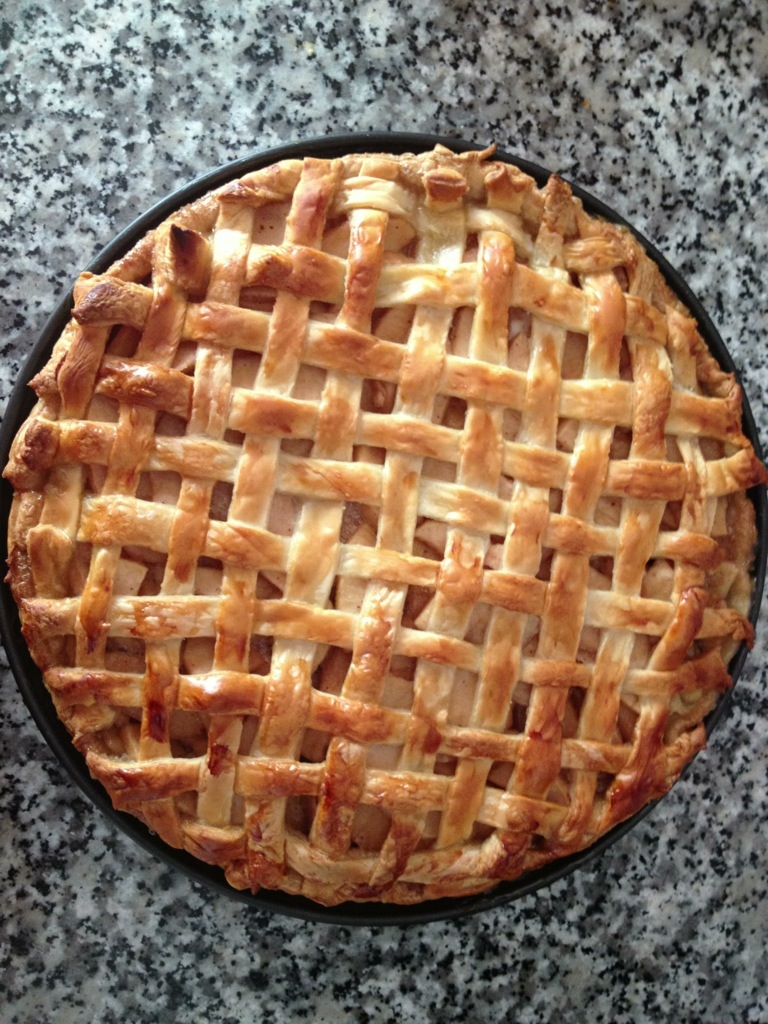
So this is why I’m crying now as I lay out the rectangular, store-bought pie crust, as I cut it into strips to make my lattice top, hopefully creating the appearance of beauty for my sub-par pie. The crust is malleable, easy to stretch, more perfect than I could ever have mixed together myself, and yet I despise it. It will not be mine, just as the holiday that has already past is not mine.

Yet, somehow, as my girls will in a moment burst in from their school day, see the piles of leftover crust and take them into their small hands, scrubbing the bottom of the apple-cinnamon-sugar bowl with delicious bits of crust, just as I did when I was a girl, I know that my pie will be fine. It may have an imperfect crust, but it will be just as beautiful, taste just as amazing with its lining of pastry cream, the Spanish apples brought down from the north, and the sweetness carried across the sea to Europe for a holiday that is the same in every language.

20121123-150058.jpg

My Perspective of Thanksgiving, 2012

For the month of November, I have been watching as many of my Facebook friends have posted daily things in their life that they are grateful for (their family, their memories, their ability to communicate with people from all over the world), all leading up to my favorite holiday, Thanksgiving. Why is this my favorite holiday? The most obvious reasons, of course: I love homemade meals, baked goods, and the idea of a celebration being based on gratitude. But most importantly, despite the dark ghost of Black Friday that hovers over this holiday like an evil villain of consumerism, I love the fact that Thanksgiving, in my opinion, is the only holiday in America that is NOT influenced by capitalism. Unlike Halloween (I learned this year, upon making a Halloween PowerPoint for my students in Spain, that the average American spends $72.50 on Halloween items, totaling $5 billion!), Fourth of July, or just about any other holiday where special decorations, clothing, or fireworks flood the stores, Thanksgiving is happily neglected by consumerism due to the impending need for stores to stock up on Christmas hopes (yes, if you thought Halloween was bad, we spend $704, or $50 billion, on Christmas!!!).

But I digress. I, like most of my friends, do see the true importance of Thanksgiving, the root of the word. Regardless of the shady, inaccurate history of this first American holiday, the ability to express the gratitude that we often forget in our day-to-day lives is not lost on me as Thanksgiving approaches.

This year, living abroad, I am more grateful than ever for what I have in my life. Coming to Spain meant sacrificing more than I ever imagined when, one year ago at about this time, I made the decision for us to take this journey. Giving up our home, the most perfect job I’d ever (and probably will ever) have, having to say goodbye to friends who we may not see much of ever again (as our return to the US will depend on where I find work), and being away from our family has been much more difficult than I could have fathomed as I dreamed of learning Spanish, traveling through Europe, and finally fulfilling a lifelong dream.

I woke early this morning, well before my alarm, before the busy street that runs along our apartment filled with the sounds of weekday traffic. I came into the hallway and started to work on the computer while I ate my breakfast, and soon I heard my two youngest daughters rise and quietly begin playing an imaginary game with the 6€ set of cars they bought with their Ratoncito Pérez (the Spanish version of the Tooth Fairy) money at the Chinese store. The sound of their voices creating characters, witnessing love and abandonment, Riona’s small chirps of laughter and Mythili’s authoritative recommendations about car placement and car-jargon dialogue, filled me with warmth.

Coming to Spain, for my girls, meant giving up nearly every toy they owned, nearly all of their books, and making do with what we could fit into their suitcases or afford to purchase upon arrival, which hasn’t been much. Just like I have learned a new perspective about everything related to culture, education, and language, they have learned a new perspective about how to play.

So this Thanksgiving, which is just a regular working day for me where I present my Thanksgiving PowerPoint to Spanish students who know little about the holiday, where I will spend my evening pedaling across town from house to house earning every euro I will need to buy food to put on our table, I am grateful for perspective. The perspective that would be the same had I stayed home, and which has changed exponentially with this experience. The perspective that allows me to be ever so grateful for what my country provides to its citizens while at the same time taking pleasure in the simplicity and family orientation of the Spanish culture. The perspective that gratitude, whether read in faraway posts or spread through heartstrings on a quiet Cartagenian morning, can follow me wherever I go, can be a part of who I am, and can make giving thanks on this day that much more meaningful.

Our Daily Words

ice cream without spoon
my restless night without you
her words bearing down

unexpected break
work finished, gift of a nap
words of love exchanged

Thanksgiving in Spain
PowerPoint some will follow
others, my words are lost

oven uninstalled
girls translate the missing parts
language their best tool

words keep me there late
every week a new story
culture coming through

It Is No Small Irony

It is no small irony who appears at our door for Mythili’s birthday party. We had warned her beforehand of the possibility of no-shows, and I want to gulp back my inadequacy as a mother. I am not there, I hear myself saying, to chat with the mothers on the sidewalk as they smoke cigarettes and hover near their cars after leaving you at school, to ask, “Can your daughter come to my daughter’s birthday celebration?”

I wonder though, in all honesty, if my schedule didn’t bear down on me, if I had all the time in the world, if I’d even dare for a moment to participate in conversations whose language I barely understand.

So let me put it frankly. The only child who rang our bell appeared with her mother and younger sister, head wrapped in a scarf. No, not the mother, the this-must-be-a-Moor mother. The baby sister.

It wasn’t until hours later, when she stood in the quickly-darkening hallway, the same small girl in tow, that I remembered: this is the girl and the mother I saw disembarking the ambulance in the rain the other day, my frenzied walk home interrupted by the sudden heartbreak of a scarf-wrapped head on a child too young to know this kind of pain.

“Fatima’s sister doesn’t go to school, we don’t know why,” the girls tell me when I inquire about the girl’s age, whether the girl is in Riona’s class, selfishly thinking of my youngest who has the greatest difficulty making friends.

Of course she doesn’t go to school. Her mother, from Morocco, the one who doesn’t speak Spanish? The one who, upon a singular invitation by Isabella has sent her daughter daily to our door for my barely-speaks-Spanish daughter to help this poor girl with her Spanish science, religion, and art homework?

It is no small irony that she is the singular invitee who appears at our door for Mythili’s birthday party. An outcast, a Moor, a Muslim. The epitome of the pitiful look I encounter when I mention the name of the school my daughters attend. Never mind that the Moors settled this land hundreds of years before the Christians, that the glamorous palace people travel thousands of miles to see in Granada is actually of Muslim architecture, that the very name of this city I live in is a blend of Moroccan “Carto” and Latin “Nova.”

When her mother buzzes our bell to collect her child more than an hour after I suggested the ‘party’ would end, I want to speak to her. I want to pull the small child standing next to her into our apartment, to spew out a slur of welcoming words, to let her know that her daughters could appear here any day of the week, that we would welcome them faster than the public healthcare system they traveled across the sea to access, that we are not Christians, but have the heart of Christians.

But, as usual, as the hallway light, on its perfect timer of impatience, flashes from brighter-than-we-can-handle to complete darkness, all I can say is, “Pasa, pasa,” gesturing to our small hallway crammed with our grocery cart, a table, and my American, Chinese-made bicycle, as her daughter gathers her coat, puts on her shoes, and takes in hand the three balloons on Chinese-store sticks that my girls have portioned out for her.

They leave without a proper exchange of words. Without me thanking them to the fullest extent, without their ability to tell me what they wanted to say. A perfect summary of the past three months of my life.

The Clouds of a Crisis

the clouds move in
on our long walk across town,
the bike ride’s end
tagging along my subconscious

their cacophony emanates
through slick crosswalks
and cart-pulling passersby
as we make our way into
the theatre where they will become
the stage presences
they’ve only seen in pictures

after the show my colleague announces,
heavy accent and all,
It’s raining men,
and his prim-and-proper appearance,
his paisley umbrella,
fit in a warm spot
at the bottom of my heart

i teach one class (solo today),
the chart comparing schools
in Spain to America
too dense to ever fit
within the bounds of
a chalk-dust ridden
minuscule version of education

the rides home, back out,
home, back out, cause waves
of daily inconsistency that
pour out of the sky,
bearing down on the heaviness
of my home across the sea

my country sits divided
on a fence i cannot fathom,
these moments of
familiarity and love
bursting through
the clouds of a crisis
none of my countrymen can understand

in darkness,
on rain-slick tiled side streets,
i make my final pedal,
capture your words on the screen,
and wonder when we can
relinquish the rain

20121106-234012.jpg

Unpredictability

You can’t predict this. That your day will begin before dawn and end later than most people in America would consider working. Hell, in Spain, too, though they sure as hell don’t mind hiring me to work that late!

There was no way of knowing, before I came here, how much homework my daughters would have. How intimidating and complex it could be, while I sit with my translate app ready to look up the English version of words like slither, spinal, and homonym. How much time this would take out of the exceedingly brief time I have with them each day. How I could lose sleep over how early I need to set the alarm, because what if Mythili fails her science test or Riona doesn’t have a chance to read aloud to me or Isabella can’t retell the story of Jesus saving all and bringing his followers to the kingdom of heaven when she’s never heard these stories in English to compare them to??

This isn’t my singular problem. I have come up with a new theory (yet again) about Spain. Since I spend most of my day not with my family but with Spaniards, I hear all kinds of stories and details about their culture. Students commonly spend 4-5 hours a night completing homework, and parents often take classes themselves, for professional development, French, English, you name it. Not because they’re looking forward to a salary increase, mind you. Because they want to learn. Week nights are essential to their incremental increase of knowledge.

Studying and working so intensely, especially between the days of Monday through Thursday, are as much a part of this culture as sacred meal times, siesta, and family-only weekends. Yes, they may live for vacations, but they work their asses off in between times so that they can enjoy them!

So when I had a few clients tonight mention to me that next Thursday is (yet another) fiesta, and “will you be working?” I almost answered no. But I’m just too damn American. I want to say, “You do realize that if I don’t work, I don’t get paid, right? And that I have a family?” But I just tell them, “Yes, I’m working,” to which they respond with, “OK… well it is a holiday, so we’ll call you next Wednesday to let you know if we’re taking a trip or not.”

It’s almost laughable! I can’t imagine planning a trip the day before I take it! Just like I can’t imagine allowing Isabella to put off her religion homework till Sunday night, or letting Mythili get by with just a 7 on her lengua exam (that will never happen again!), or allowing Riona to skip out on circling all the letters her teacher wants her to focus on enunciating this week (though this is not required).

I couldn’t have predicted how complicated our lives would be here. The impossibility of presumptions that I could have made, most of which would have been untrue, would have made a long tail that followed me across the sea and would have been chopped slowly away with each new day. Fortunately, I was too busy giving up my previous life one heartbreak at a time before boarding that plane, so I didn’t have any time to predict anything at all. And that is why I am still able to set my alarm for the exact right minute and suck the marrow out of every brief moment of life that does not involve a frenzied cycle across town, trying to explain an overly-litigate society to Spaniards whose schools don’t have proper fire alarms, or translating food wheels for a seven-year-old. Instead, I can look forward to next week’s fiesta in Benidorm, a trip I planned weeks ago, have already booked and paid for, and beats out all predictions–impossible to make–about how intensely I would love my vacations!!

Trust the World

Yes, I trust the world. Back home, I don’t lock my car, don’t even have a key to my house, and leave valuable items in plain view at my desk at school, anything from cases of Girl Scout cookies to my Smartphone. My general attitude about life is, most people can be trusted, and would rather not deal with the hassle of stealing. And overall, most people are good.

Constantly I’m admonished for this. “But what if…” fill in the blank with horror stories. It’s all I ever hear. Horror stories from personal experiences, media tales, and the like. “All it takes is one person,” I often hear. It’s true. All it takes is one person to be a shithead and steal my stuff, or to be psychotic and kidnap and murder a ten-year-old girl, but how many millions of us are there? I mean, BILLIONS? Do we need to constantly think that we will cross paths with these horror stories?

The ironic thing is, I have actually had things stolen from me. I had two bicycle tires stolen right off my bike when I was in high school. The bike was locked, but the tires weren’t. Right during the middle of the school day even! And our house in Denver, when I was fifteen, was broken into one night while we were gone, and many items were stolen, most importantly the charm bracelets whose charms my sister and I had collected each year at Christmas (such a bullshit thing to steal, not even worth much!). When I think back to both of those incidents in my life, things were not good for me or my family. We were having many problems, and sending out endless negative vibes.

So why do I still trust people? Why do I always think, It’s not going to happen to me? Because ever since I put that thought in my head, it doesn’t. I truly believe that there is some truth in positive thinking, sending thoughts out into the universe, and expecting that things are going to be OK, only to discover that… well, yes, they are going to be OK. I mean, look where I am! I had the rug pulled out from under me two weeks before the school year started in America, and I gave up the chance at a huge salary increase, full benefits, and living like kings in an apartment complex with a pool cheaper than our mortgage, to come to Spain for a salary that’s not even enough to pay for one person’s living expenses, let alone five. But here we are. I trusted in the world, and the world helped me out, giving me a salary comfortable enough for us to live on and enjoy this country.

But that’s not all. Due to the financial crisis, and perhaps the culture here, I have been forewarned by all about the epidemic of thievery. By more than a few people, I was forewarned to not even bring the bicycle, as it would surely be taken, my U-lock no match for the bolt cutters they would have here, that we wouldn’t even be able to leave the bike outside a store while we shopped!

As usual, I decided to go against the grain and bring it anyway (I was already breaking every other sane person’s rules anyway). I brought the bike, and I do lock it everywhere, but I consistently leave the helmet and saddlebag still attached. Everyone has told me to stop doing this, that these items will be stolen, but I just have to disagree.

I was planning on seeing gypsies everywhere I went. Not because I’ve seen a series of ridiculous movies, but because my Spaniards told me this is what I should expect, especially “in this region.” Well I don’t know what a gypsy even looks like, or how sneakily they can creep up and slit open your purse (again, others’ horror stories!), but the only time anyone in Cartagena has approached my Camelbak? It was on the street, yes. I was walking between tutoring appointments and a lady came up behind me and told me my backpack was partially unzipped, and she zipped it up for me!

See what I mean people?

But yesterday takes the cake. We have this little thing called a debit card with every penny of thousands of dollars we brought from America attached to it. I was being a responsible parent and went to the bank yesterday to DEPOSIT money into our account so we could pay the light bill (everything in Spain is completed via direct bank transfer). Well, I somehow forgot to retrieve my card from the ATM, and didn’t notice until about six hours later.

I know, I know… I can hear all the people screaming at me! “What if??”

But that’s just it. In almost the same moment that I noticed my card was missing, I noticed a voice mail on my phone. The lady in the bank had my card and was keeping it safe for me. Of course.

This is not luck. This is not a coincidence. While I have been surrounded by people I know always feeding me horror stories, I have managed to escape almost every tragic moment imaginable. No one has ever smashed a window in my car to take my purse, or steal the iPod I left sitting on the dash, with the keys to the car sitting right next to it (yes, I do that too). Yet these things seem to happen to everyone I know. Why? Because they’re so fucking afraid that they’re going to happen!

I really believe there is some truth to that. Yesterday, when I discovered my card was gone, I called Bruce and told him to check the account. Then I went on with my life and tutored a girl for an hour, not even thinking about it, and Bruce sent a text saying nothing was charged on the account, and did he want me to have him cancel the card? I told him not to. I wasn’t the least bit surprised. It was only a brief panic when I lost the card, not a “the world is ending now” crisis. I knew that everything would be OK, as always, because I trust the world, and the world trusts me, and my place here in it, no matter whose soil I place my trust in.

Beautiful Little Boxes

I have a schedule posted on the board in the English department’s office. It pretty much lists the twelve classes I will attend each week, all different levels of students ranging from ages 12-18, with correlating levels of English (seventh graders being the lowest level, twelfth graders the highest). However, since Spain has a different way of labeling students and grades, I haven’t quite memorized the various levels, nor knew, during my first week, what ages I would encounter until I entered the classrooms and asked students how old they were.

On my schedule in the English department are beautiful little boxes where the teachers can write the topic of the day. Beneath my schedule is a plastic funda, (I don’t know this word in English), where teachers can put photocopies of activities or, in most cases, of the textbooks that they make the poor students purchase, that we will be discussing that day.

This is how it should work: the day before the lesson, my beautiful little boxes should be filled with notes, copies should be underneath in the funda, and I can enter each of my twelve different subjects prepared to teach.

But let me review the teachers’ day in Spain. Yesterday I think it was 98 degrees (haven’t quite learned Centigrade yet, but I’m guessing over 40). Please note: no air conditioning. Students remain in the same room, together, all day, waiting for various teachers to filter in from all over the building, a pile of books and chalk in hand. Each teacher has at least three preps, usually five, and the schedule for all varies from day to day. There is not one moment of consistency. You cannot expect to go in and teach level one English during period two, five days a week. It will be three times a week, and the time changes depending on the day. Hopefully you can appear in the correct classroom at the correct time with the correct materials. So far, I have not succeeded in doing so.

I have not a qualm in the world then, when I return home and tell Bruce about my day, and he replies with, They are taking advantage of you because you showed them that you’re too good in the beginning, and I shoot back with, You have no idea what it’s like for them.

Today I had a plan for one of three classes, as one teacher put her copies in the funda and wrote her topic in my beautiful little box. I attended the bilingual meeting, where I was again reminded that I do not speak nor understand Spanish, other than when the music teacher (my new favorite person) spoke in a clear, slow, perfectly-understandable accent. I heard bits and pieces of conversations, and one somewhat heated debate involving menus, prices, and places to eat, having to do with, perhaps, everyone getting together on November 9? My goal for the end of the year: to know what happens during these weekly meetings!

I attended the first, prepared-for class. The teacher wanted me to run the entire show, beginning to end, and I felt confident that I at last understood my job. I am the only one who speaks English with perfect authority, and I only have these students once per week. They need to hear the native speaker. No matter what it is I have to say. But more importantly, the teachers? God do they need a break!!! We learned about multiculturalism in Britain after a brief lecture by me (while the teacher ran an errand) about the letters being the same in the words SILENT and LISTEN… high schoolers… ugh…

Moving on to the next class, I appeared on time, before the teacher, of course. She came in and saw the math scribbles on the board and asked me if I needed chalk, holding up the two tiny stubs of chalk that remained below the chalkboard. (Might I remind everyone that there are no overhead projectors, not even the transparency type??) Sure… I replied… what might we be doing today? (She hadn’t filled my beautiful little box, so I hadn’t the slightest idea, though I was immediately relieved to see a group of middle-school-aged kids, my home). All About Britain, she replied, and when I asked if they’d already started to read the book, she didn’t understand me. We switched to Spanish, but let me tell you. I may have trouble understanding Spanish, but at least I don’t claim to be a Spanish teacher, God forbid!

Luckily for me, this appeared the be the same lesson that was minutes-before thrust on me on Monday with a different teacher, so I perfected it quite nicely today, thank you very much! (I decided to omit his absurd terminating requirement of having one student at a time read aloud a sentence in English and translate, for the whole class, the Spanish equivalent… translation truly just doesn’t work most of the time). The teacher today? She sat in the back of the room fanning herself and not saying a word. Total trust after less than a week? I’ll take it.

On to lesson three, where I received the most beautiful gift of all time. First, there’s a fifteen-minute break for everyone in the school before the last period of the day! Second, I’d made questions for this particular text one day while sitting on the beach, and had printed them for the teacher, who, surprise surprise, never had time to make copies. I guess you will have to write them on the board then she told me… I stared at my palms, whose chalk dust I had just washed off in the bathroom. I suppose so… I admitted, crestfallen. But when we walked down to her room, voila! Smartboard, projector, computer. Do you have this room every week, for this class? I asked, more excited than a kid just arriving at Disney World. It was about the best gift I could imagine receiving. I pulled out my flash drive, asked the tallest boy in the class (high schoolers again??) to reach up to the ceiling and turn on the projector, and I felt like a real teacher again! I could type! Change fonts! Add colors!! Use a pointer, highlight, underline, everything I feel like every student needs, but ESPECIALLY second language students. How lucky the teacher is, in a room that has such a beautiful gift, one whose description would never fit into a beautiful little box, because words could never fit the gratitude that filled every moment of that oh-so-perfect American lesson.

Before I left for the day, I checked my schedule again. Someone had scribbled in, All About Britain, in the box for today (a little after the fact, I think). I also had a note on my desk from a teacher saying he wouldn’t be in the class I share with him tomorrow, but could I do the same lesson as Monday? (Well, the cultural liaison explained, Since everyone realized right away that you are an actual teacher, not like these teacher assistants we’ve had in the past, we have great trust in you…It’s up to you, though, if you want to do that…)

I couldn’t explain to her, in English or Spanish, what I do, what I have done, for the past seven years. I couldn’t explain it this morning in the meeting when the history teacher asked me if I knew anything about American history and I tried to say, in front of all, in my broken Spanish, that I co-taught that subject for seven years. I couldn’t explain to my colleagues back home what it is like to be a teacher in Spain. All I can do is be the best teacher I know how to be, to fit myself into a beautiful little box, and hope that when the box is opened, the students on the other side will see the world in a different way.
What I Miss

There are things I miss so fiercely that my heart aches. A good long, cold and isolated bike ride, breath steaming out of my lungs, coming across the deer along the fence, the perfect mountain view tinted by rays of morning sun, everything just coming into the dawn of a new day. My mornings, solitude and strength building me up for whatever I might face, knowing that I could face the world after that ride.

My recliner. Chosen by me, ridiculed for being too large, but so thick, soft, a perfect armrest I once used to nurse all my babies, it leaned back perfectly, laptop in lap, movie on screen, book in hand, the perfect piece of furniture for every situation.

My Hyundai. Not the car itself, its junky no-lights-on-interior nothing to brag about. Just the freedom it provided, piling the kids in on our latest adventure, trekking across town to the museum, the zoo, the reservoir… how I miss the ability to go anywhere, anytime, for them to share that freedom with me, to be able to explore the world without limitations of bus schedules, car rental fees, and finances.

The telephone. Being able to pick it up and call my friends, my parents, my sister, anyone, without having to worry about an eight-hour time difference, without thinking, what a fucking shitty day, I need to talk, and knowing that I can’t talk to anyone, any time, about all the things in life I need to talk about. That it really is just us, the five of us, and we have to figure out a way to be everything for each other in every moment, whether it’s my girls’ fierce insistence on me spending my last dollar on school uniforms I can’t afford because they already stand out enough, and they need to fit in, or Bruce hating his inability to communicate anything, or me running into one problem after another with the principal (what IS it with me and principals???).

Wal-mart. God, I never thought I’d say that. Wal-mart, I miss you! I know I cursed you every time I walked in, ridiculed your inability to keep items in stock, criticized your exploitation of Chinese products, your destruction of the natural environment. But I wish you were here to save me when I can’t find a decent store to buy what my girls need, to be open when I need to print out a bus ticket or make copies for lessons, to take back all my items without a receipt!! TO BE OPEN ALL THE TIME!! Even Sundays!

Microbrews. I don’t think any description needs to follow the smooth taste of a home-brewed Hefeweizen straight out of the tap from Dry Dock.

My oven!! AN oven. No homemade pizzas. No baking chicken or potatoes. No broiling steak. But above all and everything, never a chance, for a whole year, to make a single batch of brownies. I can almost feel the melted chips sticking to my tongue, the tiny crumbs at the bottom of the pan pinched between my fingers, the smell that filled the house for hours…

Again, my words, my beautiful words. Trapped here in this blog, lost to everyone here who thinks I’m just some stupid American who’s timid and speechless. Oh, how I miss my words.