the gray sky hovers
over our impending strike
as Portland rain drops


the gray sky hovers
over our impending strike
as Portland rain drops
sometimes all i need
in this upside down world
is a puppy’s love

To avoid pouring water down the drain, I spend ninety minutes washing dishes in two pans, running water out to my new mulch to dump, and putting everything away while Bruce researches home equity loans and Trump tax cuts that hurt, rather than help, our current situation.

Behind the bars of my security door, I take this picture of the sewer company’s progress replacing a portion of our main drain.

Behind the bars of this security door, I hide from the American Dream. The one that we are all promised and few of us ever attain. The one where we could afford to buy a house, afford to deal with that house’s expenses, afford to send our children to college or even pay off the loans we might still have from our own degrees.
I hide from the dream of all of my grandparents, a combination of immigrants and endlessly American, one grandfather with an eighth grade education, one with a high school diploma, who were able to raise large families and pay off mortgages well before retirement. On ONE income.
I hide from the audacity of insurance that we carry on our homes, our health, our lives. From the premiums we pay that won’t cover pre-existing conditions (like pregnancy!) or pre-existing problems on our properties (like drains), or pre-existing hope–from all the thousands and thousands of dollars we pour into these plans that leave us empty, behind bars, unable to operate a backhoe.
I hide from the for-sale houses in my neighborhood that are now so outrageously priced that my family, and none of the other families on my block, would ever be able to afford to buy the homes we stand in.
Behind the bars of my security door, I am as insecure as everyone in my generation. The generation that faces housing costs that are equivalent to more than fifty percent of what we earn in a month. The generation of debt that is impossible to avoid even with the best budget. The generation that has made the choice to bring children into this world only to constantly think: why would I bring children into this world? Children I feel inadequate to provide for, children who will face even higher college costs, children who will be straddled with debt for their entire adult lives?
Behind the bars, I cannot see the buyers of the $769,000 remodel on the next block. Where they come from. What jobs they have. What magical formula they applied for that allowed them to take a mortgage that costs more than what our two incomes bring home in a month.
Behind the bars, I hear the Spanish language spilling from the mouths of the workers who have to dig a hole in a yard on a holiday. With perfect efficiency, they have repaired a ten-foot section of pipe within two hours, and they will move on to the next family’s crisis, and the next, and the next, before going home to houses on the other side of town that they also likely can barely afford, because we all know that the $6000 we just paid for that pipe is lining the pockets of a white, male, English-only CEO.
Behind the bars, I live in my dream house, my four-bedroom, two-bathroom, beautiful-garden dream house that we waited seventeen years to purchase. I raise a family of three daughters whose pay may never match their male counterparts but, despite this, whose intelligence and candor will allow them to live the life of their dreams. I share my meals, my home, and my love with my husband who has managed our finances to such perfection that we have flawless credit, making an application for an equity loan for both our properties (because nothing can just happen to this house–both need new main drains), virtually seamless. We both work hard at our dream jobs–teaching and telecom–in order to make this picture perfect.
With the door open, before they rebury the dirt, I snap a picture of our pretty kitty hiding behind my glass of stress wine.

I sit on our paid-for leather recliner and feel the cool breeze of early summer and think about my students who have crossed the world to be a part of this American Dream, and how hard they work to make that dream possible, to learn English and learn how to navigate the complexities of our society that sometimes make us feel like we’re all going down the drain. I think of how hard my husband and I have worked to make this day possible–to give my girls a summer trip to Spain, a year in Spain, to see nearly all fifty states–because of how careful we have been with our money. I think of the health insurance that paid for most of my husband’s surgery and how my grandmother’s baby sister died of a simple infection in her mouth after tripping up on a wooden popsicle stick, all because they couldn’t afford a doctor.
With the door open, we host family friends who make us laugh until we cry, whose daughter will join us in Spain, whose presence makes us appreciate what we have surrounding us in life–a life filled with laughter, love, support.
With the door open and the Spanish-speaking workers gone, the Siberian iris frames my kitty, my pet, my perfect yard. I know that I have given so much to get to this picture, and I know I still have more to give. I have daughters who are lucky enough to have access to all the technology, diversity, and coursework that comes from an urban education, and who will enter their adult lives with an open-minded understanding of the world. I have a house that we can afford and enjoy without feeling like our money is going down the drain. I have a job that brings the global perspective to every choice I make in one of the most beautiful buildings our city has to offer. I have a marriage that has lasted from childhood to adulthood, with all the post-adolescent turmoil and trauma, all the sorrow and joy, that comes with making it work for twenty years.
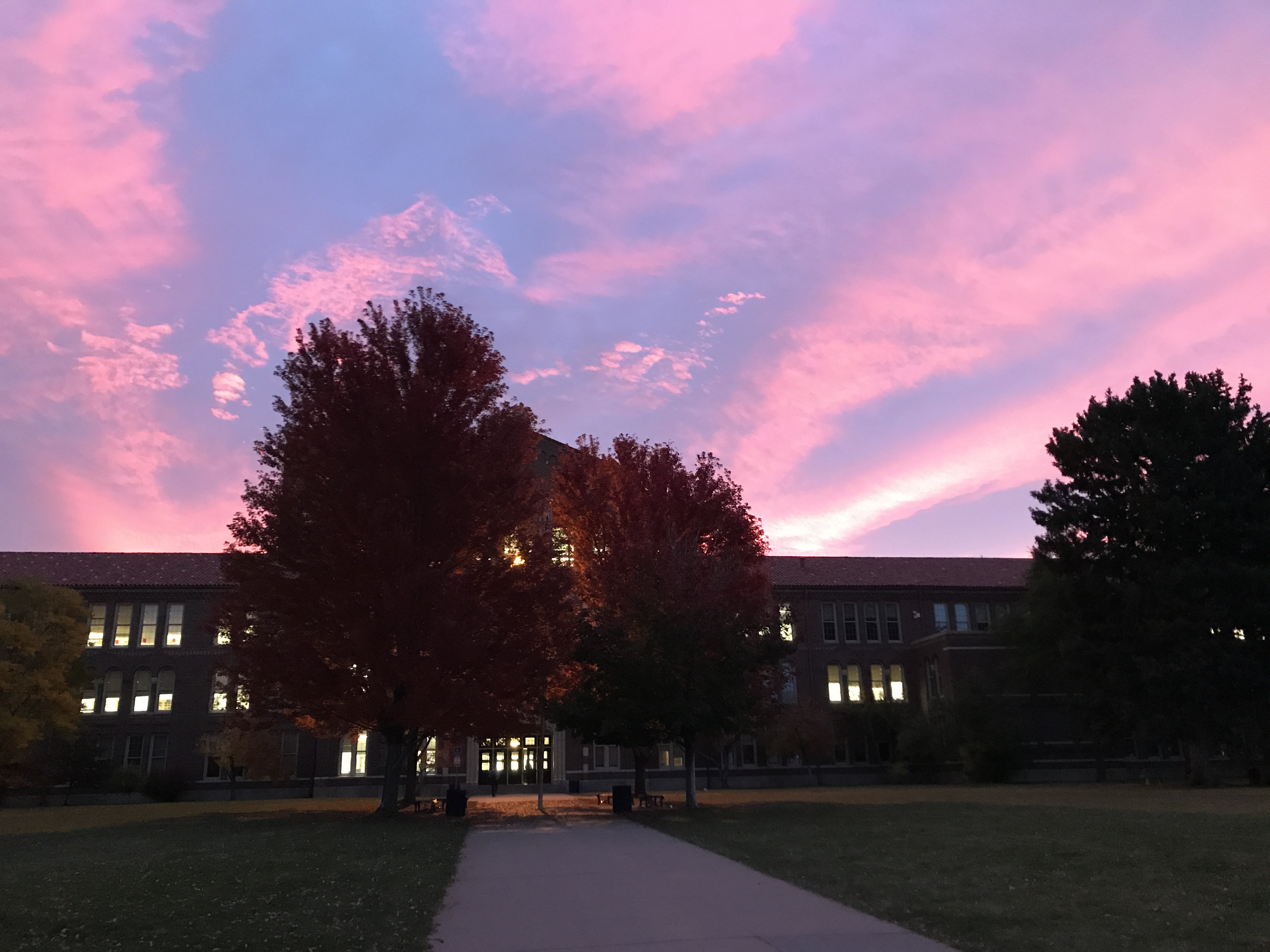
With my door open, I wait for the American Dream. Somehow, some day, some way, I will see how it is both easy and difficult to achieve. If I would learn to always open the door and move beyond the bars, I would see that not everything is going down the drain. I would see the beauty in every choice, the brutality in every loss, and find a way to make a set of silver linings sweeter than a sip of stress wine.
I would be the wife, the teacher, the mother of that perfect picture. That perfect picture would be me.
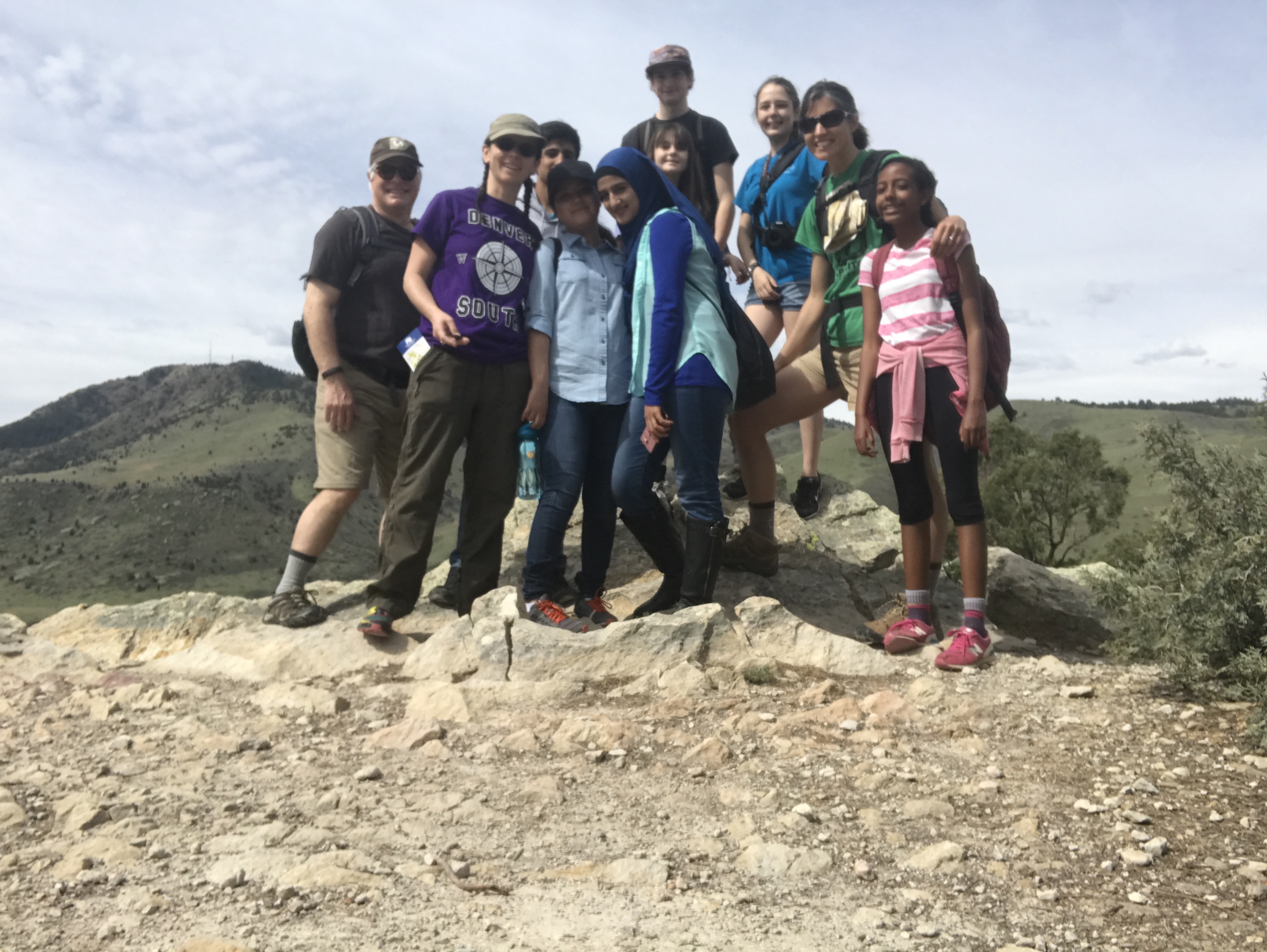
We took three Afghani students to the foothills today. They have been here for less than a year, so they learned a few English words today: Hike. Trail. Juniper. Ponderosa. Colorado=red rocks. View.
I tried to ask what it was like for them back home, but they only knew a few English words to describe it: Danger. No school. Grandparents. Parents here in Colorado. All kids–brother, sister, other brother–in Afghanistan.
Each time I asked if they wanted to continue down the trail or turn around, the most confident girl, the hijab girl, kept insisting we go on. She had no desire to go back to whatever life she had outside of that blue-sky hike, her knee-high boots and sweaty face no hindrance to her joy. She just wanted to walk. To escape. To be on that mountain.
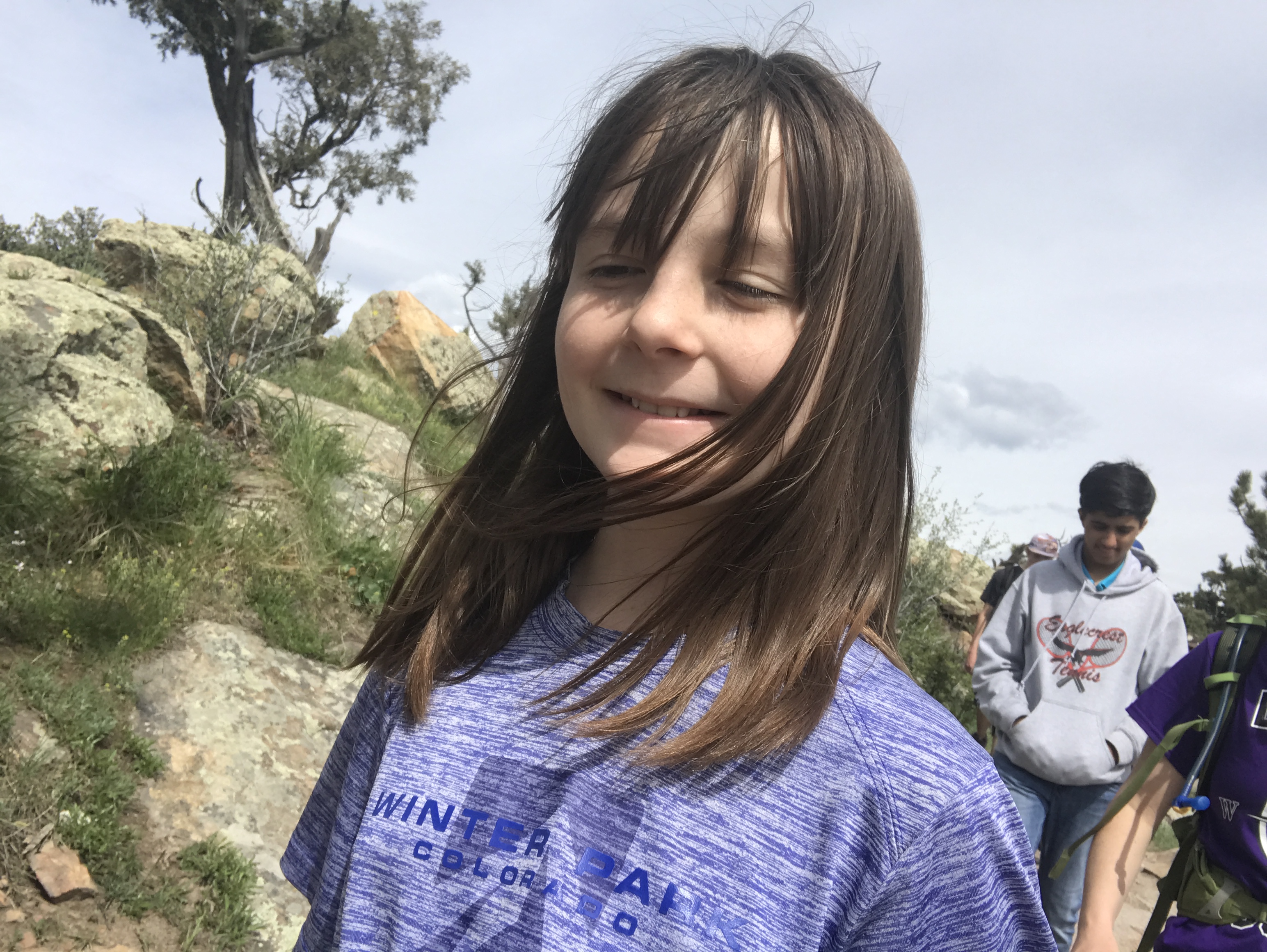
When we were at the top, she leaned in to take a selfie with me, and then one with my youngest daughter whose experiential-learning school had just visited the same location, whose quiet voice shared with us the details of the sedimentary rock layers, the lichen, the igneous and metamorphic. This was a perfect match–the low-English Afghani and my quiet youngest–smiling shyly for a photo, a perfect frame of world peace.
With a walk like this, we step towards empathy. Understanding. Gratitude. We know that things could be worse, that they are worse, for so many people in the world.
But it doesn’t stop me from feeling the pain, the loss that I feel now. For feeling gypped, for feeling like nothing I do, nothing my husband and I ever do, will be good enough to make our lives easier.
Perhaps it’s the curse of Spain. Six years ago, after welcoming two Spaniards into our home, after asking practically nothing for rent, after offering them my car for months when theirs broke down (I rode my bike to work 25 miles a day for three months), after hosting parties for their friends, babysitting their friends’ kids, driving them to South Dakota, after everything, we went to Spain and never heard from either of them again. In addition to the nightmare that that year in Spain was for us, with its broken promises, broken paychecks, and lost jobs, they had to twist the knife right into our backs by acting like they never knew us.
And now we’ve planned a redo. Twentieth wedding anniversary. Fortieth birthdays. Three years into living like kings for the first time in our marriage, with two steady, well-paying jobs, great benefits, and our dream house that we opened up to friends of ours, six of them, rent free for two months because they were down on their luck, and Spain has cursed us again. Our six-week vacation that is 90% bought and paid for, that I have spent over forty hours meticulously planning every last expenditure and activity, will be marred by a pending layoff, loss of benefits, and a mortgage we simply cannot afford on a teacher’s salary.
Let me tell you about that teacher’s salary. Let me tell you about the master’s degree plus thirty credits I have. Let me tell you about all the school events I attend, the lunch meetings, the hours before and after school I work, the summer workshops, the home visits, the dance chaperoning, the sporting events, the class coverage, the every last everything I do to work, to earn an extra buck, to make it. Let me tell you about the eight years we lived on a $48,000 frozen salary.
Let me tell you about my childhood. Parents with bachelors’ degrees in journalism working for a small town newspaper and barely making it. Powdered milk. Ten-year-old, rusted-out Datsun. Ancient house with windows so thin that ice collected on the glass. My mother scraping together a $20 bill for my eleventh birthday and me looking at it holding back silent tears because I already knew that it was equivalent to two and a half hours of her work, and my father was failing his master’s program, and we were moving to Denver for a better life, and everything was crashing down at once.
Let me tell you about contract work, the only kind of work Bruce was able to find when he left the Air Force. No guarantee. No health insurance. No paid time off. No holidays. No sick leave. And when it ends? No unemployment checks.
Let me tell you about health insurance. Let me tell you about the two children I have given birth to without having health insurance because it was a pre-existing condition, and the near $10,000 we paid for those births.
Let me find a few English words to explain to these students from Afghanistan: American Dream. Housing. Insurance. Education. SCAM.
Let me tell you about what we have done to avoid bankruptcy: No car payments. No student loans. No credit card debt. Two properties. Saving and spending. Buying a house only when we were ready, when we could afford it. Saving up for a cursed redo of Spain. Road trips staying with family and camping to save money while traveling. One computer for the whole family. Still driving my 1998 Hyundai Accent.
Let me tell you how I know what poverty is. I know what sacrifices are. I have made them.
Let me find a few English words to say: Fuck this country. Fuck this Trumpian tax cut that cuts workers while CEOs live like kings. Fuck this blue-sky day. Fuck my husband’s military sacrifice, his months in the desert, his sold-his-soul-to-boot-camp commitment, his veteran status that has given us NOTHING.
Let me be twenty years into my youthful marriage and not have to feel like I’m just twenty minutes in. Let me keep my dream house. Let him keep his union (that screwed him) dream job. Let my kids feel like there’s a future here for them and that with two degrees they won’t be buying powdered milk.
Just. Let me be. I’ve had enough.

You can enter any cafe in Spain and you will probably find the same two drinks: cheap Pilsner beer and local wine (OK, you can at least choose between red and white!). The Spanish palette for mixed drinks is limited to adding liqueur to coffee, it seems, and their availability of decent beer choices is abominable. But when it comes to education, Spaniards love a good cocktail.
Here are some instructions for making an educational cocktail, shaken, not stirred.
Ingredients:
1. Homogeneous groups of students segregated by ability who remain together all day long for years at a time, and are allowed to choose their own seats.
2. Heterogeneous teachers who range in age, management, and educational methodology.
3. A school building that does not provide resources such as technology, textbooks, government-funded lunch, or air conditioning.
Instructions:
1. Place all students in one classroom. Wait for intermittently ringing bells that will shake them up out of their seats while teachers dance through hallways crowded with other teachers and random students who have PE that period, to arrive and wrap the students up in a somewhat-chilled glass with a pinch of salt along the rim.
2. Spend three hours each week trying to settle the above shaking, using the cold stirrer of the teacher’s little authority to embed knowledge enough of one subject area to make a decent mixed drink, full of flavor and memorable enough to spill out onto the streets with jubilation.
3. Subdue them on four occasions per trimester with exams that make up the stark majority of their grades, consisting of arduous essay questions, but only about ten per exam. Their flavors will bleed through classes so that they will begin to taste more like eraser remnants than a decently mixed drink.
4. Shake up the cocktail a little just when the school year is getting cold by surprising only select groups of students in one grade of primary and one of secondary with the annual government test, whose topics, flavors, and question amounts you will never know or begin to be able to prepare for, similar to visiting the cafes in every city in Spain who may or may not have a menu, use local vocabulary non-translatable in any software to identify food items, and whose waiters never return after bringing you your order. (Surprise, surprise, we all like to guess what it is we’re bringing to our lips!)
5. If the cocktail spills, you may clean it up and refill it once, for free, but only once. After that, you will be run dry and stuck in the same situation as the rest of the third world: working shit jobs for little pay.
Alas, you can always look back at your educational experiences and say that you had the best mixed drink of all time: moving through the school system in Spain!
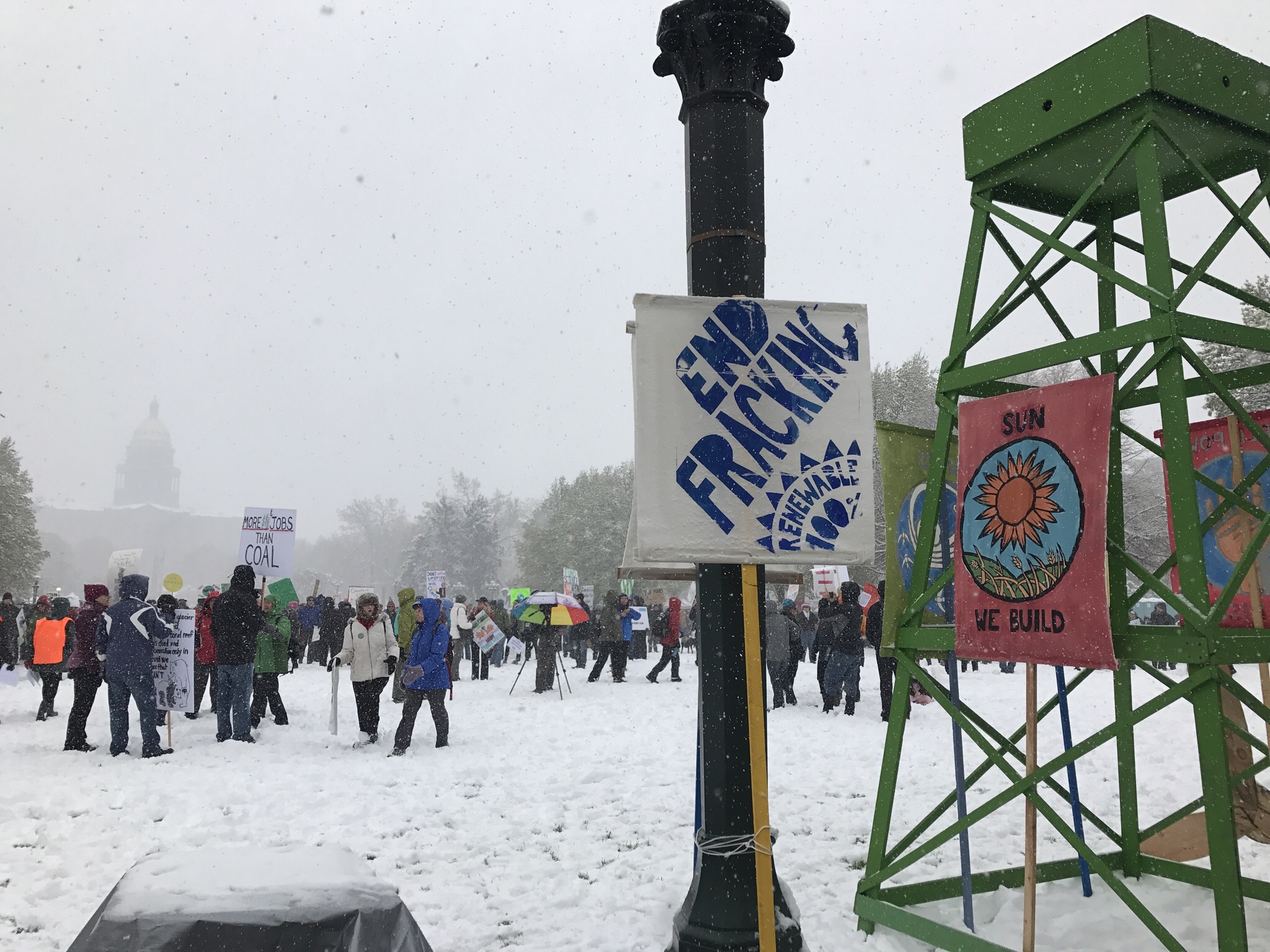
because we need this:
desertification looms
just beyond the bend
(Trump looms there as well,
where the ninety-degree March
made some record highs)
and so? a snow march
to keep precipitation
where it belongs: Earth



In the middle class houses all being scraped
to build mansions no one can afford?
In the stagnant salaries that ask us to
work harder for less money?
In the moms working two jobs,
the dads unable to keep up?
Where is my Italian grandmother’s dream
of a better tomorrow, a house she and her
Irish husband built and paid for
before they retired?
It is not my dream.
It is not our dream.
I am the working mother,
the disappearing middle class,
I am the two-incomes-barely-making it generation,
the strapped-with-student-loans
cause-we-thought-it-mattered generation,
the trapped in social media comparison
of who has the best selfie, the best vacation,
the best life?
Where is my grandparents’ America,
who came back from the war and
built from the ground up those tiny homes
that we can’t wait to tear down?
Where are the housewives who can sew clothes
and cook duck a’l’orange for a Wednesday evening?
Who are there when their children come home?
Whose husbands could buy pay for this house
on just one salary?
I am Generation X, torn between Baby Boomers
who raised us to be independent
and Millennials who can’t do anything for themselves.
I am the white woman who can never decide
between what is fair for her and fair for everyone.
Where is my grandparents’ America?
In the broken corporate ladder,
in the endless need for greed,
in the generations lost between yesterday and tomorrow.
In the hope lost between King’s improvised speech
and Trump’s rampant ignorance,
in a land I barely recognize,
in the rubble of torn-down houses,
torn-down American dreams.

(NOTE: Inspired by “Let America Be America Again” by Langston Hughes)
On a rainy October day when I was a child, my parents stopped in a small Massachusetts town on our way home from my uncle’s ski lodge in Vermont so that we could visit a Norman Rockwell exhibit. My mother had always loved growing up and looking at his realistic paintings on the covers of The Saturday Evening Post, and he had spent some time in the town where they were hosting the exhibit.
That weekend was one of the few where we were invited to pretend, via a fancy ski lodge in Vermont that boasted a sauna and private pond, that we were rich. We’d met our extended family there: aunts and uncles, cousins and grandparents. The kids all slept on mattresses in the loft, the adults took one of the four bedrooms, and my uncle took the owner’s apartment with a separate entrance at the bottom of the house. We’d play in the woods, race around the pond, braid our hair on the deck, and enjoy an array of delicious food that each family contributed to.
And then we’d drive home to our house in upstate New York, away from it all–the pond, the food, the family… the wealth.
But on that particular Columbus Day, after meandering through the Rockwell exhibit and google-eyeing all the paintings, my mother and father hemmed and hawed over one of their favorite prints: Homecoming. It sat in the gift shop at the end of the exhibit, covered in glass, matted, and lined with a simple silver frame. I don’t remember how much it cost; it may have been $20 or $100, but no matter the amount, it was too much. We didn’t have extra money for luxuries like this–art for the wall??–when we were driving a 10-year-old rusted out Datsun across three states for a weekend getaway provided by my rich uncle.
“What do you think?” my mother asked.
“It’s up to you,” my father responded.
And so the print was rung up, wrapped in brown paper, and carried across the shiny black parking lot through streaks of rain. My mother carefully stacked it atop our possessions at the back of the Datsun and we weaved our way through northeastern storms back home.
As soon as the painting appeared on the wall in our living room, I became obsessed with it. The details. So many faces!! How could he fit so many faces into such a small painting? The redheaded family with open arms, welcoming their WWII soldier home. The old brick tenement and naked trees filled with dirty children. The multi-sized shirts and shorts hanging from the line. The girl pressed against the corner wall, ready to surprise him. The gratitude in everyone’s eyes after the weary war years.
I used to try to count the people. 19? 22? 20? There were silhouettes hidden in the shadows of the apartment’s windows, and it was difficult to determine exactly how many there could be. Homecoming became an ongoing mystery: How did he paint this? How many people did he mean for there to be? How long was the boy at war?
My grandfather, a mostly silent and grumpy man, had survived that war. Was his reception like this one–so filled with emphatic joy that all would be forgotten?
I doubted it.
I saw everything in that painting. The desire. The poverty. The hope.
It hangs in my house now because my mother tired of it, earned more money, moved on to different art, and because she knew how much I loved it as a child.
I pass by it on my way out the door in the morning. Sometimes I play the game with my girls–how many people are in the painting? It witnesses all our guests, all our arguments, all the laughter and joy and chaos that are our lives.
And in these ominous days since the election, it bears witness to my hopelessness. I fold laundry and cook dinner while listening to The Nightingale by Kristin Hannah, one of the many books I have read about WWII. This one has yet another perspective–that of the takeover of France and the secret groups that defied the Nazis to try to stop the war. It focuses on women–women who had to host German soldiers in their family homes while their husbands were prisoners of war. Women who took risks to save the lives of fallen RAF British pilots. Women who had to wait in line for hours for food rations. Women who had to turn in their radios–their only communication with the outside world–and be prisoners in their own homes.
I think about, walk by, and examine Rockwell’s painting as I listen to Hannah’s words. As I remember that dreary day when we bought the print, knowing my parents’ meager salaries couldn’t really afford it. I imagine what it must have been like for my grandparents, living through the daily sacrifices that encompass a war.
I imagine what it might be like for us. As news floods in daily with human rights stripped away piece by piece, with constant comparisons to Nazi Germany, how can I avoid it?
How can I not put myself in that painting, arms open, ready to welcome home my long lost soldier?
Will there be a day in my lifetime that I am there, really there? Maybe one of the silhouettes in the back corner of the window, ready to finally come out?
Will there be an end to this madness that is only just beginning?
Will our country, our people, our democracy, ever have a homecoming?
I cannot answer these questions, just as I cannot accurately count the number of heads Rockwell painted. I can only guess. I can only imagine.
I can only hope that our homecoming is just around the corner, just like that redheaded girl, waiting for her savior to wrap his arms around her.

one student now gone
another with court papers
(deportation threats)
country’s dark shadow
creeps into every moment
of this “president”
 Step Write Up