no. we won’t shut up.
no, thank you. we won’t sit down.
we’re here. we’re watching.
we’re ready to strike.
we’re ready to fight for them.
we’re ready to win.

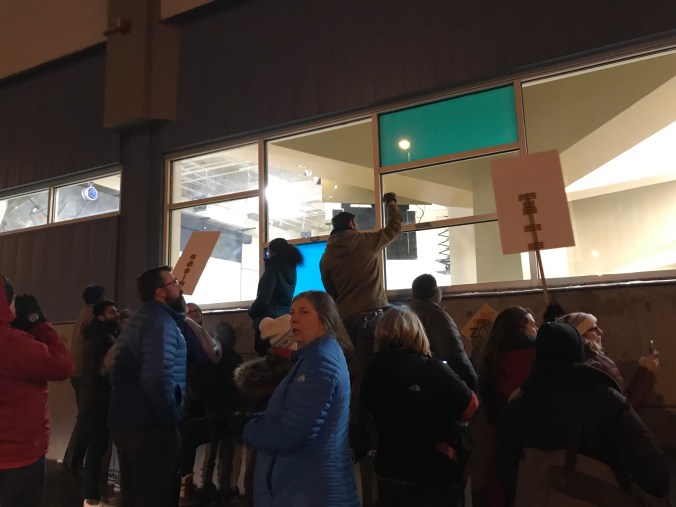

no. we won’t shut up.
no, thank you. we won’t sit down.
we’re here. we’re watching.
we’re ready to strike.
we’re ready to fight for them.
we’re ready to win.
I just want to think about how hard-won this moment is. This day. This five of us skiing down a mountain together. This money we didn’t have before that we have now.
This fresh powder.
This view. Could you beat that view if you went anywhere else in the world? Well, could you?
I don’t want to think about the five years we, a family of five, lived on a frozen, constituents-unwilling-to-vote-on-a-mill-levy teacher’s salary of $48,000. The $10,000 out-of-pocket expenses we paid to give birth to our third child. The penny-pinching. The laying-out-$400-every-three-months to earn those goddamn fifteen credits so I could get a raise if I … changed school districts.
I don’t want to think about how Spain screwed me out of a decent salary and we came home afterward with $19,000 in debt, more than any we’ve had as a married couple.
I don’t want to think about the TWO 1998 cars we have outside our house right now, car-payment free.
I don’t want to think about a teacher’s strike. I don’t want to think about my refugees trekking across town on two buses and being huddled into the auditorium to wait, without teachers, the long seven hours until they trek back, because if they don’t wait, they might not have a meal that day.
About the hundreds of hours I, and every teacher I know, has put into grading, planning, meeting, educating (ourselves and them), in the ten months between August and June. Hundreds of hours outside our contract day listening to students tell us their traumas that are greater than any soul could bear, listening to our admin and school district rate us as failures when we wake before dawn and go home after dusk to bring our best selves into that classroom every day, listening to our coworkers decide between renting a slumlord shithole or buying a house an hour away…
Listening.
I don’t want to think about the thousands of union workers who died for this day. For this choice. For a society where corporate greed is not the only answer.
I just want to see my husband and my three girls gliding down this Colorado slope, this Colorado hope.
I want to ski. To smile. To rejoice.
I don’t want to go on strike.
But I will.
Just like I walked in and out of Manual High School in 1994 when my teachers asked me to support them.
Just like I lived on pittance pay for the early part of my children’s lives.
Just like every other union member everywhere who’s looking to find empathy in the eyes of the corporate monsters that rule our society.
I will strike.
And I will ski.
And we will win ourselves a bluebird day.

top notch medicine
provided by his union
workers working win

To avoid pouring water down the drain, I spend ninety minutes washing dishes in two pans, running water out to my new mulch to dump, and putting everything away while Bruce researches home equity loans and Trump tax cuts that hurt, rather than help, our current situation.

Behind the bars of my security door, I take this picture of the sewer company’s progress replacing a portion of our main drain.

Behind the bars of this security door, I hide from the American Dream. The one that we are all promised and few of us ever attain. The one where we could afford to buy a house, afford to deal with that house’s expenses, afford to send our children to college or even pay off the loans we might still have from our own degrees.
I hide from the dream of all of my grandparents, a combination of immigrants and endlessly American, one grandfather with an eighth grade education, one with a high school diploma, who were able to raise large families and pay off mortgages well before retirement. On ONE income.
I hide from the audacity of insurance that we carry on our homes, our health, our lives. From the premiums we pay that won’t cover pre-existing conditions (like pregnancy!) or pre-existing problems on our properties (like drains), or pre-existing hope–from all the thousands and thousands of dollars we pour into these plans that leave us empty, behind bars, unable to operate a backhoe.
I hide from the for-sale houses in my neighborhood that are now so outrageously priced that my family, and none of the other families on my block, would ever be able to afford to buy the homes we stand in.
Behind the bars of my security door, I am as insecure as everyone in my generation. The generation that faces housing costs that are equivalent to more than fifty percent of what we earn in a month. The generation of debt that is impossible to avoid even with the best budget. The generation that has made the choice to bring children into this world only to constantly think: why would I bring children into this world? Children I feel inadequate to provide for, children who will face even higher college costs, children who will be straddled with debt for their entire adult lives?
Behind the bars, I cannot see the buyers of the $769,000 remodel on the next block. Where they come from. What jobs they have. What magical formula they applied for that allowed them to take a mortgage that costs more than what our two incomes bring home in a month.
Behind the bars, I hear the Spanish language spilling from the mouths of the workers who have to dig a hole in a yard on a holiday. With perfect efficiency, they have repaired a ten-foot section of pipe within two hours, and they will move on to the next family’s crisis, and the next, and the next, before going home to houses on the other side of town that they also likely can barely afford, because we all know that the $6000 we just paid for that pipe is lining the pockets of a white, male, English-only CEO.
Behind the bars, I live in my dream house, my four-bedroom, two-bathroom, beautiful-garden dream house that we waited seventeen years to purchase. I raise a family of three daughters whose pay may never match their male counterparts but, despite this, whose intelligence and candor will allow them to live the life of their dreams. I share my meals, my home, and my love with my husband who has managed our finances to such perfection that we have flawless credit, making an application for an equity loan for both our properties (because nothing can just happen to this house–both need new main drains), virtually seamless. We both work hard at our dream jobs–teaching and telecom–in order to make this picture perfect.
With the door open, before they rebury the dirt, I snap a picture of our pretty kitty hiding behind my glass of stress wine.

I sit on our paid-for leather recliner and feel the cool breeze of early summer and think about my students who have crossed the world to be a part of this American Dream, and how hard they work to make that dream possible, to learn English and learn how to navigate the complexities of our society that sometimes make us feel like we’re all going down the drain. I think of how hard my husband and I have worked to make this day possible–to give my girls a summer trip to Spain, a year in Spain, to see nearly all fifty states–because of how careful we have been with our money. I think of the health insurance that paid for most of my husband’s surgery and how my grandmother’s baby sister died of a simple infection in her mouth after tripping up on a wooden popsicle stick, all because they couldn’t afford a doctor.
With the door open, we host family friends who make us laugh until we cry, whose daughter will join us in Spain, whose presence makes us appreciate what we have surrounding us in life–a life filled with laughter, love, support.
With the door open and the Spanish-speaking workers gone, the Siberian iris frames my kitty, my pet, my perfect yard. I know that I have given so much to get to this picture, and I know I still have more to give. I have daughters who are lucky enough to have access to all the technology, diversity, and coursework that comes from an urban education, and who will enter their adult lives with an open-minded understanding of the world. I have a house that we can afford and enjoy without feeling like our money is going down the drain. I have a job that brings the global perspective to every choice I make in one of the most beautiful buildings our city has to offer. I have a marriage that has lasted from childhood to adulthood, with all the post-adolescent turmoil and trauma, all the sorrow and joy, that comes with making it work for twenty years.
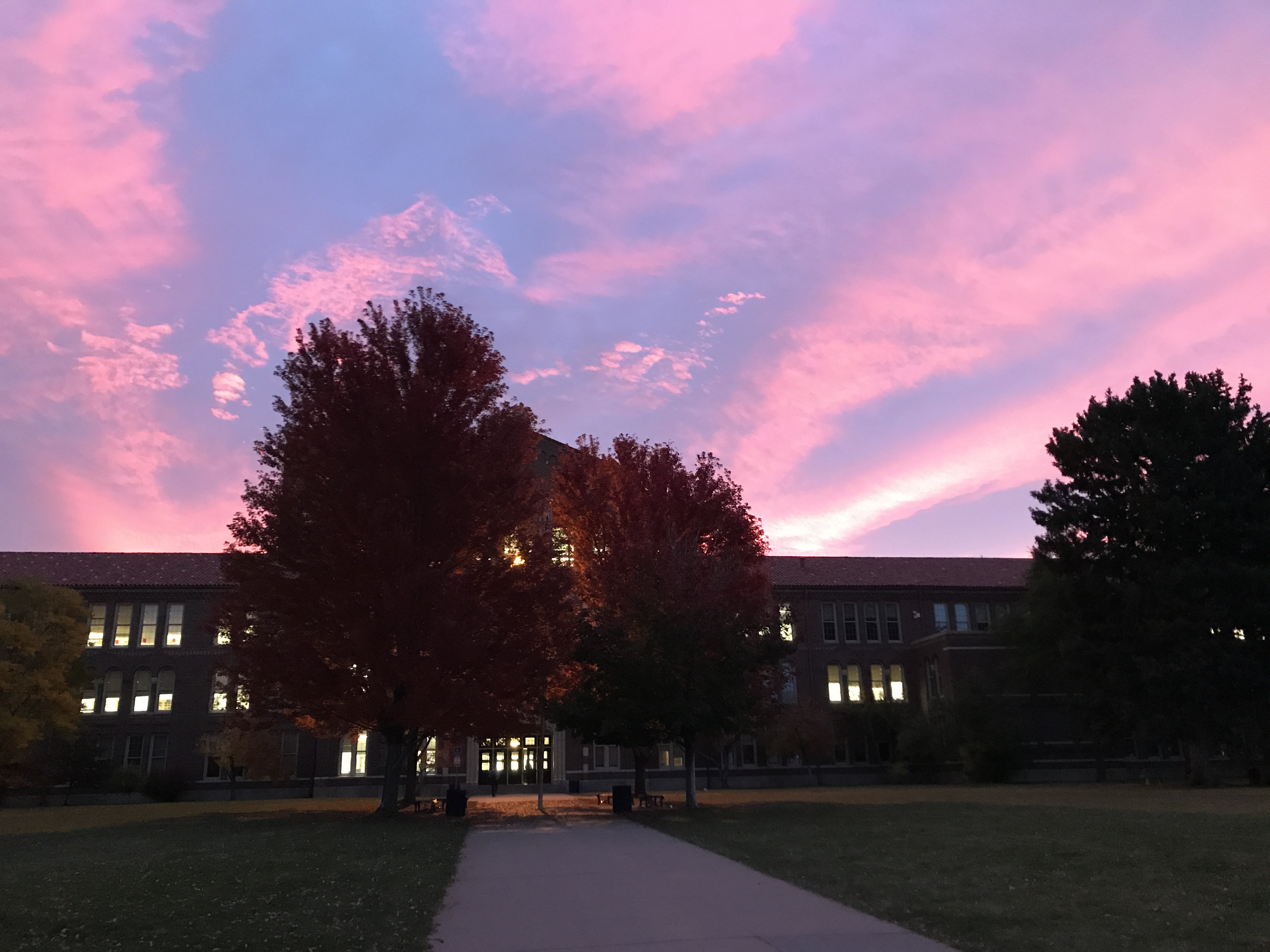
With my door open, I wait for the American Dream. Somehow, some day, some way, I will see how it is both easy and difficult to achieve. If I would learn to always open the door and move beyond the bars, I would see that not everything is going down the drain. I would see the beauty in every choice, the brutality in every loss, and find a way to make a set of silver linings sweeter than a sip of stress wine.
I would be the wife, the teacher, the mother of that perfect picture. That perfect picture would be me.
At the elevator, brace still on, crutch still under his arm, he tells me he thinks that a good return-to-work date would be June 4, five days before we leave for Spain. He seems optimistic as he hobbles down the tiled hallway, as we enter the carpeted office, as we check in and he holds the door open for a woman with a walker, pointing out, “It’s kind of strange they don’t have an automatic door in the orthopedic’s office,” to which she adamantly agrees.
On the plastic, paper-coated bed, he hands me the folder while the PA takes him for x-rays. After just a few minutes, the doctor enters with the films. He has photographs of the entire procedure. He intricately describes the meniscus (intact), the bones (drilled into), the ACL (torn and then repaired). Bruce and I lift our eyebrows at each other, barely able to distinguish the tiny details he points out in each picture.
In his cozy spinning chair, the doctor is also optimistic. “I think you can ditch the brace right now and ditch the crutches by Friday. Use the stationary bike on Sunday. By Monday, you should be walking around the block. Maybe driving.”
From the green paper folder, I begin to pull out the forms. First: short-term disability approval. A list of lines with dates, surgery and medication verification. Affably, he takes them in stride: “I’ll be sure to get these to the right people to fill them out.” Because he has people. Because he charged the insurance company $36,000, more than half of what I earn in a year, for an outpatient surgery that took less than 90 minutes. Because we live in the land of the free.
From the green paper folder, I continue to pull out forms. Bruce begins to tell him–without ever being able to finish because of the doctor’s rambling explanations, the doctor’s defense of his procedures, the doctor’s justification for not filling out anything–about wanting to return to work before Spain. I pull out The Form, the one that CenturyLink requires for him to be able to work: a release of liability for driving a company vehicle, an “if-something-happens-it’s-not-on-us, your-injury-better-not-affect-your-work” form.
From his throne, he glances at the wording. He throws in more anecdotes peppered with cussing colloquialisms. “In twenty-six years of doing this, I have never seen a company require a form like this. What if you’re a shitty driver? How can I, as your medical doctor, determine if you’re OK to drive? I won’t sign a form like that. If you get in an accident and hurt someone and I’ve signed this form, then it’s all on me.”
From my plastic chair, I listen to the tone of my twenty-years-spouse change from respectful to grainy. I can almost feel the lump at the back of his throat as he tries to go on. “Well, my supervisor is willing to let me come back on light duty…”
From his throne, the doctor interrupts: “What you’re going to be dealing with is HR, not your supervisor, and if HR says you can’t work, that’s where things get muddy when I start putting my name on these forms.”
From my plastic chair, I am counting down the hours in my mind until the moment I can let these tears actually fall. First I have to continue listening to this white-haired, privileged surgeon continue rambling on about lawsuits. Then, we have to make Bruce’s appointments for physical therapy. Next, we have to drive home and track Mythili’s progress on her bicycle, as I had no way to pick her up today. After that, I have to take her to her doctor’s appointment, where they will make commentary about how my thirteen-year-old hasn’t had her period yet.
From my plastic chair, I am frozen and without words. The doctor turns to me. “You look frustrated.”
Is that the word you would use? Do you think frustration sums up the past six weeks of my life?
“The thing is…” Bruce begins, “… I’m probably going to get laid off on July 30.”
The doctor has finished listening. “That’s why we have to be so careful when filling out these forms. This happens all the time, when companies decide you can’t work.”
“No, it’s unrelated…” he begins again, that painful lump sitting on top of his beautiful, sexy voice.
“Are you really not going to fill out the form?” is the only thing I can muster. The doctor hands it back to Bruce, asks if there’s anyone he can call, anyone he can talk to, any way he can go back to work without it.
From the tiny patient meeting room, he stands. He shuffles us out the door. He guides us to his people who will make the next appointment. I place The Form neatly back inside the green paper folder.
I think of a few cussing colloquialisms I could shout. I think of hindsight, all of it. Of next year’s ski passes we wasted $2300 on. Of the thousands we’ve already spent in this office. Of the four weeks at seventy-percent-pay he’ll get for short-term disability. Of the thousands we’ve spent on Spain that is gone and tarnished before boarding the plane.
But I have no words in these moments when I have bowed down to our litigate society, our corporations’ fear of liability, our doctors’ refusal to help the little man other than spurting cussing colloquialisms while trying to relate to us.
At the elevator, his brace in my hand, crutch still under his arm, I don’t speak. Picking up Mythili, exhausted from her bike ride, I don’t speak. At the following doctor’s appointment, where, as usual, we only get to see the PA, I cross my arms and don’t speak, forcing Mythili to respond to questions about who she lives with, how she likes her sisters, what kinds of food she eats.
From my recliner at home, I do have a few cussing colloquialisms for the orthopedic surgeon. I could spout them all day, all night, every waking moment of the past twenty years of marriage, every waking moment of my life as a not-quite-middle-class American who just needs A GODDAMN FORM SIGNED SO WE HAVE A FEW PENNIES TO OUR NAME…
From my recliner at home, the words are useless. All the words, all the work, all the life we have put into living, everything feels useless.
And there is no cussing colloquialism that will bring me that doctor’s signature, bring my husband his job, bring me some peace. So why bother spouting them at all?

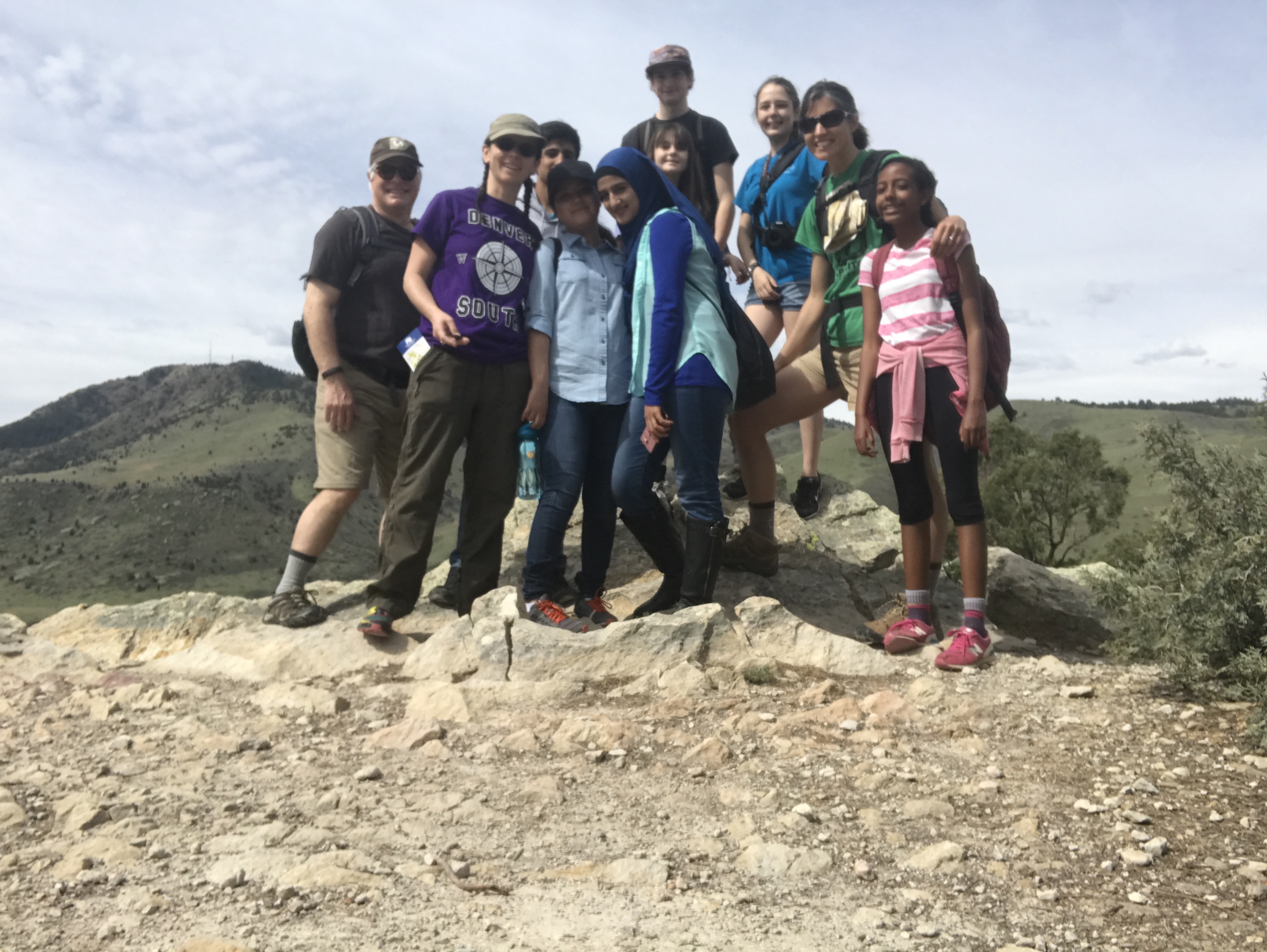
We took three Afghani students to the foothills today. They have been here for less than a year, so they learned a few English words today: Hike. Trail. Juniper. Ponderosa. Colorado=red rocks. View.
I tried to ask what it was like for them back home, but they only knew a few English words to describe it: Danger. No school. Grandparents. Parents here in Colorado. All kids–brother, sister, other brother–in Afghanistan.
Each time I asked if they wanted to continue down the trail or turn around, the most confident girl, the hijab girl, kept insisting we go on. She had no desire to go back to whatever life she had outside of that blue-sky hike, her knee-high boots and sweaty face no hindrance to her joy. She just wanted to walk. To escape. To be on that mountain.
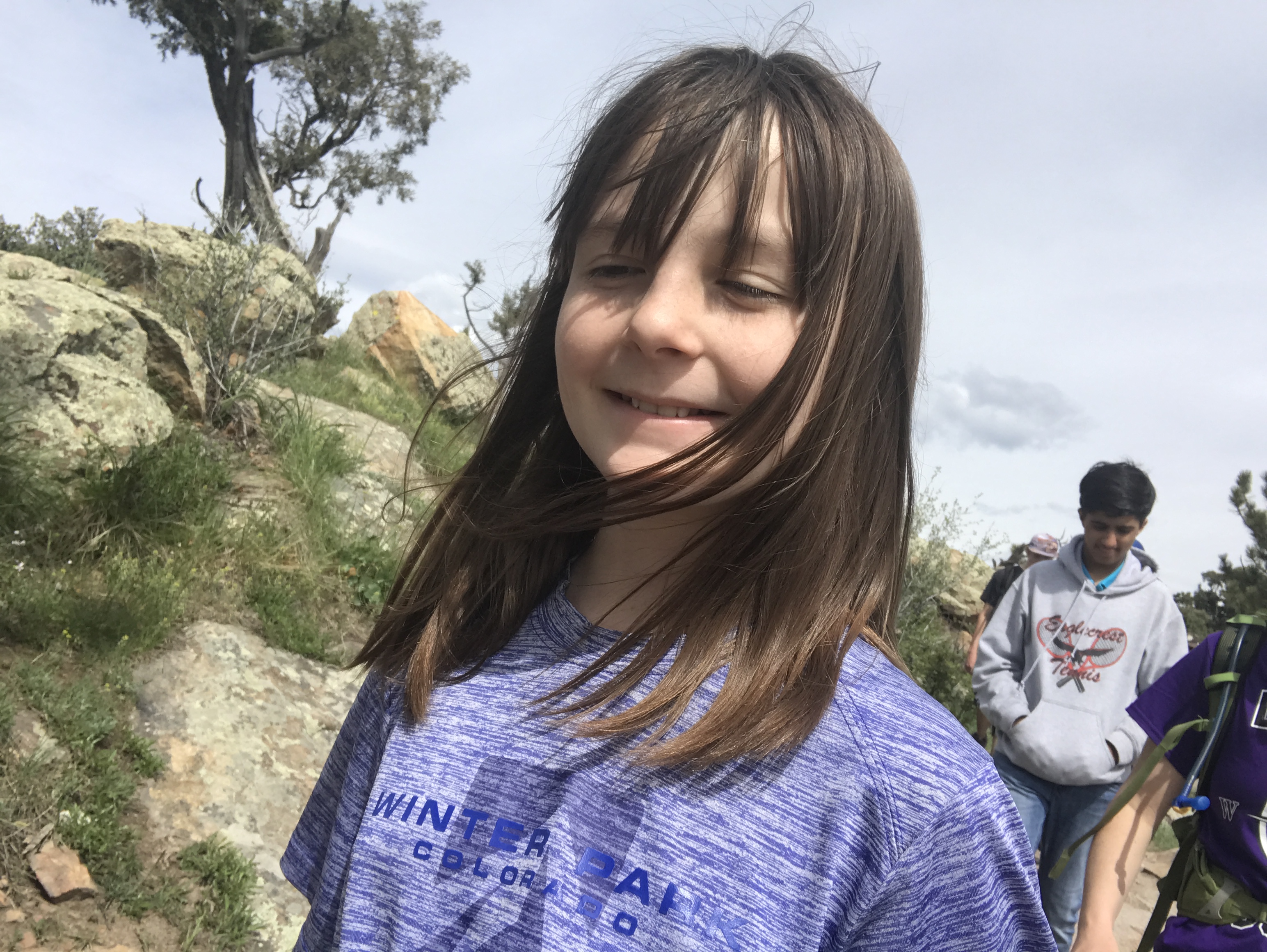
When we were at the top, she leaned in to take a selfie with me, and then one with my youngest daughter whose experiential-learning school had just visited the same location, whose quiet voice shared with us the details of the sedimentary rock layers, the lichen, the igneous and metamorphic. This was a perfect match–the low-English Afghani and my quiet youngest–smiling shyly for a photo, a perfect frame of world peace.
With a walk like this, we step towards empathy. Understanding. Gratitude. We know that things could be worse, that they are worse, for so many people in the world.
But it doesn’t stop me from feeling the pain, the loss that I feel now. For feeling gypped, for feeling like nothing I do, nothing my husband and I ever do, will be good enough to make our lives easier.
Perhaps it’s the curse of Spain. Six years ago, after welcoming two Spaniards into our home, after asking practically nothing for rent, after offering them my car for months when theirs broke down (I rode my bike to work 25 miles a day for three months), after hosting parties for their friends, babysitting their friends’ kids, driving them to South Dakota, after everything, we went to Spain and never heard from either of them again. In addition to the nightmare that that year in Spain was for us, with its broken promises, broken paychecks, and lost jobs, they had to twist the knife right into our backs by acting like they never knew us.
And now we’ve planned a redo. Twentieth wedding anniversary. Fortieth birthdays. Three years into living like kings for the first time in our marriage, with two steady, well-paying jobs, great benefits, and our dream house that we opened up to friends of ours, six of them, rent free for two months because they were down on their luck, and Spain has cursed us again. Our six-week vacation that is 90% bought and paid for, that I have spent over forty hours meticulously planning every last expenditure and activity, will be marred by a pending layoff, loss of benefits, and a mortgage we simply cannot afford on a teacher’s salary.
Let me tell you about that teacher’s salary. Let me tell you about the master’s degree plus thirty credits I have. Let me tell you about all the school events I attend, the lunch meetings, the hours before and after school I work, the summer workshops, the home visits, the dance chaperoning, the sporting events, the class coverage, the every last everything I do to work, to earn an extra buck, to make it. Let me tell you about the eight years we lived on a $48,000 frozen salary.
Let me tell you about my childhood. Parents with bachelors’ degrees in journalism working for a small town newspaper and barely making it. Powdered milk. Ten-year-old, rusted-out Datsun. Ancient house with windows so thin that ice collected on the glass. My mother scraping together a $20 bill for my eleventh birthday and me looking at it holding back silent tears because I already knew that it was equivalent to two and a half hours of her work, and my father was failing his master’s program, and we were moving to Denver for a better life, and everything was crashing down at once.
Let me tell you about contract work, the only kind of work Bruce was able to find when he left the Air Force. No guarantee. No health insurance. No paid time off. No holidays. No sick leave. And when it ends? No unemployment checks.
Let me tell you about health insurance. Let me tell you about the two children I have given birth to without having health insurance because it was a pre-existing condition, and the near $10,000 we paid for those births.
Let me find a few English words to explain to these students from Afghanistan: American Dream. Housing. Insurance. Education. SCAM.
Let me tell you about what we have done to avoid bankruptcy: No car payments. No student loans. No credit card debt. Two properties. Saving and spending. Buying a house only when we were ready, when we could afford it. Saving up for a cursed redo of Spain. Road trips staying with family and camping to save money while traveling. One computer for the whole family. Still driving my 1998 Hyundai Accent.
Let me tell you how I know what poverty is. I know what sacrifices are. I have made them.
Let me find a few English words to say: Fuck this country. Fuck this Trumpian tax cut that cuts workers while CEOs live like kings. Fuck this blue-sky day. Fuck my husband’s military sacrifice, his months in the desert, his sold-his-soul-to-boot-camp commitment, his veteran status that has given us NOTHING.
Let me be twenty years into my youthful marriage and not have to feel like I’m just twenty minutes in. Let me keep my dream house. Let him keep his union (that screwed him) dream job. Let my kids feel like there’s a future here for them and that with two degrees they won’t be buying powdered milk.
Just. Let me be. I’ve had enough.

midnight healthcare scare
makes my family more aware
of options made fair
don’t take this away
or the Democrats will sway
each bill you will play
cause love deserves life
not this plagued financial strife
that cuts like a knife
Kimmel speaks of teams
cause we’re ripping at the seams
for your twisted dreams
for you, one last word
you selfish billionaire turd:
our needs will be heard

health insurance rules
for relieving years of pain
please don’t take it back

Wednesdays have turned into a ritual for Riona and I, as the older two get a ride home from the carpool and she has joined in with her expertise at helping me go grocery shopping (if expertise means begging me for Cheez-its, Naked juice, and blueberries…).
On this Wednesday, five days into Trumpocracy, the weight of it all is heavier than ever before. The two stores, the lines of people at guest services while I wait to buy bus passes, the shuffling of semi-broken carts, the weaving in and out of crammed-too-full aisles filled with Valentine’s candy and magazines and gift cards and everything, it seems, except the food I need to feed my family.
The knowledge that I carry with me now, of stripped healthcare, border wall building, claims of voter fraud, Muslim refugee bans, women’s healthcare denials, mortgage fees reinstated… It makes even the mundane tasks of finding the right brand of almond milk, of selecting a new variety of potatoes, of giving in to the Cheez-it bid, seem heavy and dark and worrisome.
How long will this variety of foods be here? I begin to wonder. How long will this variety of people be here? My darker self asks, as I hear a series of languages and see every skin tone meander through this shared space, this shared ritual of finding food.
At the second store, after I’ve sent Riona off on her own to fulfill half the list while I buy the bus passes, we count our items in the small cart to see if we can shimmy into the “About 15 Items” line behind four other groups. We stand behind them like a crooked tail as carts shuffle past, and slowly move forward to the monotonous beep of the register. As we pile our goods atop the belt, I’m proud of her ability to stick to the list. “Good, you got just the almond milk I like,” I smile down at her, and she grins back, “Of course, Mama. I’m not Daddy.”
A tall blond woman rings us up in a slow, methodical fashion. Riona, who has just finished checking off the last item on the iPhone grocery list, proudly clicks the phone shut and begs to put my credit card into the chip reader. “How does it work, exactly?” she asks excitedly, wholly unaware that my usual no has slipped into a dull yes because my mind is on all my Muslim students from all those countries on his list who will likely never see their extended families again (and not on who’s putting my card in the chip reader).
“Awww,” the cashier coos, “I wish I could be a kid again… although, I had a terrible childhood.”
I look up at her, the pale blue eyes, the straight blond hair, and the hint of an accent. She knows she has my attention now, though of course a line of people still waits impatiently in this express lane, wanting to check out, to go home, to pop open a beer and drink this day away.
“Have you ever heard of the Bosnian genocide?” she asks, and my mind flashes back to my first year of teaching when I had a student whose letter of introduction to me was, when I asked about his childhood, “Only an American would ask about that. Because my childhood was shit. My childhood was war.”
“Yes… I have had students who were from Bosnia,” I reply to the cashier.
“Oh, where do you teach?” she asks excitedly.
“South High School.”
“My sister went there!”
I’m reminded again of how connected our humanity is. She hands me my receipt, I tell her what a great school it is, and I grab the hand of my ten-year-old, whose childhood still lights up by the sushi we always share (unbeknownst to her sisters) before we drive home. Whose childhood is road trips and living in Europe for a year and grandparents who are right down the road and two loving, living parents.
We make our way across the parking lot, and she rams the cart into the speed bump. The eggs tumble to the ground and she frantically looks up at me, ready for the annoyance that would normally be present on my lips.
But I am crying because I don’t care about the damn eggs. I care about the millions of refugees, just like that girl in the grocery store, who won’t be coming here. About the thousands who have come. And the thousands who have been left behind. About the impotence I feel, the numbness that creeps into the corners of my days, as I face this new regime.
“What is it, Mama?” she asks, taking my hand again. I tell her what the girl said about the Bosnian genocide. About the papers Trump is ready to sign. About my first-year-of-teaching student.
We open our crunchy California roll and I put all the wasabi on one piece. She smiles, holding up the bottle of water for me, wanting me to douse it out. “Not this time,” I say, “I want to feel all that fire in my mouth.”
I want to feel something. To feel like I can go to the grocery store without crying. To feel like we live in a place where everyone is welcome, everyone is loved, and everyone is free. Where everyone has the chance to have a happy childhood.
Halfway home, she asks, “Can I have the last piece?”
“Of course.”
She pops it into her mouth and squirms in her seat. “Don’t worry, Mama, I’ll throw the package away before the sisters find out.” She hops out of the car and dances across the lawn towards the outside trash can. “It’ll be OUR secret.”
As usual, she is as happy as a clam. She doesn’t carry the weight of the media, the weight of the presidential pen, the weight of a genocide, as she goes through her days.
She has the gift of a happy childhood. And for now, that is the only weight I want her carry.
“We’ll never tell,” I smile back, the spicy wasabi still sticking to my tastebuds. I can feel the fire in my mouth. And for this moment, at least, I am only thinking about how happy she is.
About how glad I am to have my girls, my home, my school that is a safe haven for all the refugees, for the grocery store filled with a microcosm of the world where a refugee now works, and all the food our family will need.
Because it is something. It is enough. Enough for today.
before dawn alarm
lesson planning just can’t wait
always on my mind
six a.m. invite
curly-haired house of welcome
piano and grins
inside the lead walls?
plea for more books, print, copy
teach the world’s kids
order sympathy
on an unsigned card of hate
my heart sees flowers
psychologist’s help
ends with failing soccer star
begs for a grade change
policies can’t write
or change the screaming patient
that closes my day
teary, manly hugs
from those arms that ask for more
doctors don’t listen
at dark i drive home
day wholly spent on others
to hear more sad news
such is adult life
no more hide and seek for me
everything exposed
but how their eyes light
as they share their days’ stories
must. remember. JOY
 Step Write Up