Perfectly Cracked, Perfectly Hopeful

i walk my puppy,

fight weekend grocery store crowds,

and bake a cheesecake

before 10 a.m.,

i cook raspberry compote

and finish laundry

by noon, i’m ready

to begin this Sunday cleanse

and climb out of here

the city beckons

(no, no—the world beckons

for another chance)

our democracy

and the fate of our future

rest with how we vote

(even though it’s cracked,

my daughter’s birthday cheesecake

is one of many)

let this election

be one of many chances

to give us all hope

Shut Your Ego

all you need to know:

we legally have this kid

(it’s not your business)

What I Heard Today

“Hiking? In the forest? No. Only to look for firewood to cook our food. Not for fun.”

“Yes, I’ve ‘visited’ Mexico. I was there for two months waiting for the coyote.”

“In a room the size of this kitchen there were forty of us. They gave us blankets just like that [pointing to tinfoil]. And when they had to wake someone up to deport them, they woke all of us. And they came in every fifteen minutes to wake someone.”

“Hermano, mira. Hay una lavandería aquí en la casa.”

“My 23-year-old brother wanted to come, but he can’t run fast enough.”

“He can’t run fast enough?”

“To get on the train. I saw so many… broken legs, arms. Even a body with its legs completely amputated. You have to be able to run.”

“I crossed the Rio Grande on a raft.”

“I’ve never seen a dishwasher. We had to wash our clothes and dishes by hand.”

“Eggs, beans, and rice for lunch and dinner. Coffee for breakfast.”

“My cousin bought me the plane ticket, the phone, everything. And the detention center had all of his information, so when I arrived at the airport, the police were waiting for him.”

“$250 here for strep antibiotics? In my country it’s free. Being sick here is a luxury I guess.”

I guess it is.

Something Given (Datum)

I have a data tracking problem. It starts with the word itself which is used to put a number, instead of a face, on my students. Data. A Star Trek android.  A mathematician’s daily routine. A financier’s dream.

Here is my data problem. It starts with the word itself. From Latin dare, “to give” to Latin datum, “something given.”

We ask them to give us everything. Their trauma (trainings throughout the year on the various levels of trauma which range from a singular event to chronic abuse to historical-impossible-to-erase-racial bias), their educational history, or lack thereof, their familial and cultural belief systems, their languages, their motivation (impacted by anything that ranges from zero to a thousand), their futuristic ambitions.

We ask them for everything. We ask them for themselves.

And they bring themselves, each little datum, into my room each day. They bring themselves to my meetings with colleagues when, upon realization during our DDI analyses, my co-teacher informs me that the majority of an entire section of her course can’t even read the sentence, “The cat sat upon the mat and spat,” let alone correctly analyze an SAT passage for grammatical inconsistencies.

“And how am I supposed to teach them how to read?” she ponders, a high school teacher for twenty-five years.

And how am I supposed to categorize my students’ data by skin color, as my school asks me to, to close the gap between my three-years-here Iraqi refugee whose favorite English words are cusses, who has adeptly adapted to U.S. culture so fluently that he can identify how absurd it is when people come up to him on the street, assume he’s Latino, and start rambling in Spanish, with the Rohingya Muslim who just entered my room from a refugee camp where the militia taught him a great deal of verbal English, but who has never spent a day in school, saw his parents murdered by this same militia, and can’t even read or write in Burmese, let alone English?

Or should I include the datum of A who spent five months trying to cross the border and another five months in three American detention centers with limited food, clothing, blankets, toothbrushes, or hope, only to be “adopted” by a white American suburban family, more or less ex-communicating his entire Honduran upbringing and culture because “it must be better here”?

Should I include each individual datum of the paraprofessionals who translate information for these students? Who have mostly arrived here as refugees themselves, but lost everything in war-torn, conflict-bound transport, including degrees in education, civil engineering, law, and decency, to get paid $15 an hour to translate to my kids the silly little things their crazy teacher says?

Should my, could my, data include my school district, that spends millions of dollars a year purchasing curricula that neither reflects my students’ faces or experiences nor is adequate enough to meet the various cultural and linguistic needs of every kid who walks into my classroom anxious to learn? My school district that employs and perpetuates incompetent leaders who have never taught an ELD course in their lives, let alone learned a second language, but choose inadequate resources for my students because THEY LINED THEIR POCKETS WITH GREED?

Should my data include what my Newcomers scored on their practice PSAT 9 test? Do you think that after two months of learning how to pronounce “th” and practicing “There is/there are” verbal phrases, they can accurately and beautifully read 500-word passages and correctly choose the best College-Board-meant-to-cherry-pick-college-bound-geniuses analyses?

Should my data include my professional development leadership meetings, where they show me every week, rather than asking me how it’s going, rather than ever once visiting my data meeting and giving me feedback, rather than taking a moment to understand what it’s like to be an English Language Learner, how to run a data meeting?

One that includes disgruntled teachers. One that includes major gaps. One that includes colonial white language and not the language of my students, and WHAT ARE YOU GOING TO DO TO FIX THAT, ESPECIALLY WITH THIS WHITE COLONIAL LANGUAGE WE THROW AT YOU WITH OUR “CURRICULUM”?

No.

My data is I. B. A. J. E. A. H. All their names. All their stories. All the letters of the alphabet (some of them just learned this alphabet from me, thank you very much).

My data is me talking to those two boys about how their counselor should have told them they didn’t have to take physics with the hardest teacher in the school, that they could have taken zoology and had a passing grade and the science credits they needed to graduate.

My data is every one of the dishes my Newcomers brought to the table after learning how to give directions, walking through the neighborhood and telling each other to turn left, stop at the light, learning how to bake brownies from scratch, learning that English verbs are actually quite simple, and they can explain to the entire class and the entire world how easy it is to make chapati, pupusas, patacones, flan.

My school, my school district, my world: they ask me for something given.

But what have they given to them?

Have they given them a better life? Have they given them words as powerful as redwoods, indestructible after a thousand years? Have they given them the hope they crossed the ocean, the river, the bitterness, to attain?

Have they given them the data that they will need to make their dreams a reality?

I have a data problem. It starts with the word itself. And it stops when I see their beautiful faces.

It stops here. Because they are all that matters. Not numbers. Not something given.

Something to give. Me to them. More than anything: them to me.


Fly Us Home

Wanting a better life for her family, my mother uprooted us to move to Denver when I was 11. Contrarily, her own parents had ripped her from Park Hill Elementary at the same age 33 years prior in the 1960s “white flight” migration. Always burdened by this blatant racism, my mother told us, “We’re moving straight to Denver, and you girls will learn the value of diversity.”

I attended Merrill and Cole middle schools and Manual High School, the latter two hosting the burgeoning Denver School of the Arts.

Unlike my tiny town in upstate New York, DPS offered me a side of society I’d never seen: racial violence in forced-integration hallways, a Chicano Mathletics coach, and a set of friends from multiple races, language backgrounds, and family dynamics. DSA offered me a spotlight into the world of LGBTQ acceptance and the privilege of the most inspirational teacher anyone could ever imagine–Mrs. Jana Clark.

Mrs. Clark and DPS are the reasons I became a teacher and the reason I came back to this district after teaching stints elsewhere.

Because Denver is my microcosm of what the world could be. What my mother wanted and what I was lucky enough to proclaim: I am a DPS graduate. I am a DPS parent. I am a DPS teacher.

DPS represents our world. Its teachers represent DPS.

Listen to the teachers. Their right to strike is your right to make this city the one we want to fly to, not fly from.

U9oG15rmSW6k9Ma1CIKt2w

My Livelihood is ‘Political Theater’

I have twenty-eight students with one to two essays due EACH WEEK in my new University of Phoenix class, my second job that pays $225/week on the occasional basis that I am granted a class.

I haven’t taught this particular class in over two years, so of course, they’ve changed the entire syllabus, I have to read two different textbooks, and I need to update all my rubrics. Also, all of the online discussion questions have changed, so I will need to respond to thirty different questions with a new set of thirty 200-300-word responses.

Part of the reason I keep this job is that it’s online, and I can squeeze it into (every possible free moment of) my day.

Another reason I have kept it, at the moment, is to fund the $2000+ I’m paying, in addition to doing hundreds of hours of work, to try to obtain my National Board Certification, which is the only possible way to get a raise at this point in my career without investing thousands of dollars and hours in another degree (I am MA+30).

The disheartening reality of what every teacher I know does to survive, every teacher who isn’t lucky enough to marry rich, or at the very least marry someone with guaranteed job opportunities and a forever-steady income, is that we must jump through every hoop imaginable to make ends meet.

We teach summer school. We do home visits. We spend our own money on advanced degrees and credits with the hope of improving our instruction and earning mediocre raises.

This is on top of the fifty or more hours a week we spend planning lessons, grading papers, counseling students in trauma at lunch and after school, attending meetings, sports events, professional development, and student recruitment events (because we have to sell our schools now).

So when my state, my “blue” but really purple (perhaps leaning red) state, calls us actors on a “political theater” stage, I am at my wit’s end:

“Criticizing the most recent teacher pay bargaining session as ‘political theater,’ the head of the Colorado Department of Labor and Employment urged the Denver school district and its teachers union Monday to work harder to find common ground — even as he expressed skepticism that the two sides would reach a deal” (Chalkbeat).

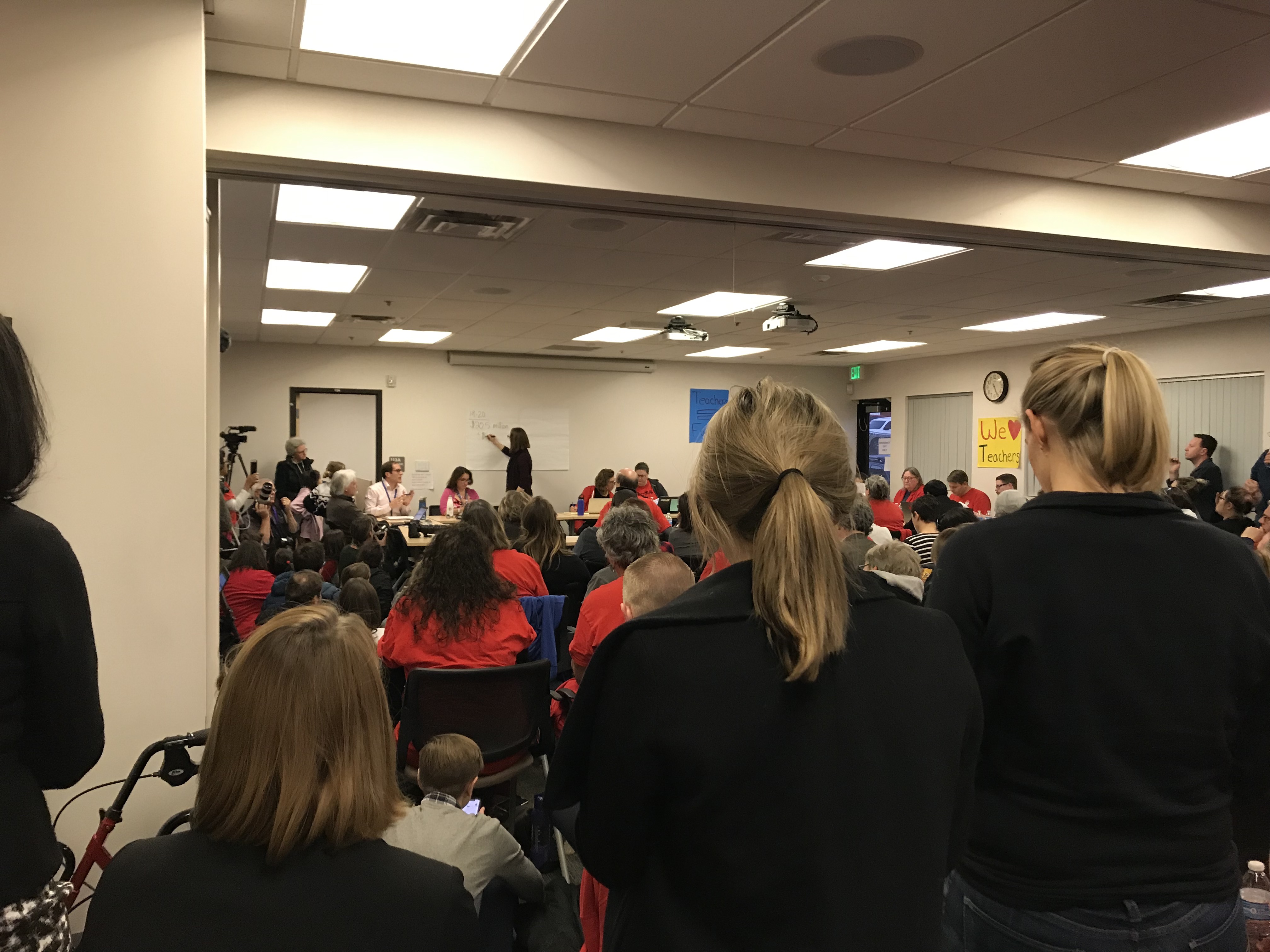
Was it theatrical that we gave up the tenth evening in as many weeknights to wait for our district to come to the table with an actual proposal rather than a cost-of-living increase already in the budget?

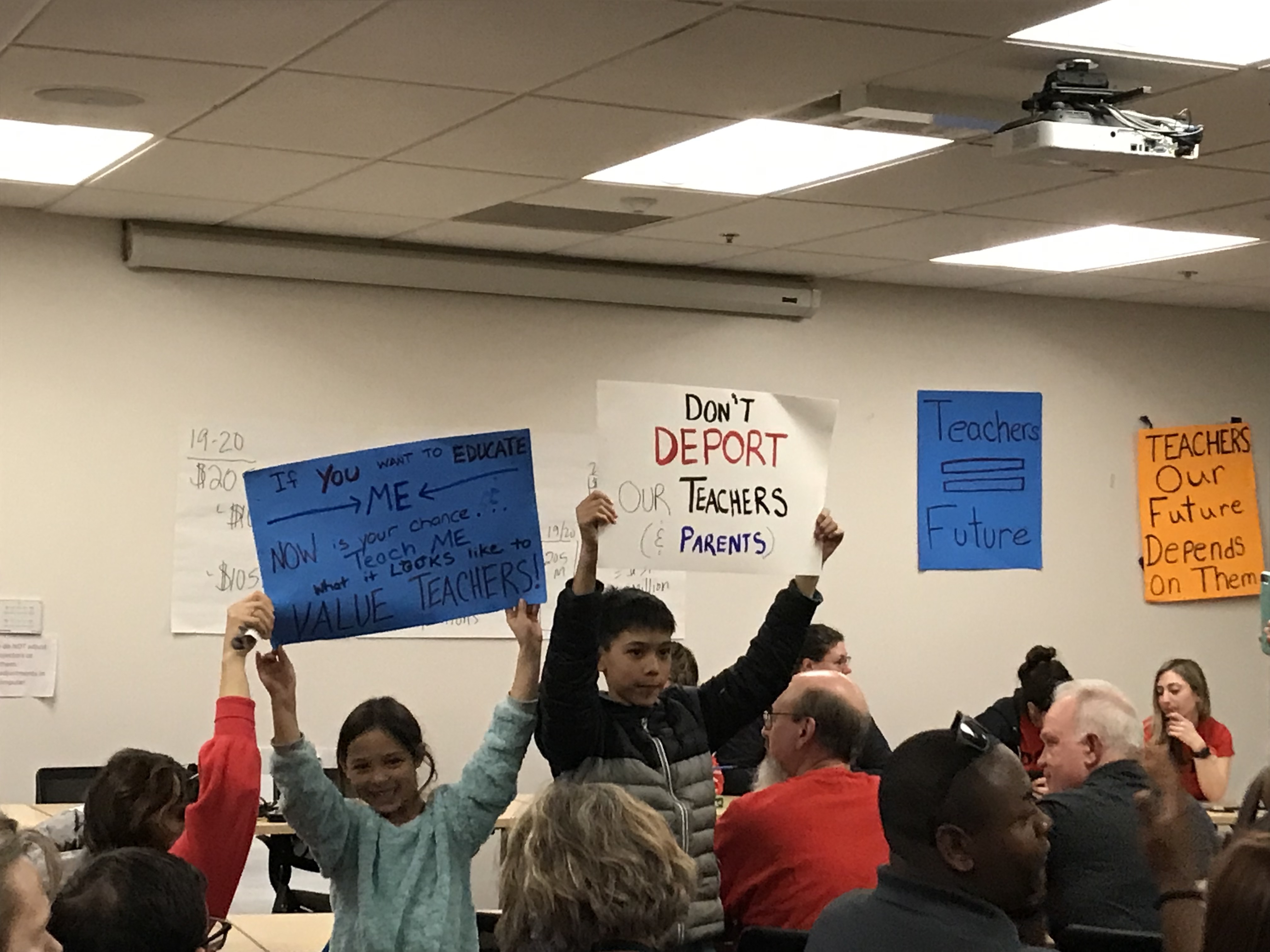
Was it theatrical that young children stood behind the fraudulent superintendent with signs begging her not to deport our teachers after the HR department more or less threatened their right to work?

Was it theatrical that we have negotiated for fifteen months, yes over “philosophy disagreements” because the PHILOSOPHY OF OUR DISTRICT IS TO SHUT DOWN PUBLIC SCHOOLS, TAKE OPPORTUNITIES AWAY FROM STUDENTS OF COLOR, AND GENTRIFY EVERYTHING FROM NEIGHBORHOODS TO CURRICULUM?

And. Just. Like. That.

All the hours. All the years. All the goddamn blood, sweat, and tears have been put on stage for the world to see, chart-paper and all, chants in the background, livelihoods on the line.

For political theater of the worst show you will ever wish you didn’t buy a ticket to see.

Oh, Susana (Cordova)

Oh, I came from no advancement
with my income on my sleeve
I’m g’wan to leave Denver
my true rate for to see
Oh, it rained all night the day I left
the district it was dry,
the burn so hot I froze to death
Susana, don’t you cry

Oh, Susana, oh don’t you cry for me
I’ve come from no advancement
with my income on my sleeve

I jumped aboard the income gap
And traveled down the schedule
The ‘lectric lie magnified
My college’s credential
The district bargaining went bust,
I really thought I’d die,
I shut my eyes to hold my breath,
Susana, don’t you cry

Oh, Susana, oh don’t you cry for me
I’ve come from no advancement
with my income on my sleeve

I had a dream the other night
When everything was still
I thought I saw Susana,
a-coming down the hill
The ProComp deal was in her cheek,
The tear was in her eye,
Says I am coming for you, meek,
Susana, don’t you cry

Oh, Susana, oh don’t you cry for me
I’ve come from no advancement
with my income on my sleeve

I soon will be without a check,
And then I’ll look all round,
And when I find Susana,
I’ll fall upon the ground,
But if I do not find her,
This bargaining will die,
And when it’s dead and buried,
Susana, don’t you cry.

Fifteen Reasons Why: We Deserve More, DPS

Denver Public Schools has filed a request for state intervention to prevent the teachers’ union from striking next week. In the 19-page file, Superintendent Susana Cordova and her school district legal team have laid out reasons A-O (fifteen reasons) why the state should intervene.

Fifteen reasons why we, the teachers, deserve to be paid a fair, living, predictable wage.

Fifteen reasons why schools are targeted as the saviors of society in the same moment that teachers are vilified by the press and the public.

Fifteen reasons why we need a strike: let’s draw national attention to our plight, to the plight of a society that devalues education and the teachers who work to change the world.

Below, I have copied and pasted the fifteen reasons with haikus that represent teachers like me who have dealt with every one in some form or fashion:

A. Loss of Instructional Time from Teachers on Strike:
six hours a day
with every kid, every need
(and six more at home)

B. Students with Special Needs:
making learning plans
for families who need voices,
for inclusive rights

C. English Language Learner Students:
try writing our wrongs
again: try righting our wrongs
to build fluency

D. Potential Denial of H1-B Visas:
immigrant teachers:
First Amendment denial
(freedom, too, revoked)

E. Students Enrolled in Affective-Needs/Autism Center Programs:
routine disruption
tears students from what they need:
teachers who love them

F. Students Receiving Mental Health Services:
so much more than school
SSPs save our students
(sometimes from themselves)

G. Students Receiving Medical Care Services:
our school nurse gives them:
medicine, patience, advice,
hope for the future

H. Students Dependent on Schools for Food and Nutrition:
every teacher here
has given to the food bank
(lunch is not enough)

I. Students Dependent on Schools for Shelter from the Elements:
the prison pipeline
could stop with these school buildings
and a teacher’s love

J. Gifted and Talented Students:
let them be leaders
led by those who see their light
(you guessed it–teachers)

K. Student-Athletes Seeking Scholarships:
cultural veto:
to remove a student’s chance
of avoiding loans

L. Students Taking Concurrent College Classes:
what teachers give them:
highly-educated guides
for college keenness

M. Financial Hardship on Families:
double-income trap
means no parent waits at home
(they need our service)

N. Absence of Childcare for Families:
after all, aren’t we
glorified babysitters
asking for too much?

O. Fewer Resources for New American Families:
I beg taxpayers:
come visit our newcomers
to grasp sacrifice

Fifteen reasons why we fight every day for our students’ needs. Our society’s needs.

Thank you, DPS, for laying out our reasons. For proving to our country how badly we need to strike. For creating a legal request to clarify how heavily we carry the weight of the world.

For showing us all how little we earn as we carry it.

A Few English Words

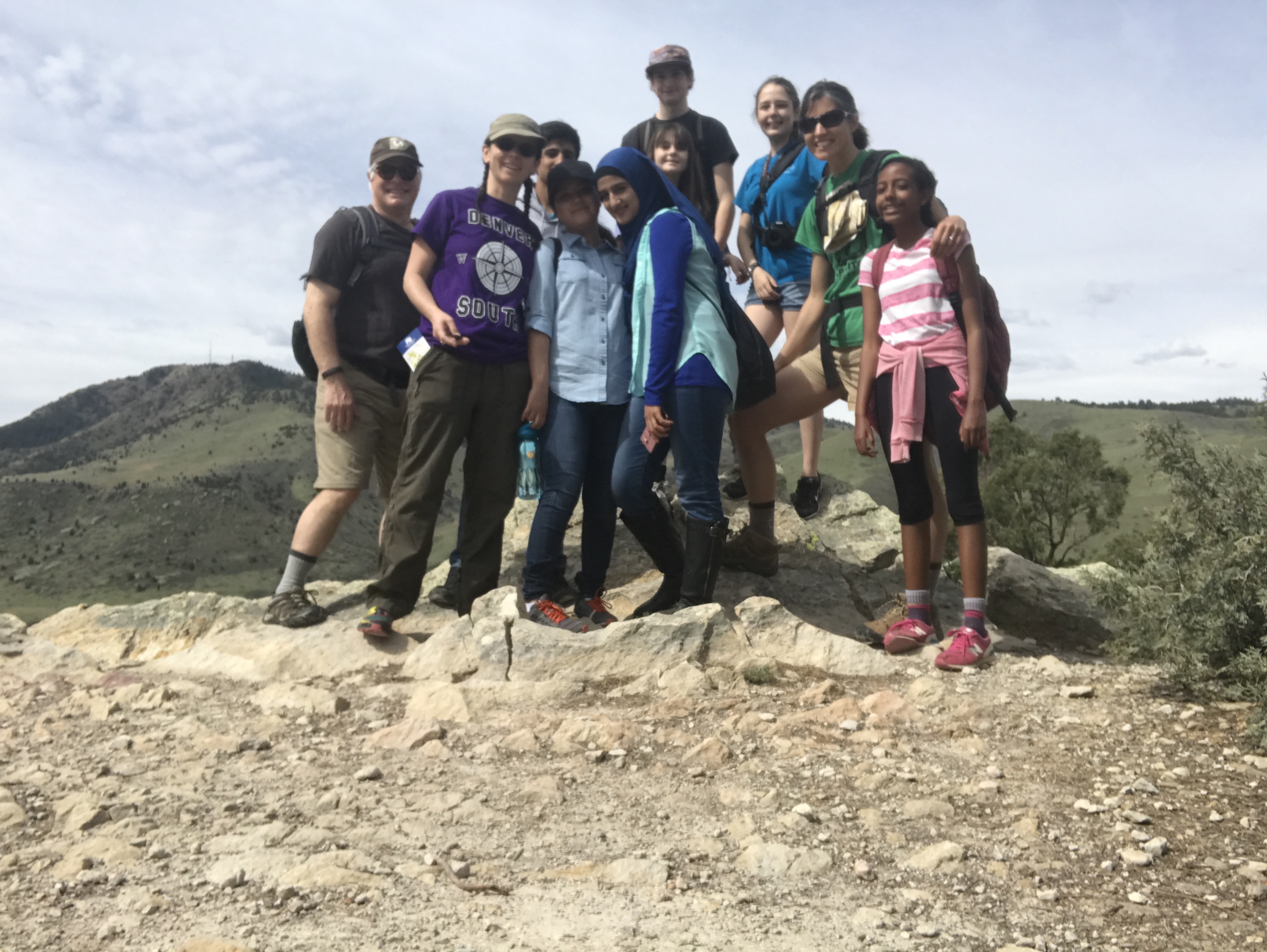
We took three Afghani students to the foothills today. They have been here for less than a year, so they learned a few English words today: Hike. Trail. Juniper. Ponderosa. Colorado=red rocks. View. 

I tried to ask what it was like for them back home, but they only knew a few English words to describe it: Danger. No school. Grandparents. Parents here in Colorado. All kids–brother, sister, other brother–in Afghanistan. 

Each time I asked if they wanted to continue down the trail or turn around, the most confident girl, the hijab girl, kept insisting we go on. She had no desire to go back to whatever life she had outside of that blue-sky hike, her knee-high boots and sweaty face no hindrance to her joy. She just wanted to walk. To escape. To be on that mountain.

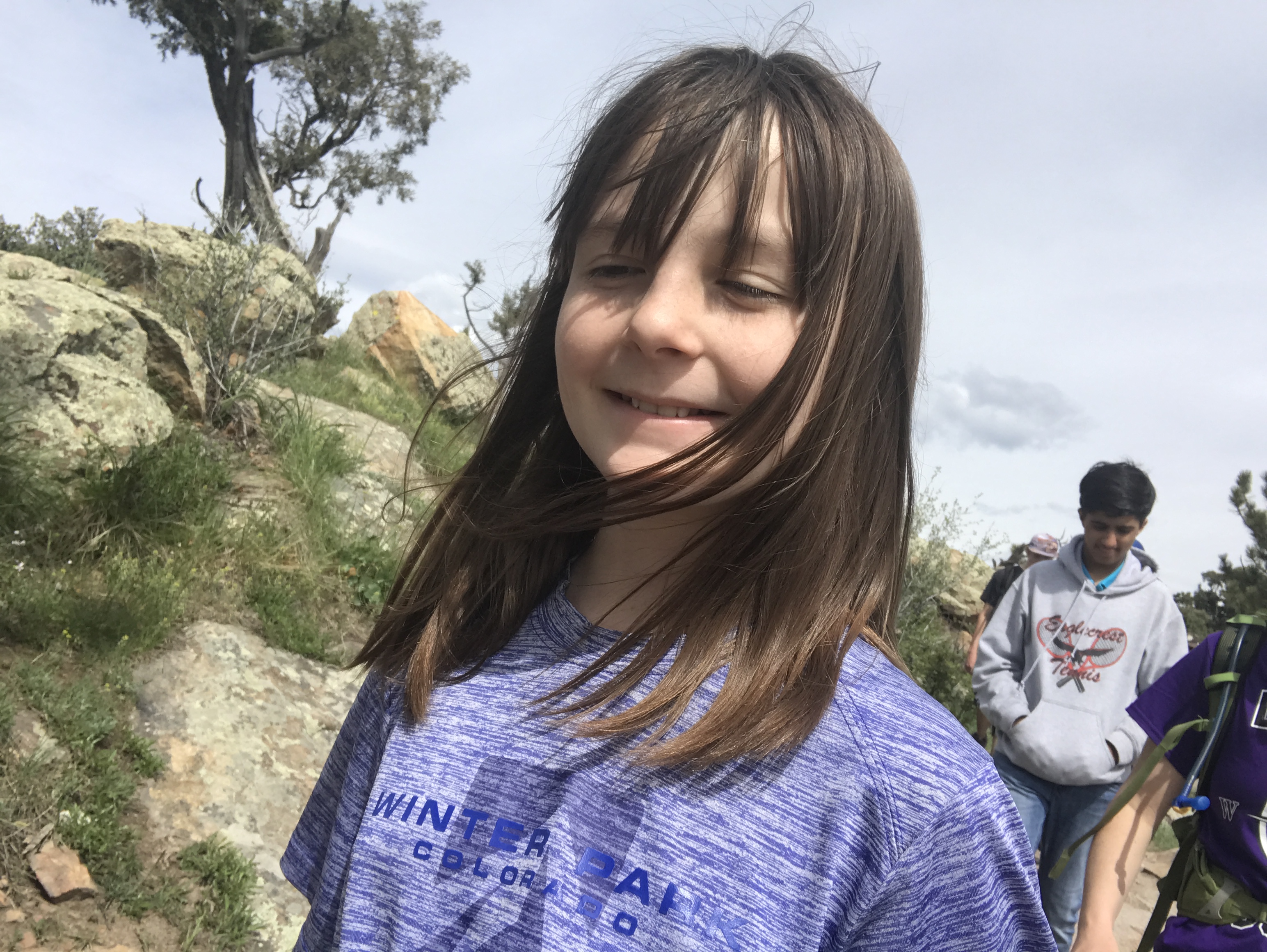
When we were at the top, she leaned in to take a selfie with me, and then one with my youngest daughter whose experiential-learning school had just visited the same location, whose quiet voice shared with us the details of the sedimentary rock layers, the lichen, the igneous and metamorphic. This was a perfect match–the low-English Afghani and my quiet youngest–smiling shyly for a photo, a perfect frame of world peace.

With a walk like this, we step towards empathy. Understanding. Gratitude. We know that things could be worse, that they are worse, for so many people in the world.

But it doesn’t stop me from feeling the pain, the loss that I feel now. For feeling gypped, for feeling like nothing I do, nothing my husband and I ever do, will be good enough to make our lives easier.

Perhaps it’s the curse of Spain. Six years ago, after welcoming two Spaniards into our home, after asking practically nothing for rent, after offering them my car for months when theirs broke down (I rode my bike to work 25 miles a day for three months), after hosting parties for their friends, babysitting their friends’ kids, driving them to South Dakota, after everything, we went to Spain and never heard from either of them again. In addition to the nightmare that that year in Spain was for us, with its broken promises, broken paychecks, and lost jobs, they had to twist the knife right into our backs by acting like they never knew us.

And now we’ve planned a redo. Twentieth wedding anniversary. Fortieth birthdays. Three years into living like kings for the first time in our marriage, with two steady, well-paying jobs, great benefits, and our dream house that we opened up to friends of ours, six of them, rent free for two months because they were down on their luck, and Spain has cursed us again. Our six-week vacation that is 90% bought and paid for, that I have spent over forty hours meticulously planning every last expenditure and activity, will be marred by a pending layoff, loss of benefits, and a mortgage we simply cannot afford on a teacher’s salary.

Let me tell you about that teacher’s salary. Let me tell you about the master’s degree plus thirty credits I have. Let me tell you about all the school events I attend, the lunch meetings, the hours before and after school I work, the summer workshops, the home visits, the dance chaperoning, the sporting events, the class coverage, the every last everything I do to work, to earn an extra buck, to make it. Let me tell you about the eight years we lived on a $48,000 frozen salary.

Let me tell you about my childhood. Parents with bachelors’ degrees in journalism working for a small town newspaper and barely making it. Powdered milk. Ten-year-old, rusted-out Datsun. Ancient house with windows so thin that ice collected on the glass. My mother scraping together a $20 bill for my eleventh birthday and me looking at it holding back silent tears because I already knew that it was equivalent to two and a half hours of her work, and my father was failing his master’s program, and we were moving to Denver for a better life, and everything was crashing down at once.

Let me tell you about contract work, the only kind of work Bruce was able to find when he left the Air Force. No guarantee. No health insurance. No paid time off. No holidays. No sick leave. And when it ends? No unemployment checks.

Let me tell you about health insurance. Let me tell you about the two children I have given birth to without having health insurance because it was a pre-existing condition, and the near $10,000 we paid for those births.

Let me find a few English words to explain to these students from Afghanistan: American Dream. Housing. Insurance. Education. SCAM.

Let me tell you about what we have done to avoid bankruptcy: No car payments. No student loans. No credit card debt. Two properties. Saving and spending. Buying a house only when we were ready, when we could afford it. Saving up for a cursed redo of Spain. Road trips staying with family and camping to save money while traveling. One computer for the whole family. Still driving my 1998 Hyundai Accent.

Let me tell you how I know what poverty is. I know what sacrifices are. I have made them.

Let me find a few English words to say: Fuck this country. Fuck this Trumpian tax cut that cuts workers while CEOs live like kings. Fuck this blue-sky day. Fuck my husband’s military sacrifice, his months in the desert, his sold-his-soul-to-boot-camp commitment, his veteran status that has given us NOTHING.

Let me be twenty years into my youthful marriage and not have to feel like I’m just twenty minutes in. Let me keep my dream house. Let him keep his union (that screwed him) dream job. Let my kids feel like there’s a future here for them and that with two degrees they won’t be buying powdered milk.

Just. Let me be. I’ve had enough.

FBQ: Friday. Be Qualitative.

“This is an FBQ conversation,” she begins. And her artistry, backed by data, emphasizes the urgency.

The urgency. It is mid-October, and I’ve seen my principal cry too many times in the course of twelve months.

The urgency of children who have escaped a war zone, who have traveled on three city buses to escape their neighborhood school, who have escaped poverty with our food bank, to be on the tips of our tongues as we sit in the come-down-to-Jesus choir room, AKA, staff meeting with bad news.

This isn’t the day after the election when our hijab-wearing girls were too fearful to take a bus to school, when our students of color were threatened by now-openly-racist citizens, when we were lost souls in a city school surrounded by bigotry.

This isn’t the almost-there rating of last year when we met in our usual fourth floor, everything’s-going-to-be-fine lunchroom location.

This is a Friday-the-thirteenth, tell-it-like-it-is, FBQ meeting. The urgent meeting.

We face ourselves and then each other. Is it you? Is it me? Is it them? Is it us?

We argue in the hallway after, fuck the contract hours on a Friday afternoon when we’re supposed to be at FAC. “You know those charter schools eliminate kids left and right. One infraction, gone. SPED? Gone. Detention for forgetting a pencil and you don’t show up? Gone. Charter schools in the poor neighborhoods? Don’t even try to argue, I looked at all the scores last night. RED.”

We are ourselves, wholly ourselves, and we promise to honor her FBQ request.

But this room will be on our minds for the weekend, for the week, for the rest of the year. This conversation, this seeking of solutions. This, what-did-we-do-wrong-this-time question that sits at the back of our minds every damn day when kids don’t show up, when kids say, “Fuck this class,” when kids come crying about their dying mothers, their far-from-home brothers, when kids wish nothing more than one percentage point higher than what they have earned.

“Can we turn the qualitative values of this school–I mean, look how many of you are wearing purple today–into something quantitative?”

FBQ: Family, Be Quiet.

I want to stand up and shout: You can’t measure this. You can’t quantitatively, statistically, mathematically, measure the amount of emotion that drips down her cheeks, that causes me to clench my fists and hold back my own tears, that makes us question the very effort and belief system we put in place with every moment of every lesson we work so hard to place before them.

You cannot measure, quantitatively, LOVE.

Family, Begin Questioning.

Start with:

1) Why do we vilify teachers?
2) Why do we blame students?
3) Why do we quantify humans?

I want to change her acronym. I want to change them all. To mesh the SLO with the CLO, to move LEAP into SIOP, to blend FAC with FBQ. I want to change colors from yellow to green to the beautiful blue sky that hovers over my beautiful school, with its red-yellow leaves just making that blue pop like a world you’ve yet to see.

It’s Friday.

Be Qualitative.

Because you can’t quantify love. And isn’t that what matters?