Views from the Road

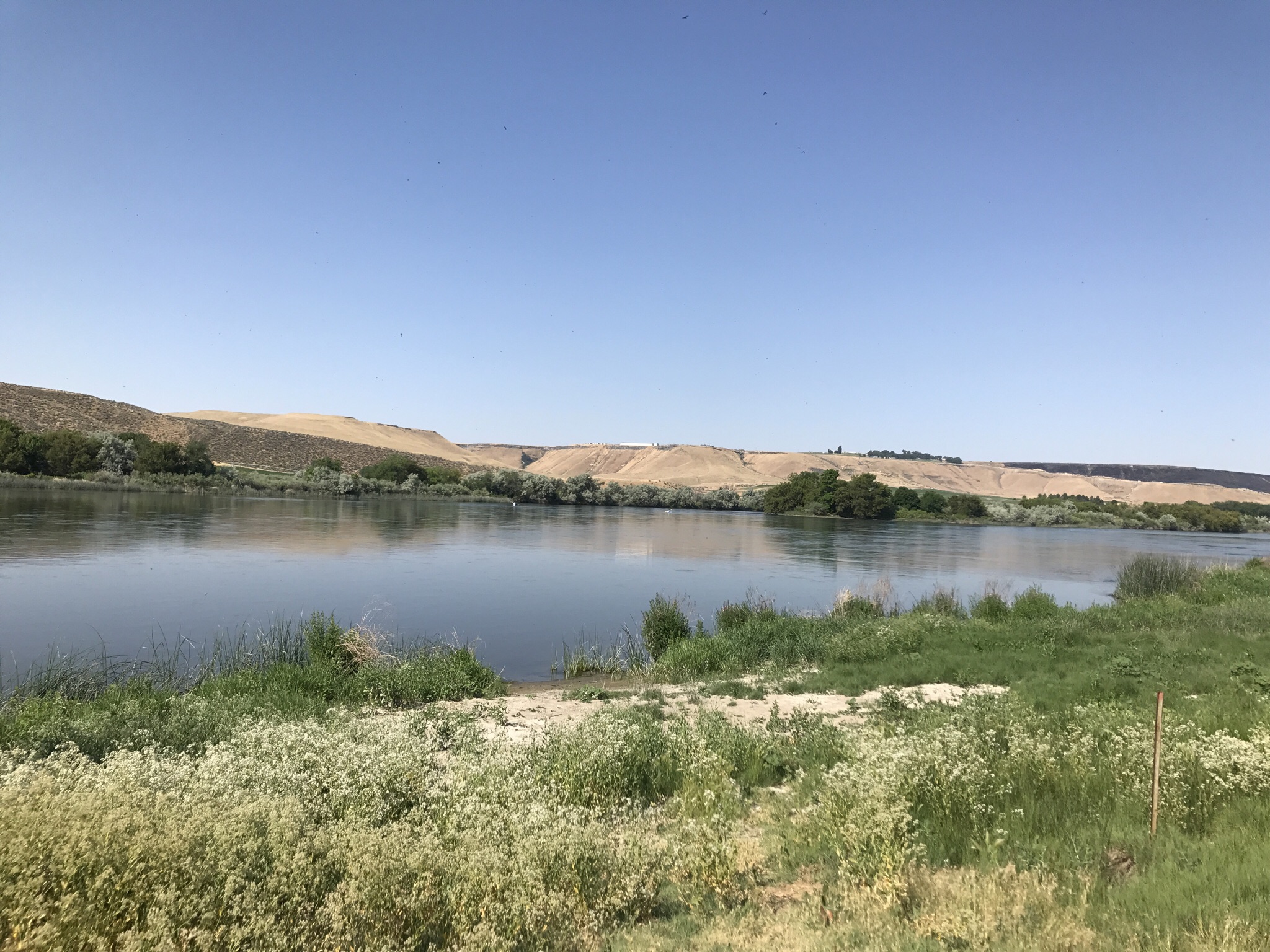
The beauty of the road is so much more than views. It is the elevation loss and gain that sneaks up on you as quickly as the road snakes its way along the Snake River.

It is the surprise of the desert that has made its rural-America mark in southeastern Oregon.

It is the spontaneity of stopping at state parks for a peek at history and scenery so breathtaking you feel you’ve stepped into a mini Grand Canyon.

It is the trail our ancestors walked upon that you place your weary soles on now, however twisted and stolen it may be. It is still a silent beauty resting behind a sleepy Americana town, waiting for rediscovery and firsthand learning for three young women.

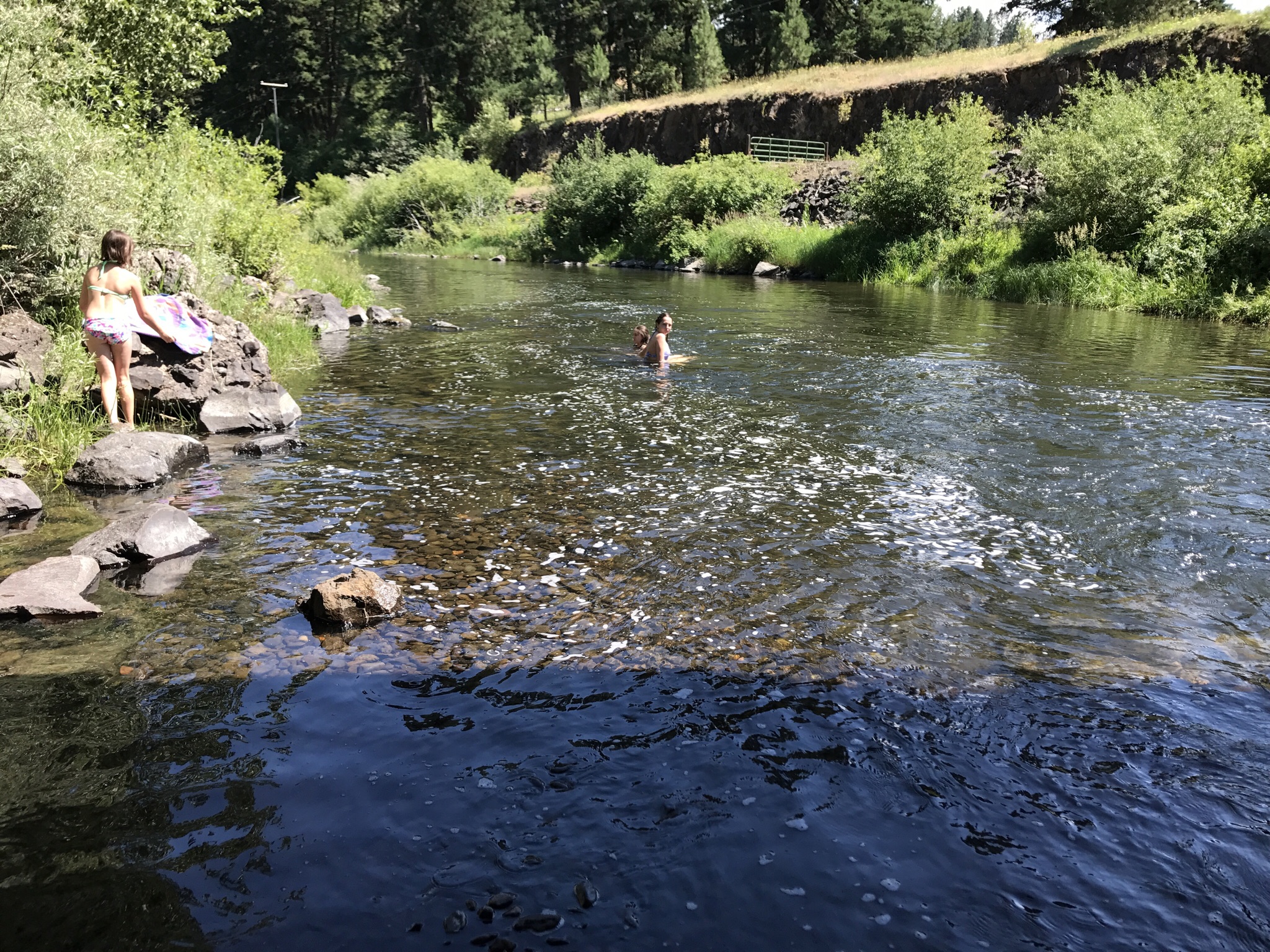
It is the creek sparkling in the hotter-than-expected northwestern sun, and the quick dip that makes an afternoon sparkle just as brightly.

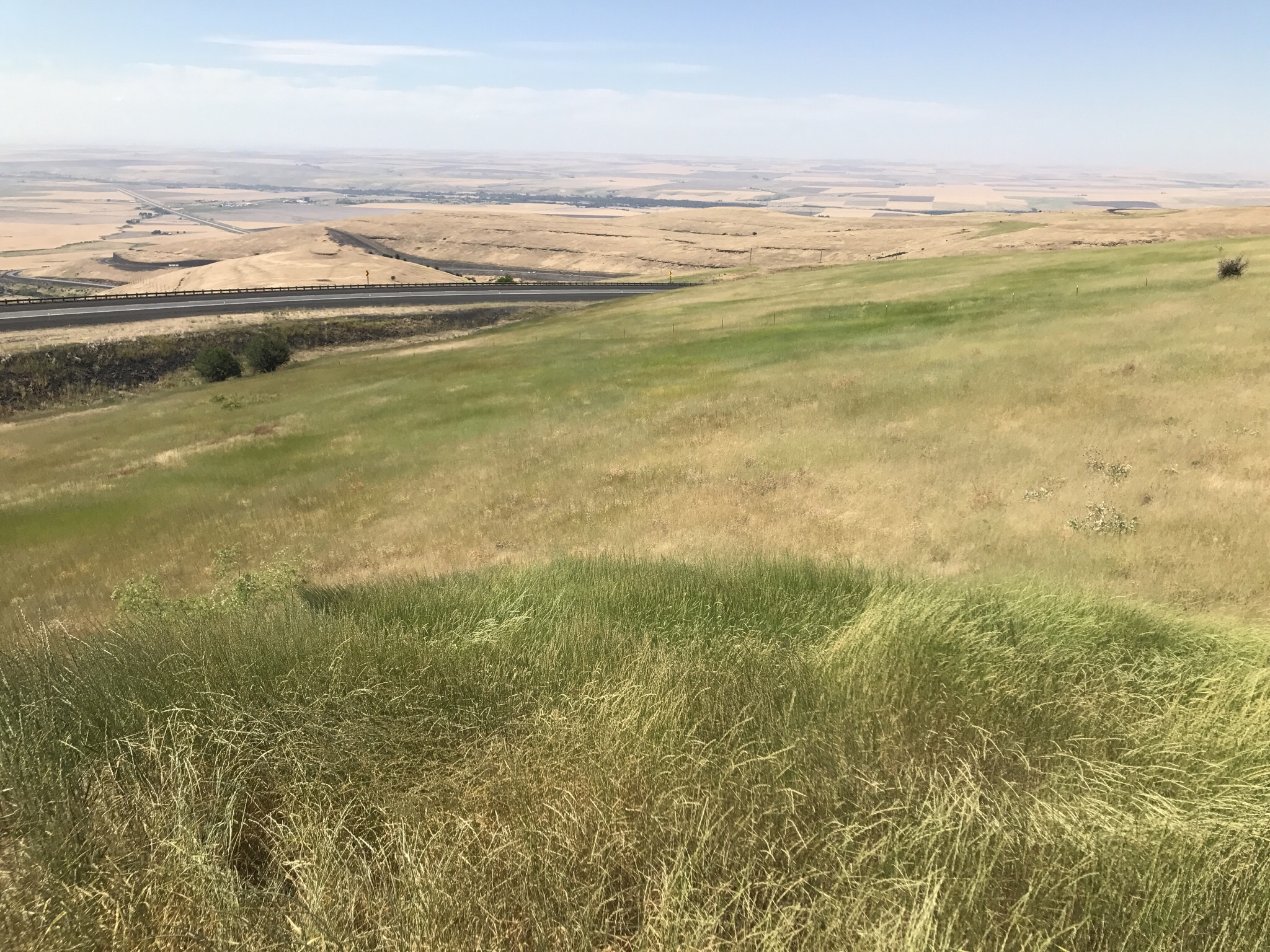
It is the curve that moves from summit to limitless landscapes, to the expansive end of the Oregon Trail, played out in a quilt of farm fields, and the hope they held for a better life.

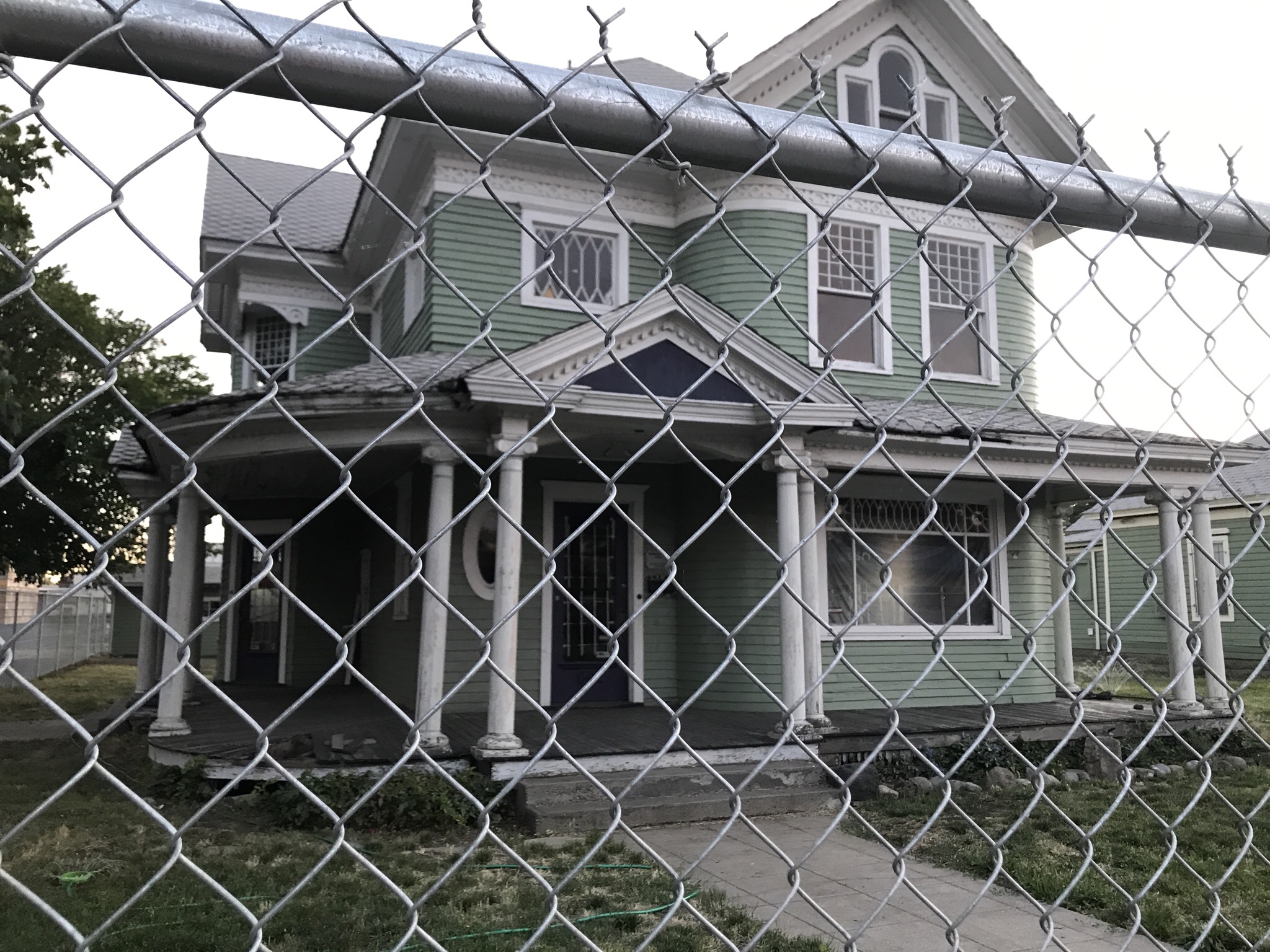
The road brings beauty, and within this beauty lies everything you’d expect and wouldn’t expect: children bickering, bits and pieces of trash and clothing piled up in the backseats, state lines that bear no stoppable signs, audiobooks and downloaded movies, snapshots taken from a moving vehicle, trucks that hog both lanes, treeless mountains and endless vineyards, poverty and wealth found behind fences and up on winery hilltops.

The road brings more than views of tall pines, sagebrush-only molehills, and sleepy rivers. It brings us all a new world view where we search for ourselves and find ourselves in each other. Where children find joy in only their siblings’ company, where the road promises a pool at the end of the day and a reality check about small city poverty to remind us of what we have.

Can you see it from an airplane, from a train ride, from a walk down the block?

Never quite like the views you’ll find when you hit the open road. The views of nature, of civilization… of yourself.

You just need one set of keys, a whole lot of gumption, and a pair of soul-searching eyes, and you can find yourself a whole new world view.

Coming Home to Hope

On a rainy October day when I was a child, my parents stopped in a small Massachusetts town on our way home from my uncle’s ski lodge in Vermont so that we could visit a Norman Rockwell exhibit. My mother had always loved growing up and looking at his realistic paintings on the covers of The Saturday Evening Post, and he had spent some time in the town where they were hosting the exhibit.

That weekend was one of the few where we were invited to pretend, via a fancy ski lodge in Vermont that boasted a sauna and private pond, that we were rich. We’d met our extended family there: aunts and uncles, cousins and grandparents. The kids all slept on mattresses in the loft, the adults took one of the four bedrooms, and my uncle took the owner’s apartment with a separate entrance at the bottom of the house. We’d play in the woods, race around the pond, braid our hair on the deck, and enjoy an array of delicious food that each family contributed to.

And then we’d drive home to our house in upstate New York, away from it all–the pond, the food, the family… the wealth.

But on that particular Columbus Day, after meandering through the Rockwell exhibit and google-eyeing all the paintings, my mother and father hemmed and hawed over one of their favorite prints: Homecoming. It sat in the gift shop at the end of the exhibit, covered in glass, matted, and lined with a simple silver frame. I don’t remember how much it cost; it may have been $20 or $100, but no matter the amount, it was too much. We didn’t have extra money for luxuries like this–art for the wall??–when we were driving a 10-year-old rusted out Datsun across three states for a weekend getaway provided by my rich uncle.

“What do you think?” my mother asked.

“It’s up to you,” my father responded.

And so the print was rung up, wrapped in brown paper, and carried across the shiny black parking lot through streaks of rain. My mother carefully stacked it atop our possessions at the back of the Datsun and we weaved our way through northeastern storms back home.

As soon as the painting appeared on the wall in our living room, I became obsessed with it. The details. So many faces!! How could he fit so many faces into such a small painting? The redheaded family with open arms, welcoming their WWII soldier home. The old brick tenement and naked trees filled with dirty children. The multi-sized shirts and shorts hanging from the line. The girl pressed against the corner wall, ready to surprise him. The gratitude in everyone’s eyes after the weary war years.

I used to try to count the people. 19? 22? 20? There were silhouettes hidden in the shadows of the apartment’s windows, and it was difficult to determine exactly how many there could be. Homecoming became an ongoing mystery: How did he paint this? How many people did he mean for there to be? How long was the boy at war?

My grandfather, a mostly silent and grumpy man, had survived that war. Was his reception like this one–so filled with emphatic joy that all would be forgotten?

I doubted it.

I saw everything in that painting. The desire. The poverty. The hope.

It hangs in my house now because my mother tired of it, earned more money, moved on to different art, and because she knew how much I loved it as a child.

I pass by it on my way out the door in the morning. Sometimes I play the game with my girls–how many people are in the painting? It witnesses all our guests, all our arguments, all the laughter and joy and chaos that are our lives.

And in these ominous days since the election, it bears witness to my hopelessness. I fold laundry and cook dinner while listening to The Nightingale by Kristin Hannah, one of the many books I have read about WWII. This one has yet another perspective–that of the takeover of France and the secret groups that defied the Nazis to try to stop the war. It focuses on women–women who had to host German soldiers in their family homes while their husbands were prisoners of war. Women who took risks to save the lives of fallen RAF British pilots. Women who had to wait in line for hours for food rations. Women who had to turn in their radios–their only communication with the outside world–and be prisoners in their own homes.

I think about, walk by, and examine Rockwell’s painting as I listen to Hannah’s words. As I remember that dreary day when we bought the print, knowing my parents’ meager salaries couldn’t really afford it. I imagine what it must have been like for my grandparents, living through the daily sacrifices that encompass a war.

I imagine what it might be like for us. As news floods in daily with human rights stripped away piece by piece, with constant comparisons to Nazi Germany, how can I avoid it?

How can I not put myself in that painting, arms open, ready to welcome home my long lost soldier?

Will there be a day in my lifetime that I am there, really there? Maybe one of the silhouettes in the back corner of the window, ready to finally come out?

Will there be an end to this madness that is only just beginning?

Will our country, our people, our democracy, ever have a homecoming?

I cannot answer these questions, just as I cannot accurately count the number of heads Rockwell painted. I can only guess. I can only imagine.

I can only hope that our homecoming is just around the corner, just like that redheaded girl, waiting for her savior to wrap his arms around her.

mj13_rockwellredheads_9450526_600dpi_nomast-copy

Weighing In

Wednesdays have turned into a ritual for Riona and I, as the older two get a ride home from the carpool and she has joined in with her expertise at helping me go grocery shopping (if expertise means begging me for Cheez-its, Naked juice, and blueberries…).

On this Wednesday, five days into Trumpocracy, the weight of it all is heavier than ever before. The two stores, the lines of people at guest services while I wait to buy bus passes, the shuffling of semi-broken carts, the weaving in and out of crammed-too-full aisles filled with Valentine’s candy and magazines and gift cards and everything, it seems, except the food I need to feed my family.

The knowledge that I carry with me now, of stripped healthcare, border wall building, claims of voter fraud, Muslim refugee bans, women’s healthcare denials, mortgage fees reinstated… It makes even the mundane tasks of finding the right brand of almond milk, of selecting a new variety of potatoes, of giving in to the Cheez-it bid, seem heavy and dark and worrisome.

How long will this variety of foods be here? I begin to wonder. How long will this variety of people be here? My darker self asks, as I hear a series of languages and see every skin tone meander through this shared space, this shared ritual of finding food.

At the second store, after I’ve sent Riona off on her own to fulfill half the list while I buy the bus passes, we count our items in the small cart to see if we can shimmy into the “About 15 Items” line behind four other groups. We stand behind them like a crooked tail as carts shuffle past, and slowly move forward to the monotonous beep of the register. As we pile our goods atop the belt, I’m proud of her ability to stick to the list. “Good, you got just the almond milk I like,” I smile down at her, and she grins back, “Of course, Mama. I’m not Daddy.”

A tall blond woman rings us up in a slow, methodical fashion. Riona, who has just finished checking off the last item on the iPhone grocery list, proudly clicks the phone shut and begs to put my credit card into the chip reader. “How does it work, exactly?” she asks excitedly, wholly unaware that my usual no has slipped into a dull yes because my mind is on all my Muslim students from all those countries on his list who will likely never see their extended families again (and not on who’s putting my card in the chip reader).

“Awww,” the cashier coos, “I wish I could be a kid again… although, I had a terrible childhood.”

I look up at her, the pale blue eyes, the straight blond hair, and the hint of an accent. She knows she has my attention now, though of course a line of people still waits impatiently in this express lane, wanting to check out, to go home, to pop open a beer and drink this day away.

“Have you ever heard of the Bosnian genocide?” she asks, and my mind flashes back to my first year of teaching when I had a student whose letter of introduction to me was, when I asked about his childhood, “Only an American would ask about that. Because my childhood was shit. My childhood was war.”

“Yes… I have had students who were from Bosnia,” I reply to the cashier.

“Oh, where do you teach?” she asks excitedly.

“South High School.”

“My sister went there!”

I’m reminded again of how connected our humanity is. She hands me my receipt, I tell her what a great school it is, and I grab the hand of my ten-year-old, whose childhood still lights up by the sushi we always share (unbeknownst to her sisters) before we drive home. Whose childhood is road trips and living in Europe for a year and grandparents who are right down the road and two loving, living parents.

We make our way across the parking lot, and she rams the cart into the speed bump. The eggs tumble to the ground and she frantically looks up at me, ready for the annoyance that would normally be present on my lips.

But I am crying because I don’t care about the damn eggs. I care about the millions of refugees, just like that girl in the grocery store, who won’t be coming here. About the thousands who have come. And the thousands who have been left behind. About the impotence I feel, the numbness that creeps into the corners of my days, as I face this new regime.

“What is it, Mama?” she asks, taking my hand again. I tell her what the girl said about the Bosnian genocide. About the papers Trump is ready to sign. About my first-year-of-teaching student.

We open our crunchy California roll and I put all the wasabi on one piece. She smiles, holding up the bottle of water for me, wanting me to douse it out. “Not this time,” I say, “I want to feel all that fire in my mouth.”

I want to feel something. To feel like I can go to the grocery store without crying. To feel like we live in a place where everyone is welcome, everyone is loved, and everyone is free. Where everyone has the chance to have a happy childhood.

Halfway home, she asks, “Can I have the last piece?”

“Of course.”

She pops it into her mouth and squirms in her seat. “Don’t worry, Mama, I’ll throw the package away before the sisters find out.” She hops out of the car and dances across the lawn towards the outside trash can. “It’ll be OUR secret.”

As usual, she is as happy as a clam. She doesn’t carry the weight of the media, the weight of the presidential pen, the weight of a genocide, as she goes through her days.

She has the gift of a happy childhood. And for now, that is the only weight I want her carry.

“We’ll never tell,” I smile back, the spicy wasabi still sticking to my tastebuds. I can feel the fire in my mouth. And for this moment, at least, I am only thinking about how happy she is.

About how glad I am to have my girls, my home, my school that is a safe haven for all the refugees, for the grocery store filled with a microcosm of the world where a refugee now works, and all the food our family will need.

Because it is something. It is enough. Enough for today.

Running Rabid

since the election,
 somehow my days have become
 a cataclysmic mix of mundane chores
 and tearing my hair out over
 what we’ve done to our democracy
 
 it’s the gut wrenching choice
 Travis must make as Riona and I
 grapple with Old Yeller-
 do I shoot my best friend
 or suffer the same fate?
 
 only—
 our fate is sealed, well after
 the roan bull has staggered onto our property… and Yeller?
 his last howl hovers over
 a hydrophobic nation
 
 God save us all.


American Doomsday

when i took this pic
 i didn’t know the sunset
 would be our sundown


And Then I Remember

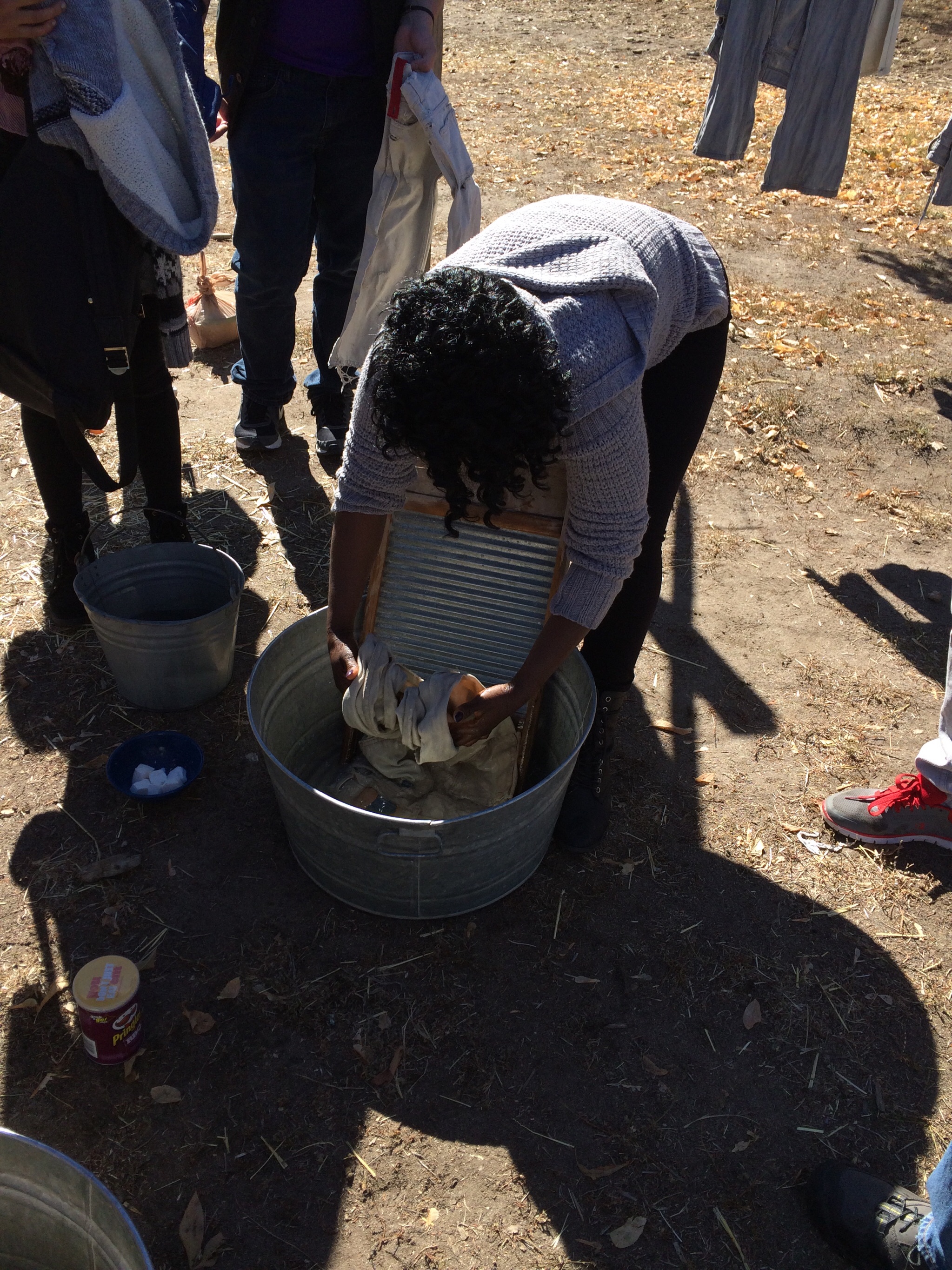
 This. This is why I teach. For three years she’s been in my class. She has gotten married. Had a baby. But she still can’t decode words. She still struggles with basic sentences. I know she has more going on in her mind than Bambara and Mali and motherhood, but I haven’t found a way to reach this girl. I haven’t been able to communicate with her in a way to help her understand. But “reliving” 1880s farm chores today, she said, “I got this. We do this in my country.” And today, today, today, she was the best at something. This. This is #whyiteach


Lost and Found

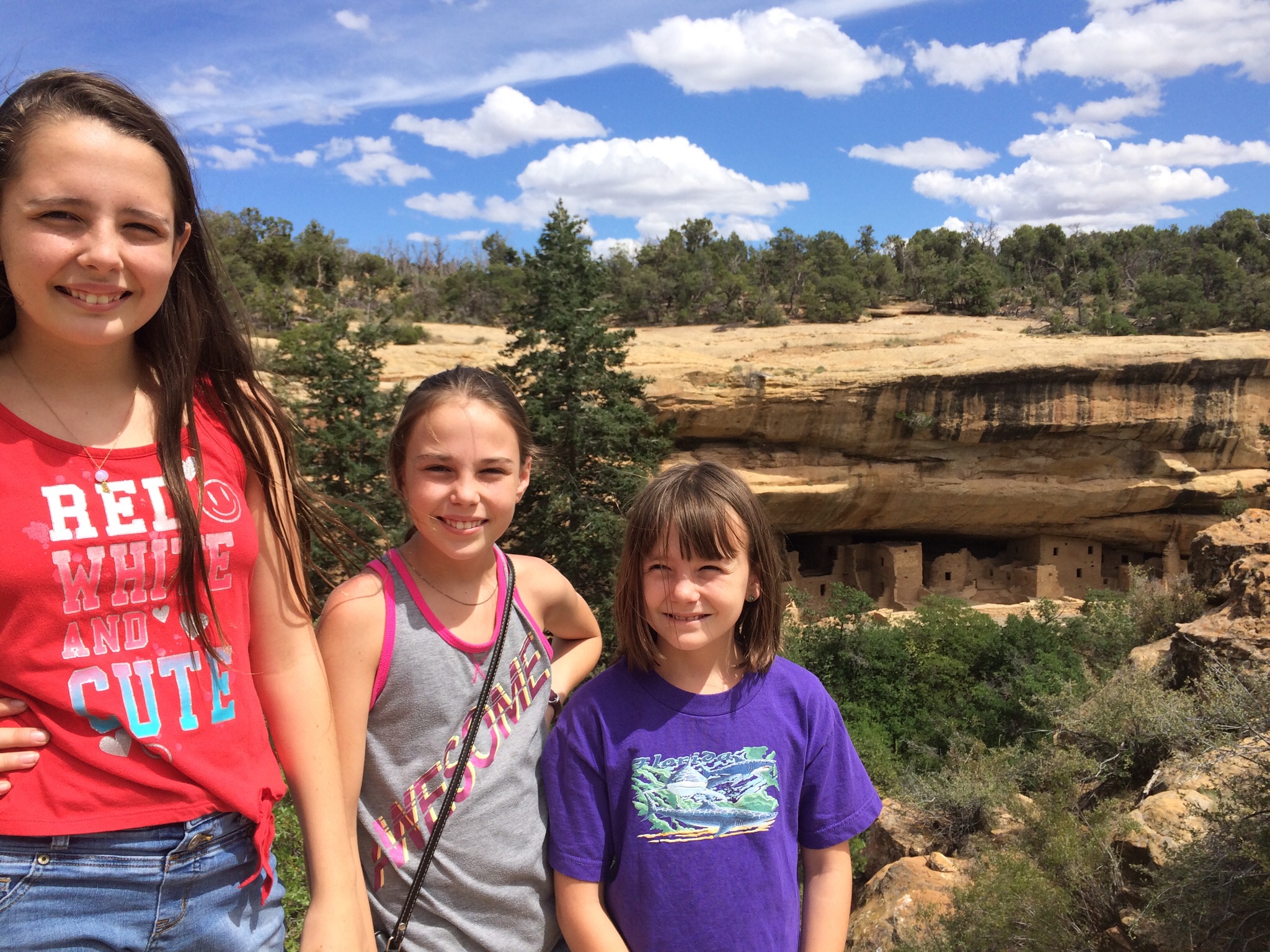
you couldn’t steal this:
 ancient homes, history learned,
 survivors by cliff
 

 or these sweet faces
 of my three girls, unafraid
 to face your world
 

 no, you can’t take that;
 my identity’s in words
 found here. not with you.
 

Day Fourteen, Road Trip 2016

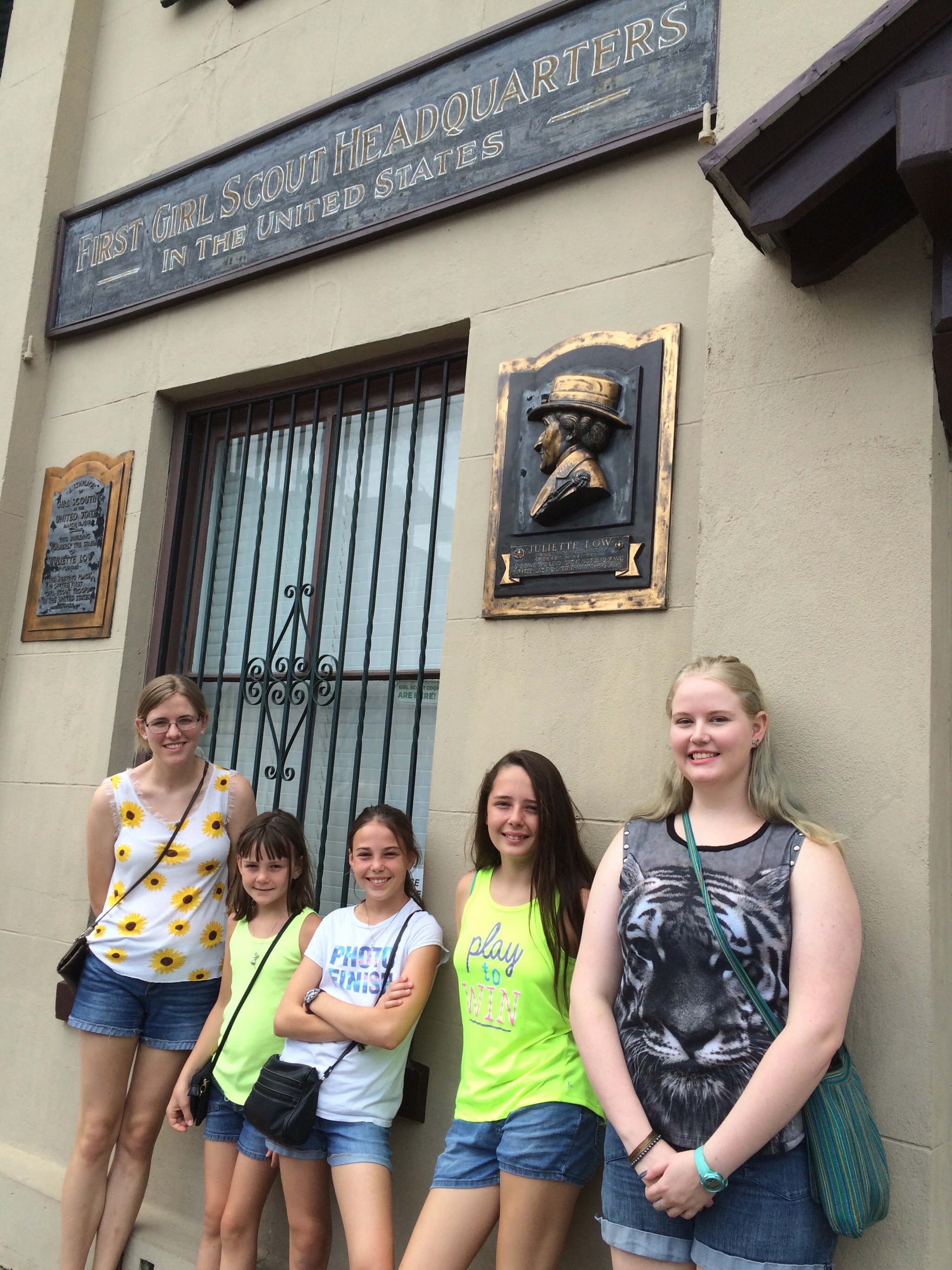
Girl Scout Headquarters
 mixed with colonial wealth
 (built on the slaves’ backs)


sometimes beauty’s marred
 history’s hard to swallow
 amid perfect squares


yet we walk through it
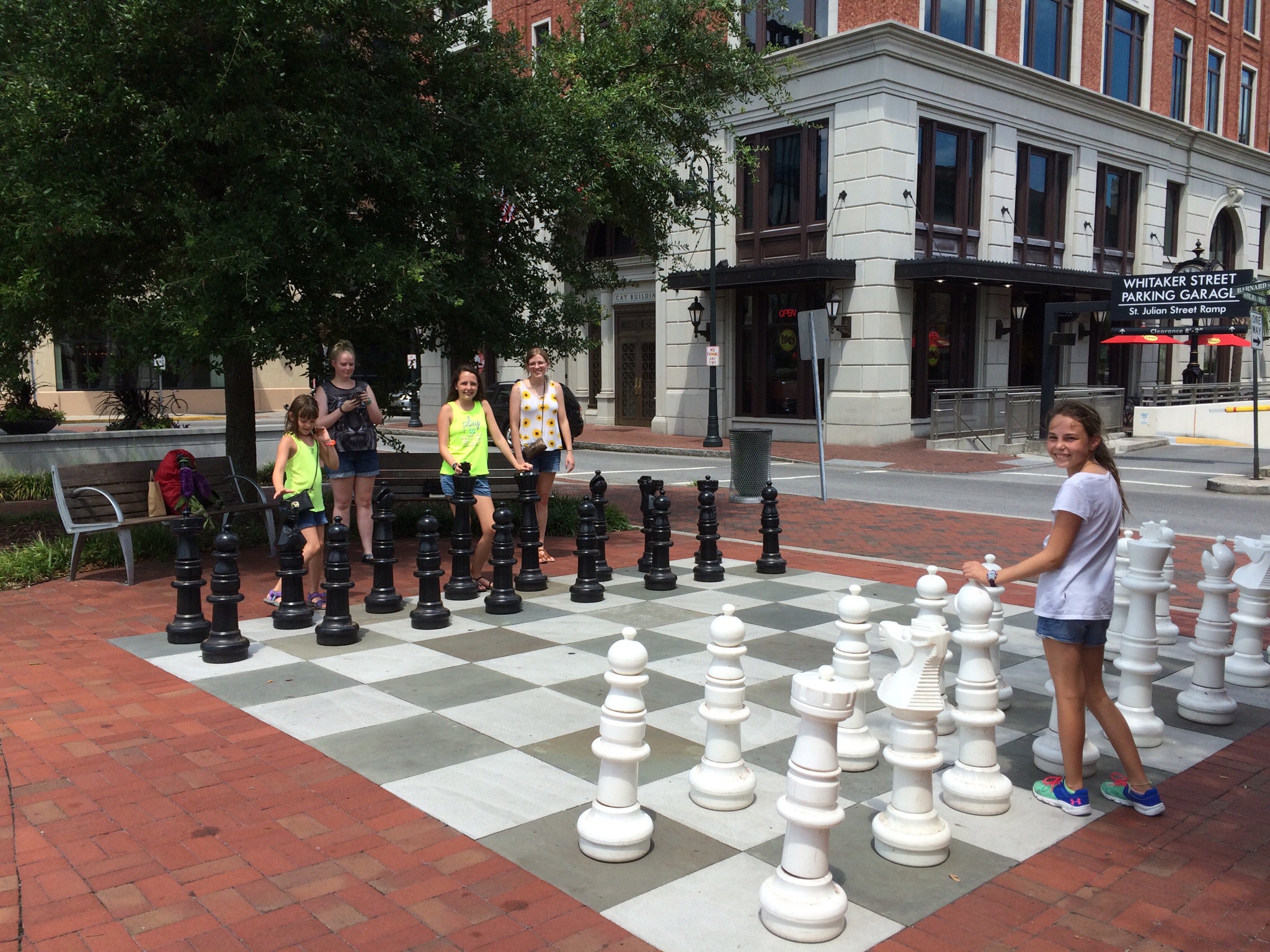
 splashing, playing giant chess,
 our steps going on


pieces of our past
 even when they’re earned with blood
 mark a clear future:
 
 we can absorb this,
 take pics, eat gator, and grin,
 hoping we’ve moved on
 
 (though the shadows know
 of King Cotton, oppressed girls,
 Sherman’s burning march)


we can’t have it all
 the vacation, family… peace
 without the whole truth


we can just love them
 hope they never see the dark
 (only the beauty)
 

Behind the Curtain

We drive across the city and knock on doors, purple head to toe, hands full of purple pens and folders, t-shirts, and backpacks. Salespeople for the newcomers.

But we are not sales associates. We are teachers spending time on these hot June days sitting in traffic, making phone calls, driving from witnessing a midday drug bust (line of cops, tow truck, handcuffs and all), to a mansion in Cherry Hills that overlooks a forested bike path.

You can see in one day, in one drive, in one singular city, the rainbow of humanity. Rundown yards and barking dogs. Old Victorians in disrepair with living rooms that function as bedrooms, only a thin curtain separating them from the parlor. Perfect little ranches in questionably safe neighborhoods, slicked down and swept up for our visit. Fathers chain smoking and playing violent video games in a government-run housing project, shouting at us out the window before coming to the door, “What do you want?” and then letting us in anyway, telling us the struggles of how to afford a bus pass, a camera for the photography class for his daughter, of being an autistic para who was just attacked by his student last week (proud to show the bruise below his eye) as we sit in the dark room with shabby furniture and not a single painting on the wall.

“Can we get a livable wage for people who are taking care of the hardest kids?” my colleague says to me as we drive away.

And Muslims. Our last visit on this Friday afternoon. Another housing project steps from the violence that hovers outside. We walk three floors up and timidly knock on the door.

One of my students answers (her brother will be attending the school this fall–the reason for our visit), and I barely recognize her without her headscarf. We enter the tiny apartment where an Asian romance is playing on TV with Spanish subtitles, where her mother sits on the floor of the kitchen with bits of meat and spices and vegetables surrounding her in various arrays of order as she prepares the evening meal, the kitchen with no counter to speak of and no table.

We settle into the two sofas and ask about the brother while the youngest boy sneaks his grin around the corner. My student rushes into the other room and emerges with her scarf on, then asks us if we’d like a drink.

“Oh no, of course not, we’ll just be here a minute.”

“No. You will have a drink.” She disappears into the kitchen for fifteen minutes and we hear water boiling, popcorn popping. In bewilderment we look at the cheesy program on the TV and wonder where the remote is, worried that they will spend the entire summer watching Spanish-only TV and not learn any English.

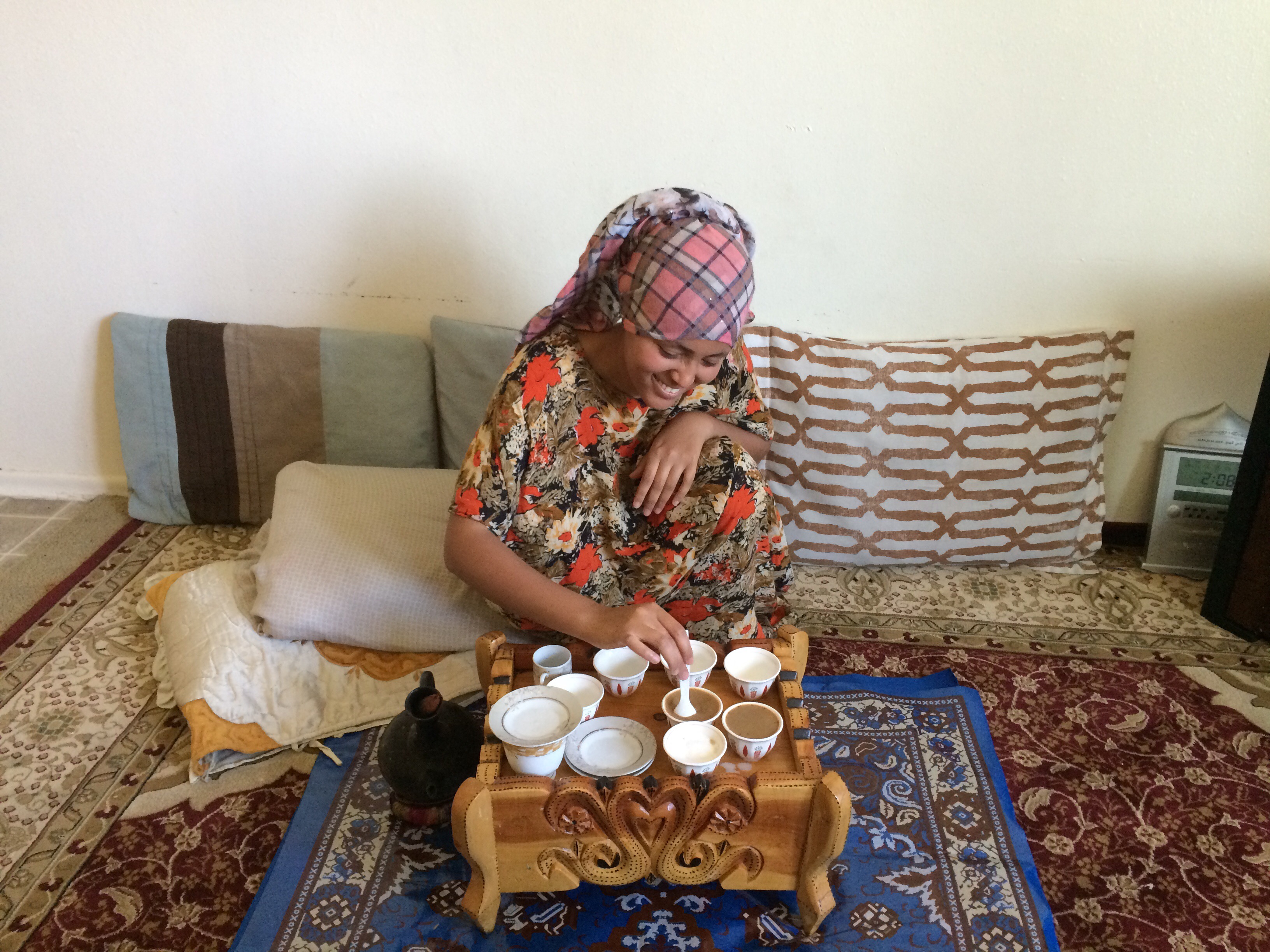
The baby brother dives behind the sofa for the remote when we express our concern. We flip through and realize only one channel is in Spanish. Relieved, my girl comes in with an ornate wooden tray and perfectly polished porcelain coffee set. She pulls a pillow from the line of pillows along the wall and settles in to prepare the Ethiopian coffee. First she lays down a plastic mat, then pours in way too much sugar, adds milk and uses the brown clay pitcher to pour the espresso into the tiny cups which she places before us on the circular coffee table.

Finally her brother comes home and we pepper him with questions about high school, many of which he doesn’t quite understand. We use our break-down-the-language skills to get our point across, and my girl insists we have another cup of the glorious, smooth, sweet liquid. The heat rises up out of the air and blows in the window and the coffee is as hot as all of Africa, and better than any cup I’ve ever tasted (and I don’t drink coffee).

And this is the only house we’ve been to with a Muslim family. And this is the only house we’ve been to with this kind of reception.

They don’t even have a table. They came to this country with nothing but the shirts on their backs and probably this coffee set. They barely know us. And they treat us as honored guests.

And you can’t see this or be a part of this, in this post or in the heat of that thirty minutes, without opening your mind a little. Just pull back the curtain of your hatred, of your bigotry. Tip the tiny cup into your open lips. Swirl the creamy mixture of milk and sugar and bottomed-out coffee grains and look at that grin on her face.

You will find yourself here. You will find yourself there. In the sweet taste on your tongue, the bright hope in her eyes, the kindness that only comes from love.

Just pull back the curtain. You will see a whole new world, one without hate.

Because I Am a Woman

I am so angry today because I am a woman and a mother of three daughters. I am so angry today because my mother, one of seven, six of them girls, was the only one in her family to finish college and then earn a master’s degree, and she did so by defying her mother who wrote an anti-education letter to the university to deter her from making that choice (for which my mother won a feminism scholarship). In 1972.

I am so angry today because I work so hard to be tolerant. The world is filled with every walk of humanity, and they all have rights to carry out their beliefs, whether they be nationalistic, religious, or cultural. But. When those beliefs expect and demand oppression, I am no longer a bleeding heart feminist liberal.

I am just angry.

More than thirty years ago, Audre Lorde wrote the most perfect essay I’ve ever read, “There Is No Hierarchy of Oppression”, in which she eloquently describes my angst: “…among those of us who share the goals of liberation and a workable future for our children, there can be no hierarchies of oppression. I believe that sexism … and heterosexism … both arise from the same source as racism–a belief in the inherent superiority of one ______ over all others and thereby its right to dominance” (1).

I am angry because the police were called. Because Child Protective Services were called. Because they spent less than one afternoon questioning her and her family and brought her back home. She spent today not at school but cooking the meal for her engagement party, henna ceremony, and impending wedding. At age fourteen.

I am angry because it is 2016. Because she lost her mother two months ago. Because her family came here for a future that her father is now denying her. Because we have come too far in this trek for feminism to be taking giant leaps back and putting our girls in a situation of entrapment.

I am angry because my government does nothing to protect children. To protect women. Because an online threat of suicide isn’t enough to PULL. THE. CHILD. AWAY. FROM. HOME.

I am angry because she is me. She is you. She is all of us. She is the caged bird Maya Angelou describes, stalking back and forth in rage. She is the religious martyr who couldn’t stay in Burma because she wasn’t Buddhist. She is the daughter and sister and friend and STUDENT who you wish you had in your life.

I am angry because I am a woman. Because I am a human. Because I am free, and she is not. She is oppressed by sexism, religious zeal, and cultural tradition. And whether you believe in God or support your culture or want to fight for traditional gender roles, none of these things give you the right to oppress another human being.

I am angry because there is no hierarchy of oppression. And when one of us is oppressed, we are all oppressed.

I am so angry today. And I will still be angry tomorrow. And the next day. And every day forever after, as long as I am a witness to oppression.

Because I am a woman. Because I am a human. Because this needs to stop.

Help me. Help me make it stop.