After a Year in Spain…

My teeth will be coffee stained. There is no remorse for this, no trip to the dentist, one of the few medical services wholly uncovered, whose riches I see once a week in the mid-city mansion where I tutor three students and transverse to the third story of their home.

I’ll be fluent. Mostly anyway, enough to pick up on street conversations, meal requests, payment inquiries, everything related to school. Everything that I will need to know.

I will wake up each day and be ever so grateful for the socialistic society that provides us with a computer, texts, projectors, document cameras, copies, and everything else we could possibly need to function as educators.

I will only be me, the person you know so well, just slightly different. I might confuse this store for the microcosm of Spanish society, or forget that everything’s open relentlessly, or remember that I can hop in a car and drive across the country on a whim and a prayer.

Yes, a whim and a prayer… the same two words that carried my family 5000 miles, penniless and filled with hope, to become the people we would be after a year in Spain.

Home

It’s been six weeks. They’ve had some bitter arguments, teary-eyed, face-slapping, pinching arguments. They’ve fought over toys, bread, milk. They’ve had fleeting comments about one place, friend, family member, or taste that they miss from back home.

But they have not once said, “I wish we didn’t come.”

Instead they have filled their time with: week one–decorating their rooms with paper torn from one of the notebooks we brought, colored pencils from Wal-mart, drawing pictures of flowers, pretty little girls, rainbows, and taping them up all over the white walls. Week two–preparing for school and getting their feet ready to walk miles in a day, gushing about the beauty of the harbor, trying out different kinds of foods, commenting on all the similarities and differences between this country and theirs. Week three–adjusting to school, crying a bit, laughing a bit, bragging over short hours, casual clothes, a variety of subjects that they’ve never experienced before. Week four–perfecting their hideouts in the park, being chased after by boys and girls, loving the festival’s parade, carnival, and ginormous cotton candies. Week five–wanting only uniforms to conform, they asked for nothing else, not more money, a desire to own a car, be free, to speak better Spanish. Week six–curling in their rooms with books in the iPad, playing games with Zoobles and the cars they spent six euros on today, blowing bubbles and living in a world that is completely different from home, a world in which they are completely at home.

How I love my girls. How amazing they are, to come here, to do this with me, and never for one moment think this is not where we should be. They are my strength, my dream, my hope for wherever we go in this life.

Beautiful Little Boxes

I have a schedule posted on the board in the English department’s office. It pretty much lists the twelve classes I will attend each week, all different levels of students ranging from ages 12-18, with correlating levels of English (seventh graders being the lowest level, twelfth graders the highest). However, since Spain has a different way of labeling students and grades, I haven’t quite memorized the various levels, nor knew, during my first week, what ages I would encounter until I entered the classrooms and asked students how old they were.

On my schedule in the English department are beautiful little boxes where the teachers can write the topic of the day. Beneath my schedule is a plastic funda, (I don’t know this word in English), where teachers can put photocopies of activities or, in most cases, of the textbooks that they make the poor students purchase, that we will be discussing that day.

This is how it should work: the day before the lesson, my beautiful little boxes should be filled with notes, copies should be underneath in the funda, and I can enter each of my twelve different subjects prepared to teach.

But let me review the teachers’ day in Spain. Yesterday I think it was 98 degrees (haven’t quite learned Centigrade yet, but I’m guessing over 40). Please note: no air conditioning. Students remain in the same room, together, all day, waiting for various teachers to filter in from all over the building, a pile of books and chalk in hand. Each teacher has at least three preps, usually five, and the schedule for all varies from day to day. There is not one moment of consistency. You cannot expect to go in and teach level one English during period two, five days a week. It will be three times a week, and the time changes depending on the day. Hopefully you can appear in the correct classroom at the correct time with the correct materials. So far, I have not succeeded in doing so.

I have not a qualm in the world then, when I return home and tell Bruce about my day, and he replies with, They are taking advantage of you because you showed them that you’re too good in the beginning, and I shoot back with, You have no idea what it’s like for them.

Today I had a plan for one of three classes, as one teacher put her copies in the funda and wrote her topic in my beautiful little box. I attended the bilingual meeting, where I was again reminded that I do not speak nor understand Spanish, other than when the music teacher (my new favorite person) spoke in a clear, slow, perfectly-understandable accent. I heard bits and pieces of conversations, and one somewhat heated debate involving menus, prices, and places to eat, having to do with, perhaps, everyone getting together on November 9? My goal for the end of the year: to know what happens during these weekly meetings!

I attended the first, prepared-for class. The teacher wanted me to run the entire show, beginning to end, and I felt confident that I at last understood my job. I am the only one who speaks English with perfect authority, and I only have these students once per week. They need to hear the native speaker. No matter what it is I have to say. But more importantly, the teachers? God do they need a break!!! We learned about multiculturalism in Britain after a brief lecture by me (while the teacher ran an errand) about the letters being the same in the words SILENT and LISTEN… high schoolers… ugh…

Moving on to the next class, I appeared on time, before the teacher, of course. She came in and saw the math scribbles on the board and asked me if I needed chalk, holding up the two tiny stubs of chalk that remained below the chalkboard. (Might I remind everyone that there are no overhead projectors, not even the transparency type??) Sure… I replied… what might we be doing today? (She hadn’t filled my beautiful little box, so I hadn’t the slightest idea, though I was immediately relieved to see a group of middle-school-aged kids, my home). All About Britain, she replied, and when I asked if they’d already started to read the book, she didn’t understand me. We switched to Spanish, but let me tell you. I may have trouble understanding Spanish, but at least I don’t claim to be a Spanish teacher, God forbid!

Luckily for me, this appeared the be the same lesson that was minutes-before thrust on me on Monday with a different teacher, so I perfected it quite nicely today, thank you very much! (I decided to omit his absurd terminating requirement of having one student at a time read aloud a sentence in English and translate, for the whole class, the Spanish equivalent… translation truly just doesn’t work most of the time). The teacher today? She sat in the back of the room fanning herself and not saying a word. Total trust after less than a week? I’ll take it.

On to lesson three, where I received the most beautiful gift of all time. First, there’s a fifteen-minute break for everyone in the school before the last period of the day! Second, I’d made questions for this particular text one day while sitting on the beach, and had printed them for the teacher, who, surprise surprise, never had time to make copies. I guess you will have to write them on the board then she told me… I stared at my palms, whose chalk dust I had just washed off in the bathroom. I suppose so… I admitted, crestfallen. But when we walked down to her room, voila! Smartboard, projector, computer. Do you have this room every week, for this class? I asked, more excited than a kid just arriving at Disney World. It was about the best gift I could imagine receiving. I pulled out my flash drive, asked the tallest boy in the class (high schoolers again??) to reach up to the ceiling and turn on the projector, and I felt like a real teacher again! I could type! Change fonts! Add colors!! Use a pointer, highlight, underline, everything I feel like every student needs, but ESPECIALLY second language students. How lucky the teacher is, in a room that has such a beautiful gift, one whose description would never fit into a beautiful little box, because words could never fit the gratitude that filled every moment of that oh-so-perfect American lesson.

Before I left for the day, I checked my schedule again. Someone had scribbled in, All About Britain, in the box for today (a little after the fact, I think). I also had a note on my desk from a teacher saying he wouldn’t be in the class I share with him tomorrow, but could I do the same lesson as Monday? (Well, the cultural liaison explained, Since everyone realized right away that you are an actual teacher, not like these teacher assistants we’ve had in the past, we have great trust in you…It’s up to you, though, if you want to do that…)

I couldn’t explain to her, in English or Spanish, what I do, what I have done, for the past seven years. I couldn’t explain it this morning in the meeting when the history teacher asked me if I knew anything about American history and I tried to say, in front of all, in my broken Spanish, that I co-taught that subject for seven years. I couldn’t explain to my colleagues back home what it is like to be a teacher in Spain. All I can do is be the best teacher I know how to be, to fit myself into a beautiful little box, and hope that when the box is opened, the students on the other side will see the world in a different way.

Dear America: Love Your School!!

You are so lucky!! I have always known this, and tried not to take advantage of your wealth. I mean it. We don’t have all the typical luxuries that many Americans have, especially in the past 9.5 years of having children and only one salary to support them, one TEACHER’S salary. But still. Now that I’ve been here, I realize day in and day out how SPOILED we are. We have a huge home with a huge yard, two cars, the ability to go anywhere at any time, and jobs that ROCK!

Let me tell you about what it’s like to be a teacher in Spain. To be a student in Spain. You will have, more or less, the same hours as in America. But the similarities end there. Students, you have to buy, and carry across town, all your textbooks. Your parents will put forward 300€-400€ every year just for this. Teachers, you can say goodbye to the dream of having your own classroom. You’ll move around all day, toting books and supplies, to white-walled, un-air-conditioned, packed-to-the-gills classrooms with teenage body odors seeping into every moment. And just when you thought you could make an amazing presentation to your students on the first day of school with the PowerPoint you spent hours preparing, filled with special effects and links to important sites crucial for their understanding? Sorry! There is not a computer here. Not a projector. Not even an old-fashioned, transparency-laden, ten-years-back projector, nor a screen! (Don’t even MENTION a document camera, please, or I might die!) A whiteboard? Please, a whiteboard? Of course not! Everyone loves the feeling of dry chalk dust on their palms for the rest of the dashing-through-hallways day! (Just in case you were under the impression that you could tote your Mac and projector from America and use Wifi to access everything you ever needed–God forbid you have such an idea!–I might add that Wifi pretty much doesn’t exist here, and if it “does” it’s a lie, sham, scam, and disappointment, because you might wait five minutes for one page to open!)

A couple of hours will pass, and it feels like it ought to be lunch time. A siren announces that it’s… not lunch time. Oh, I’m sorry, your parents can’t afford to feed you? Sucks to be you, no free-and-reduced lunch forms to fill out here! No cafeteria! Perhaps your parents packed you some pan and you can wander around the school for thirty minutes counting down till your main meal at 3:30, after the last bell.

If you’re a student and you need special services, such as, um, Spanish as a second language? Special education? A teacher might just come and pull you out of class every day with a small group of other students, a mixture of all types of needs, and you will neither know why nor have a single phone call or form sent home to your parents.

I know what you’re thinking, America. Sounds a lot easier, doesn’t it? There’s no stress about decorating classrooms, arranging desks in a special way, filling out paperwork and attending IEP/ELLP/MEETINGS! But come on! Just try it for one day, and you will be forever grateful for what you may have thought was a desperate situation, a no-respect, get-me-out-of-this-profession situation. Trust me. One day in a Spanish school, and you will learn to LOVE your job, your board of education, your rights, your Americanism!!

And that, over everything, I think, is why I’m here. 🙂

Two Days Past Full

i am haunted in sleep
my subconscious stolen by bright lights
a coughing neighbor
words on the street sounding so familiar
i feel my language has followed me here

night hovers each time i look at the clock
even when dawn should be ringing my alarm
I have another hour of darkness to endure

the waning moon
two days past full
lights my ride across town

last night another moment of panic
isolation and cultural constraints
keeping me, once again, from what i need

a short call, a simple email
his words come across both lines
i have it for you, come home, it is better
it is a simple grammatical error
I feel the correction at the tip of my tongue
(come to your house, you mean?)
but as i wait for fingertips of sun
and gather my ticket of isolation,
i allow his words to rest,
to make a home in my heart

Peppered

For Jana Clark

you are still in your same house
(i have the address memorized)
my favorite neighborhood,
across the sea from me now.
you lived there then,
the Septembers of my youth,
peppered with your words
that ask me now to write a memory

i could write about the time when
in one weekend warm weather withered
into a bitterly cold fall,
my first year of college
one heartbreak crashing into another,
the Labor Day break just a reminder
that warmth no longer existed

or back in the day,
my naivete governing all thoughts,
i believed i was becoming a woman,
my ache for belonging too great a need
as i gave myself to him
(thinking the whole time
i need to tell my best friend,
the sharing of the news
more meaningful than the milestone)

but none of these match up,
they can’t quite compare
to the memories i make today,
four weeks after you stood beside me in the bar
and begged me to cast my ballot

i am in a new dimension of reality
where Romans and Carthagenians
march across town in handmade
togas, swords, and shields,
peppered with brightly lit rides
and rebuilt Rome, chock full
of every marisco you never quite knew

my September to remember,
no falling leaves,
no fall festival,
just skinned rabbits in the grocer,
fresh bread on every corner,
and your words peppered
in the background of all i do,
of all i am, all these years
and miles later.

He Perdido Mis Palabras

And do you know what I hate the most? I am a wordsmith. OK, maybe not the most amazing worker of words the world has ever seen, but I can say what I need to say, and what anyone else might be thinking as well, in a way that is genuine, that people can understand.

Do you know how difficult it is to go through each day and NOT be able to say what you want to say? To barely understand what those around you say in order to come up with an appropriate response? I am no longer witty. I am no longer audacious. I am just an ignorant fuck who sounds like a bumbling idiot.

If you were me, if you were the one whose parents and teachers told her at age eight, “You have a gift for words, you should be a writer,” do you know how difficult each waking moment would be? To know that your words were gone, stripped, tossed away? That your children’s words, the social butterfly oldest’s especially, the one who finds a friend in every circumstance, but has fear and anxiety now due to her language barrier, are all taken away??

And I ask myself, why am I here? Why have I demeaned myself to this extent that I will sit here crying for hours because my principal hates me so much that he told the department head that I deserved to be on my own, to travel to Murcia alone and figure out how to do my job because I have been so COLD to him???

I have met him twice, briefly, and I didn’t say much. I don’t talk much here. I am not myself. And now I am hated for not being myself, just like I am hated in other places for using my mouth too fucking much.

Why would I do this? Why would I turn down a viable job with a decent salary to become a teacher assistant in a foreign country where I CLEARLY don’t fit in, where the language burns my tongue, limits my every movement, where we are paupers with kids in a shitty school, where I have pulled myself ten notches down from my earned position in life?

The irony of it all: to learn a language. To find a new set of words, a new way of describing the world, to take on and imbed the words somewhere deep down, plant them in my soul for the hope of a different, better, view of this world.

Por favor. Ayúdame. He perdido mis palabras!

And It’s Not All Warm and Cozy

I wish I could say to you in English how I feel, how you have made me feel. Smaller than an ant. Like an evil bitch. Speechless. ME. The mouthiest person you will never know, and I am now getting myself into trouble for NOT talking???

Please, let me give you a moment in my life. Just a tad. You go ahead and take your pretty little fanny onto a plane with your wife and three children, all who speak English much less than you, and start a job in an American school. You will probably meet twenty people on your first day. You will be introduced, shake hands, and not even be able to remember who is who, what department they work in, or what their names are. You will be surrounded by words you’ve never heard, gestures you’re unfamiliar with, and you will not know the appropriate response.

You will go home, walk the streets, perhaps one of your colleagues might see you, but you can’t remember who in the flurry of your first few days, when you have been traipsing across town filling out forms, trying to enroll your children in a decent school, and nodding transparently to everyone you meet whose words you cannot comprehend.

You might be just a little, um, COLD. Not because you are a cruel person, not because of the country you come from. Because YOU DON’T UNDERSTAND.

And just like you don’t understand these words I type for you now, you certainly don’t understand me. You have already written me off like I’m dirt, without taking a moment to consider that every moment of my life for the past five months has been either gut-wrenching disappointment and fear or overwhelming confusion. Can you give me a break and consider how difficult this is for me? I am not a twenty-year-old college student whose parents are funding a fun time in Spain. I HAVE PUT MY ENTIRE LIFE ON THE LINE FOR YOU, FOR THIS “JOB,” AND YOU DON’T EVEN GIVE ME A SECOND THOUGHT.

But it’s OK. I’m the one who’s being cold, right?

Carthagineses y Romanos

We walked the four miles it takes to make it down to the harbor and back. So easy of a commute for adult legs, so arduous with three girls in tow. No one who ever wrote an expatriate web site, who ever published an expatriate book, who offers advice for traveling across Europe, who romanticizes the reality of everyday life, gave up a steady job, a home with a yard, and a debt-free life for one year in Spain with an English-only husband and three daughters in tow.

Let me write the blog post for you. The book for you. It will begin with staying up late and sleeping in, like all Spaniards do. We might throw in a siesta strewn with screaming girls who are today fighting over the fort they are wholly incapable of completing without our assistance, who beg to go on a bike ride, to go to the park where the three small boys in matching outfits will chase them and call them “ingleses“.

We will have a Spanish tortilla for dinner, made in our newly-purchased 10€ sarten, and eat at the usual hour of Americans after our four-mile journey to the center of town where we thought we were witnessing a children’s festival and came across, instead, a Lion King-esque display of Roman dressed tribes holding up babes in togas, presentations to the emperor and empress, the formal announcement of each family like a baptism of a new generation that we can’t quite understand or be a part of.

There were no bouncy castles. No face painting. Just women presenting gift baskets of fruit, throwing candy that my nine-year-old snatched up and filled her pockets with, asking me later how to say candy in Spanish so she could offer it to the four-year-old boy on the playground. We are reminded, again, that we don’t have a car, that we can’t pile in and own our weekend, but must give in to what this city has to offer us, whether it be a strange historical reenactment, a walk that six small legs no longer endear to endure, or an evening where we settle in, once again, to the solitude of this life we have chosen, no friends, no family outside the small circle we create for ourselves in the midst of a language none of us wholly understand.

This is my Spanish Sunday. It ends with me listening to a book so descriptive of a white Christmas that I ache for this endless summer to be over, the hot drought of Colorado bleeding through to palm trees and no breeze on a late September Spain, the beach like a taunting ghost, hovering before us but not quite within our reach as we stand before the replica of the first ship to circumnavigate the world, our feet foreign, our faces, hands, mouths foreign, in a place we have chosen to make our home.

20120924-085009.jpg

Our Latest Spain Adventure

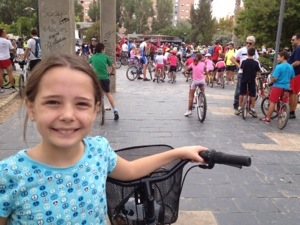
With handlebars barely within her reach, a bike seat that doesn’t allow her feet to touch the ground like she’s used to, and hand brakes only (also new), it is a bumpy one-mile ride to the beginning of our latest Spain adventure. Isabella, nine, is anxious to be a part of something here, both with me and the people of this city. She lives to belong.

This is the cheap bicycle we bought for Bruce at Carrefour, the one with crooked handlebars and a pedal that already fell off and is now on somewhat crookedly as well, its bearings stripped after a single repair. We move along side streets until we reach the bike lane, having to stop only a few times for hazard-lit cars whose drivers are greeting friends, delivering fruit, or just not in a hurry.

No one here is ever in a hurry. After a fall and a few precarious turns by Isabella, we are ten minutes late to the park. However, as cyclists of all ages continue to stream in, it becomes clear to me, once again, that this is not America. There is no liability form to sign, no registration fee, no separate event for kids and adults. And there is certainly no reason we should begin on time!

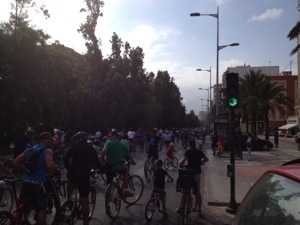
After another twenty-five minutes of waiting, we begin, five hundred or more, to stream out of the park. We fill the street with trailers, tagalongs, training wheels, baby bike seats, and a speed slow enough to walk. North to the first roundabout, over to the main Alameda, where we move along the palm trees toward the harbor, our safety enforced by neon-green uniformed policemen who stand at each corner. “It’s like being in a parade, just like the one last night!” Isabella announces, reminiscing the 11:00 p.m. march across town of people dressed in B.C.E. Roman and Carthagenian robes, kilts, skins, helmets, and furs. (Yes, I said 11 PM, where every age from little Roman toga-bearing babies and seventy-year-old crowned queens lit up the streets with their drums and song).

I am a cyclist. I have ridden three thousand miles in eight months, regularly ride my bike twenty-five miles to and from work each day, and have participated in a cycling event that took me over two mountain passes in the depths of the San Juans. But I certainly have never seen anything like this.

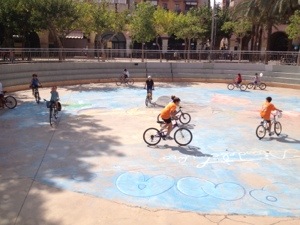
Like a slow-motion mob, we “ride” across town, weaving in and out of kids ranging in age from two to seventy (kind of like the parade!). There is no finish line, no lineup of booths promoting muscle milk or the latest carbon bike, no giant banners bragging about sponsorship. There are freestyle cyclists showing off, juegos tadicionales like hopskotch and jump rope, and all the families in Cartagena, gathered here at the city center to cycle their way to a sacred Saturday of family time.

I watch my daughter, who has mastered control of her handlebars, who leads me along what she calls “the Italian street” into and out of narrow “alleys”, who rides in circles with the other kids on the concrete at the center of a park, who asks to ride the long way home. We weave in and out of pedestrians, meander along the bike path past all the now-dispersed cyclists, and make our way back.

She has completed her first cycling event. I have completed my first cycling event in Spain. In our latest Spain adventure, where nothing is the same and everything is the same, we arrive home, unscathed, barely sweating, eight miles behind us, and all the miles ahead of us paved in love, in beauty, in the connectedness of belonging to a culture that cherishes their children far more than riding a bike over two mountain passes.

20120922-154714.jpg

20120922-154800.jpg

20120922-154904.jpg

20120922-154931.jpg