no. we won’t shut up.
no, thank you. we won’t sit down.
we’re here. we’re watching.
we’re ready to strike.
we’re ready to fight for them.
we’re ready to win.

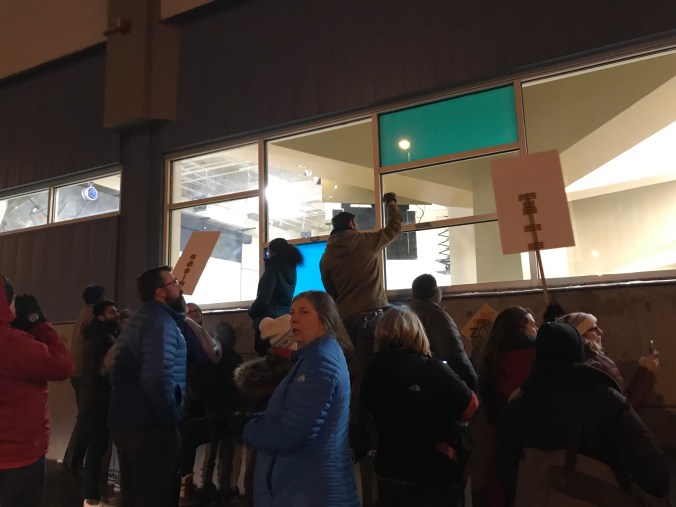

no. we won’t shut up.
no, thank you. we won’t sit down.
we’re here. we’re watching.
we’re ready to strike.
we’re ready to fight for them.
we’re ready to win.
Denver Public Schools has filed a request for state intervention to prevent the teachers’ union from striking next week. In the 19-page file, Superintendent Susana Cordova and her school district legal team have laid out reasons A-O (fifteen reasons) why the state should intervene.
Fifteen reasons why we, the teachers, deserve to be paid a fair, living, predictable wage.
Fifteen reasons why schools are targeted as the saviors of society in the same moment that teachers are vilified by the press and the public.
Fifteen reasons why we need a strike: let’s draw national attention to our plight, to the plight of a society that devalues education and the teachers who work to change the world.
Below, I have copied and pasted the fifteen reasons with haikus that represent teachers like me who have dealt with every one in some form or fashion:
A. Loss of Instructional Time from Teachers on Strike:
six hours a day
with every kid, every need
(and six more at home)
B. Students with Special Needs:
making learning plans
for families who need voices,
for inclusive rights
C. English Language Learner Students:
try writing our wrongs
again: try righting our wrongs
to build fluency
D. Potential Denial of H1-B Visas:
immigrant teachers:
First Amendment denial
(freedom, too, revoked)
E. Students Enrolled in Affective-Needs/Autism Center Programs:
routine disruption
tears students from what they need:
teachers who love them
F. Students Receiving Mental Health Services:
so much more than school
SSPs save our students
(sometimes from themselves)
G. Students Receiving Medical Care Services:
our school nurse gives them:
medicine, patience, advice,
hope for the future
H. Students Dependent on Schools for Food and Nutrition:
every teacher here
has given to the food bank
(lunch is not enough)
I. Students Dependent on Schools for Shelter from the Elements:
the prison pipeline
could stop with these school buildings
and a teacher’s love
J. Gifted and Talented Students:
let them be leaders
led by those who see their light
(you guessed it–teachers)
K. Student-Athletes Seeking Scholarships:
cultural veto:
to remove a student’s chance
of avoiding loans
L. Students Taking Concurrent College Classes:
what teachers give them:
highly-educated guides
for college keenness
M. Financial Hardship on Families:
double-income trap
means no parent waits at home
(they need our service)
N. Absence of Childcare for Families:
after all, aren’t we
glorified babysitters
asking for too much?
O. Fewer Resources for New American Families:
I beg taxpayers:
come visit our newcomers
to grasp sacrifice
Fifteen reasons why we fight every day for our students’ needs. Our society’s needs.
Thank you, DPS, for laying out our reasons. For proving to our country how badly we need to strike. For creating a legal request to clarify how heavily we carry the weight of the world.
For showing us all how little we earn as we carry it.

To avoid pouring water down the drain, I spend ninety minutes washing dishes in two pans, running water out to my new mulch to dump, and putting everything away while Bruce researches home equity loans and Trump tax cuts that hurt, rather than help, our current situation.

Behind the bars of my security door, I take this picture of the sewer company’s progress replacing a portion of our main drain.

Behind the bars of this security door, I hide from the American Dream. The one that we are all promised and few of us ever attain. The one where we could afford to buy a house, afford to deal with that house’s expenses, afford to send our children to college or even pay off the loans we might still have from our own degrees.
I hide from the dream of all of my grandparents, a combination of immigrants and endlessly American, one grandfather with an eighth grade education, one with a high school diploma, who were able to raise large families and pay off mortgages well before retirement. On ONE income.
I hide from the audacity of insurance that we carry on our homes, our health, our lives. From the premiums we pay that won’t cover pre-existing conditions (like pregnancy!) or pre-existing problems on our properties (like drains), or pre-existing hope–from all the thousands and thousands of dollars we pour into these plans that leave us empty, behind bars, unable to operate a backhoe.
I hide from the for-sale houses in my neighborhood that are now so outrageously priced that my family, and none of the other families on my block, would ever be able to afford to buy the homes we stand in.
Behind the bars of my security door, I am as insecure as everyone in my generation. The generation that faces housing costs that are equivalent to more than fifty percent of what we earn in a month. The generation of debt that is impossible to avoid even with the best budget. The generation that has made the choice to bring children into this world only to constantly think: why would I bring children into this world? Children I feel inadequate to provide for, children who will face even higher college costs, children who will be straddled with debt for their entire adult lives?
Behind the bars, I cannot see the buyers of the $769,000 remodel on the next block. Where they come from. What jobs they have. What magical formula they applied for that allowed them to take a mortgage that costs more than what our two incomes bring home in a month.
Behind the bars, I hear the Spanish language spilling from the mouths of the workers who have to dig a hole in a yard on a holiday. With perfect efficiency, they have repaired a ten-foot section of pipe within two hours, and they will move on to the next family’s crisis, and the next, and the next, before going home to houses on the other side of town that they also likely can barely afford, because we all know that the $6000 we just paid for that pipe is lining the pockets of a white, male, English-only CEO.
Behind the bars, I live in my dream house, my four-bedroom, two-bathroom, beautiful-garden dream house that we waited seventeen years to purchase. I raise a family of three daughters whose pay may never match their male counterparts but, despite this, whose intelligence and candor will allow them to live the life of their dreams. I share my meals, my home, and my love with my husband who has managed our finances to such perfection that we have flawless credit, making an application for an equity loan for both our properties (because nothing can just happen to this house–both need new main drains), virtually seamless. We both work hard at our dream jobs–teaching and telecom–in order to make this picture perfect.
With the door open, before they rebury the dirt, I snap a picture of our pretty kitty hiding behind my glass of stress wine.

I sit on our paid-for leather recliner and feel the cool breeze of early summer and think about my students who have crossed the world to be a part of this American Dream, and how hard they work to make that dream possible, to learn English and learn how to navigate the complexities of our society that sometimes make us feel like we’re all going down the drain. I think of how hard my husband and I have worked to make this day possible–to give my girls a summer trip to Spain, a year in Spain, to see nearly all fifty states–because of how careful we have been with our money. I think of the health insurance that paid for most of my husband’s surgery and how my grandmother’s baby sister died of a simple infection in her mouth after tripping up on a wooden popsicle stick, all because they couldn’t afford a doctor.
With the door open, we host family friends who make us laugh until we cry, whose daughter will join us in Spain, whose presence makes us appreciate what we have surrounding us in life–a life filled with laughter, love, support.
With the door open and the Spanish-speaking workers gone, the Siberian iris frames my kitty, my pet, my perfect yard. I know that I have given so much to get to this picture, and I know I still have more to give. I have daughters who are lucky enough to have access to all the technology, diversity, and coursework that comes from an urban education, and who will enter their adult lives with an open-minded understanding of the world. I have a house that we can afford and enjoy without feeling like our money is going down the drain. I have a job that brings the global perspective to every choice I make in one of the most beautiful buildings our city has to offer. I have a marriage that has lasted from childhood to adulthood, with all the post-adolescent turmoil and trauma, all the sorrow and joy, that comes with making it work for twenty years.
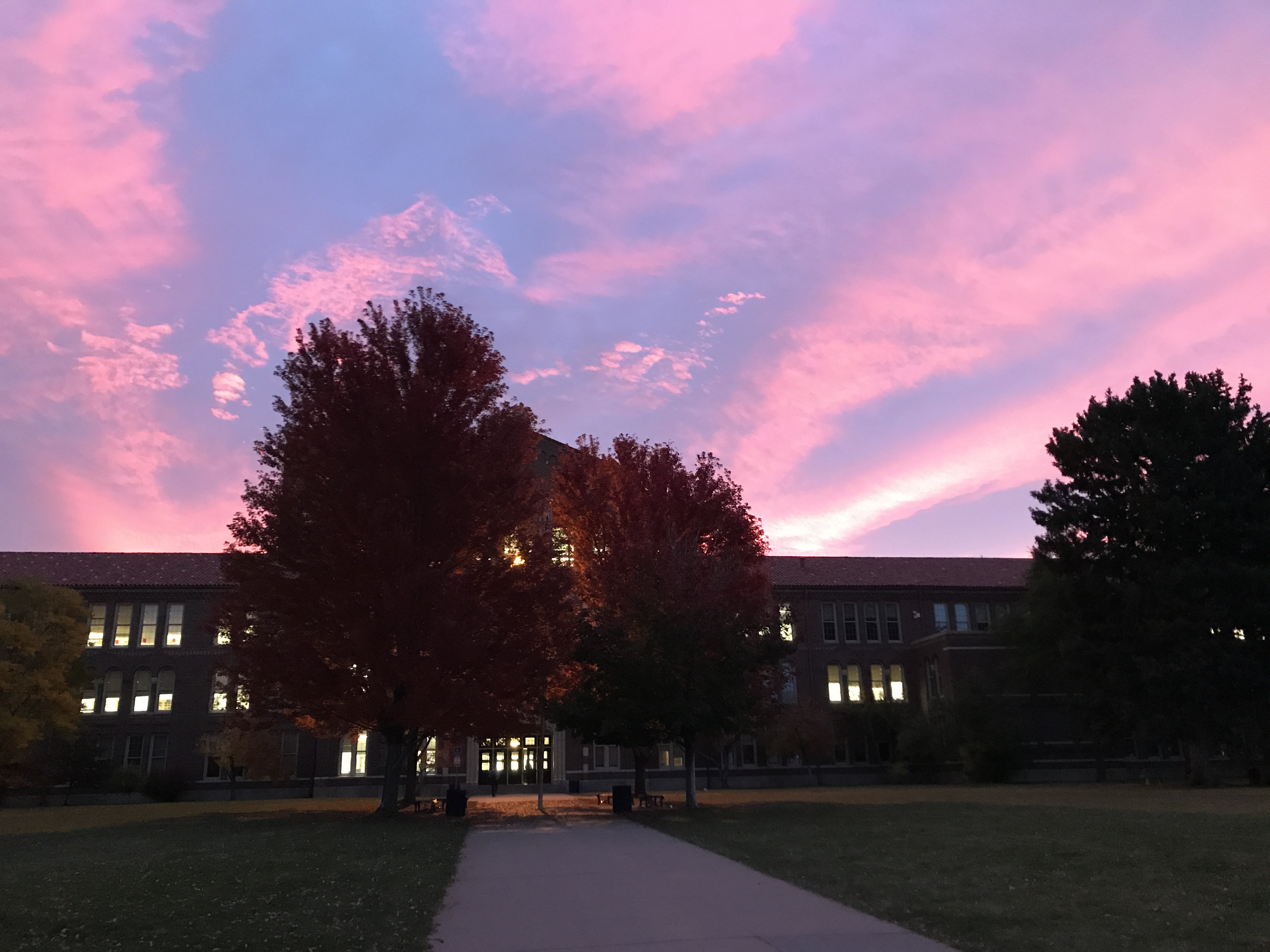
With my door open, I wait for the American Dream. Somehow, some day, some way, I will see how it is both easy and difficult to achieve. If I would learn to always open the door and move beyond the bars, I would see that not everything is going down the drain. I would see the beauty in every choice, the brutality in every loss, and find a way to make a set of silver linings sweeter than a sip of stress wine.
I would be the wife, the teacher, the mother of that perfect picture. That perfect picture would be me.
At the elevator, brace still on, crutch still under his arm, he tells me he thinks that a good return-to-work date would be June 4, five days before we leave for Spain. He seems optimistic as he hobbles down the tiled hallway, as we enter the carpeted office, as we check in and he holds the door open for a woman with a walker, pointing out, “It’s kind of strange they don’t have an automatic door in the orthopedic’s office,” to which she adamantly agrees.
On the plastic, paper-coated bed, he hands me the folder while the PA takes him for x-rays. After just a few minutes, the doctor enters with the films. He has photographs of the entire procedure. He intricately describes the meniscus (intact), the bones (drilled into), the ACL (torn and then repaired). Bruce and I lift our eyebrows at each other, barely able to distinguish the tiny details he points out in each picture.
In his cozy spinning chair, the doctor is also optimistic. “I think you can ditch the brace right now and ditch the crutches by Friday. Use the stationary bike on Sunday. By Monday, you should be walking around the block. Maybe driving.”
From the green paper folder, I begin to pull out the forms. First: short-term disability approval. A list of lines with dates, surgery and medication verification. Affably, he takes them in stride: “I’ll be sure to get these to the right people to fill them out.” Because he has people. Because he charged the insurance company $36,000, more than half of what I earn in a year, for an outpatient surgery that took less than 90 minutes. Because we live in the land of the free.
From the green paper folder, I continue to pull out forms. Bruce begins to tell him–without ever being able to finish because of the doctor’s rambling explanations, the doctor’s defense of his procedures, the doctor’s justification for not filling out anything–about wanting to return to work before Spain. I pull out The Form, the one that CenturyLink requires for him to be able to work: a release of liability for driving a company vehicle, an “if-something-happens-it’s-not-on-us, your-injury-better-not-affect-your-work” form.
From his throne, he glances at the wording. He throws in more anecdotes peppered with cussing colloquialisms. “In twenty-six years of doing this, I have never seen a company require a form like this. What if you’re a shitty driver? How can I, as your medical doctor, determine if you’re OK to drive? I won’t sign a form like that. If you get in an accident and hurt someone and I’ve signed this form, then it’s all on me.”
From my plastic chair, I listen to the tone of my twenty-years-spouse change from respectful to grainy. I can almost feel the lump at the back of his throat as he tries to go on. “Well, my supervisor is willing to let me come back on light duty…”
From his throne, the doctor interrupts: “What you’re going to be dealing with is HR, not your supervisor, and if HR says you can’t work, that’s where things get muddy when I start putting my name on these forms.”
From my plastic chair, I am counting down the hours in my mind until the moment I can let these tears actually fall. First I have to continue listening to this white-haired, privileged surgeon continue rambling on about lawsuits. Then, we have to make Bruce’s appointments for physical therapy. Next, we have to drive home and track Mythili’s progress on her bicycle, as I had no way to pick her up today. After that, I have to take her to her doctor’s appointment, where they will make commentary about how my thirteen-year-old hasn’t had her period yet.
From my plastic chair, I am frozen and without words. The doctor turns to me. “You look frustrated.”
Is that the word you would use? Do you think frustration sums up the past six weeks of my life?
“The thing is…” Bruce begins, “… I’m probably going to get laid off on July 30.”
The doctor has finished listening. “That’s why we have to be so careful when filling out these forms. This happens all the time, when companies decide you can’t work.”
“No, it’s unrelated…” he begins again, that painful lump sitting on top of his beautiful, sexy voice.
“Are you really not going to fill out the form?” is the only thing I can muster. The doctor hands it back to Bruce, asks if there’s anyone he can call, anyone he can talk to, any way he can go back to work without it.
From the tiny patient meeting room, he stands. He shuffles us out the door. He guides us to his people who will make the next appointment. I place The Form neatly back inside the green paper folder.
I think of a few cussing colloquialisms I could shout. I think of hindsight, all of it. Of next year’s ski passes we wasted $2300 on. Of the thousands we’ve already spent in this office. Of the four weeks at seventy-percent-pay he’ll get for short-term disability. Of the thousands we’ve spent on Spain that is gone and tarnished before boarding the plane.
But I have no words in these moments when I have bowed down to our litigate society, our corporations’ fear of liability, our doctors’ refusal to help the little man other than spurting cussing colloquialisms while trying to relate to us.
At the elevator, his brace in my hand, crutch still under his arm, I don’t speak. Picking up Mythili, exhausted from her bike ride, I don’t speak. At the following doctor’s appointment, where, as usual, we only get to see the PA, I cross my arms and don’t speak, forcing Mythili to respond to questions about who she lives with, how she likes her sisters, what kinds of food she eats.
From my recliner at home, I do have a few cussing colloquialisms for the orthopedic surgeon. I could spout them all day, all night, every waking moment of the past twenty years of marriage, every waking moment of my life as a not-quite-middle-class American who just needs A GODDAMN FORM SIGNED SO WE HAVE A FEW PENNIES TO OUR NAME…
From my recliner at home, the words are useless. All the words, all the work, all the life we have put into living, everything feels useless.
And there is no cussing colloquialism that will bring me that doctor’s signature, bring my husband his job, bring me some peace. So why bother spouting them at all?

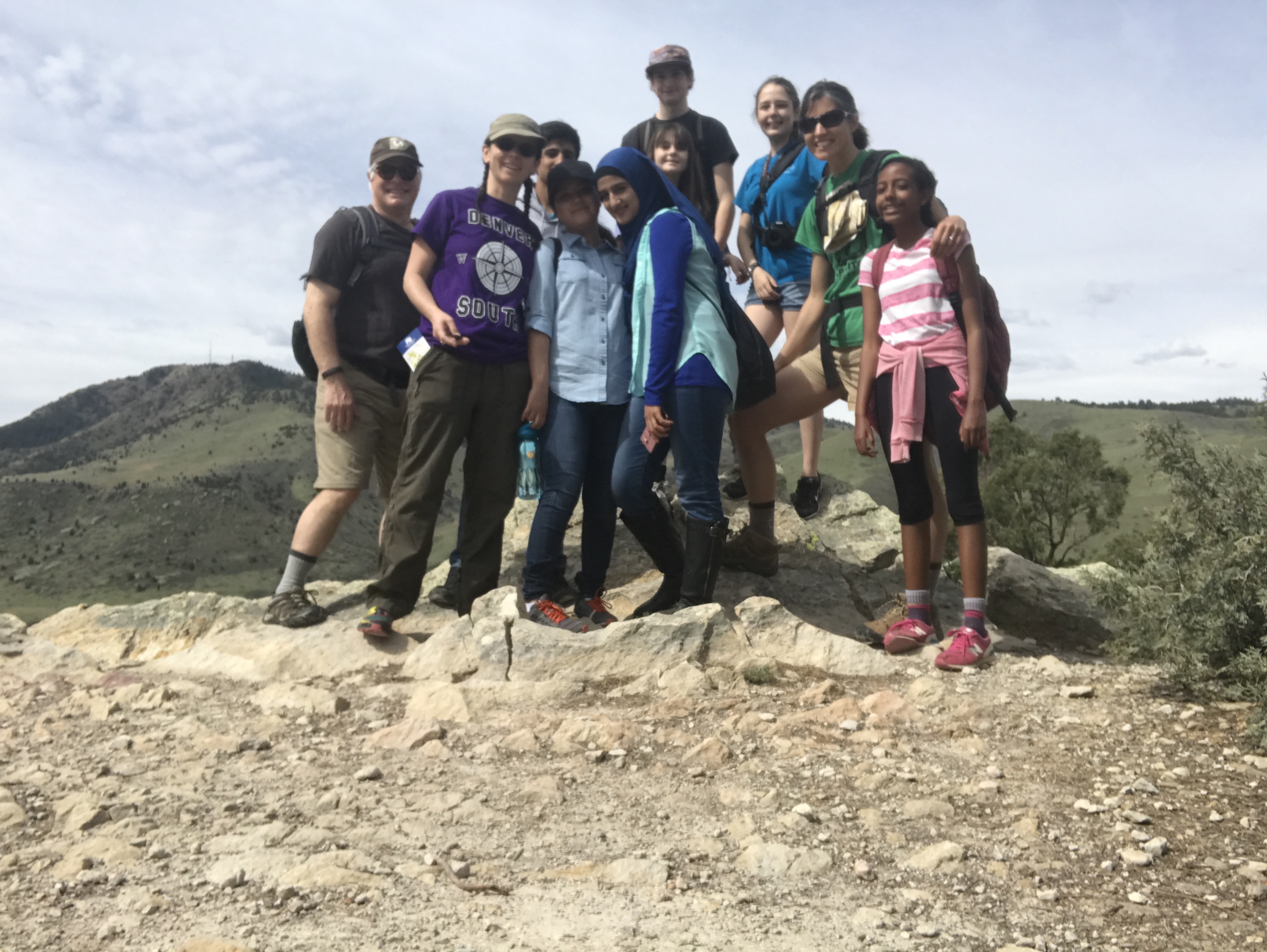
We took three Afghani students to the foothills today. They have been here for less than a year, so they learned a few English words today: Hike. Trail. Juniper. Ponderosa. Colorado=red rocks. View.
I tried to ask what it was like for them back home, but they only knew a few English words to describe it: Danger. No school. Grandparents. Parents here in Colorado. All kids–brother, sister, other brother–in Afghanistan.
Each time I asked if they wanted to continue down the trail or turn around, the most confident girl, the hijab girl, kept insisting we go on. She had no desire to go back to whatever life she had outside of that blue-sky hike, her knee-high boots and sweaty face no hindrance to her joy. She just wanted to walk. To escape. To be on that mountain.
When we were at the top, she leaned in to take a selfie with me, and then one with my youngest daughter whose experiential-learning school had just visited the same location, whose quiet voice shared with us the details of the sedimentary rock layers, the lichen, the igneous and metamorphic. This was a perfect match–the low-English Afghani and my quiet youngest–smiling shyly for a photo, a perfect frame of world peace.
With a walk like this, we step towards empathy. Understanding. Gratitude. We know that things could be worse, that they are worse, for so many people in the world.
But it doesn’t stop me from feeling the pain, the loss that I feel now. For feeling gypped, for feeling like nothing I do, nothing my husband and I ever do, will be good enough to make our lives easier.
Perhaps it’s the curse of Spain. Six years ago, after welcoming two Spaniards into our home, after asking practically nothing for rent, after offering them my car for months when theirs broke down (I rode my bike to work 25 miles a day for three months), after hosting parties for their friends, babysitting their friends’ kids, driving them to South Dakota, after everything, we went to Spain and never heard from either of them again. In addition to the nightmare that that year in Spain was for us, with its broken promises, broken paychecks, and lost jobs, they had to twist the knife right into our backs by acting like they never knew us.
And now we’ve planned a redo. Twentieth wedding anniversary. Fortieth birthdays. Three years into living like kings for the first time in our marriage, with two steady, well-paying jobs, great benefits, and our dream house that we opened up to friends of ours, six of them, rent free for two months because they were down on their luck, and Spain has cursed us again. Our six-week vacation that is 90% bought and paid for, that I have spent over forty hours meticulously planning every last expenditure and activity, will be marred by a pending layoff, loss of benefits, and a mortgage we simply cannot afford on a teacher’s salary.
Let me tell you about that teacher’s salary. Let me tell you about the master’s degree plus thirty credits I have. Let me tell you about all the school events I attend, the lunch meetings, the hours before and after school I work, the summer workshops, the home visits, the dance chaperoning, the sporting events, the class coverage, the every last everything I do to work, to earn an extra buck, to make it. Let me tell you about the eight years we lived on a $48,000 frozen salary.
Let me tell you about my childhood. Parents with bachelors’ degrees in journalism working for a small town newspaper and barely making it. Powdered milk. Ten-year-old, rusted-out Datsun. Ancient house with windows so thin that ice collected on the glass. My mother scraping together a $20 bill for my eleventh birthday and me looking at it holding back silent tears because I already knew that it was equivalent to two and a half hours of her work, and my father was failing his master’s program, and we were moving to Denver for a better life, and everything was crashing down at once.
Let me tell you about contract work, the only kind of work Bruce was able to find when he left the Air Force. No guarantee. No health insurance. No paid time off. No holidays. No sick leave. And when it ends? No unemployment checks.
Let me tell you about health insurance. Let me tell you about the two children I have given birth to without having health insurance because it was a pre-existing condition, and the near $10,000 we paid for those births.
Let me find a few English words to explain to these students from Afghanistan: American Dream. Housing. Insurance. Education. SCAM.
Let me tell you about what we have done to avoid bankruptcy: No car payments. No student loans. No credit card debt. Two properties. Saving and spending. Buying a house only when we were ready, when we could afford it. Saving up for a cursed redo of Spain. Road trips staying with family and camping to save money while traveling. One computer for the whole family. Still driving my 1998 Hyundai Accent.
Let me tell you how I know what poverty is. I know what sacrifices are. I have made them.
Let me find a few English words to say: Fuck this country. Fuck this Trumpian tax cut that cuts workers while CEOs live like kings. Fuck this blue-sky day. Fuck my husband’s military sacrifice, his months in the desert, his sold-his-soul-to-boot-camp commitment, his veteran status that has given us NOTHING.
Let me be twenty years into my youthful marriage and not have to feel like I’m just twenty minutes in. Let me keep my dream house. Let him keep his union (that screwed him) dream job. Let my kids feel like there’s a future here for them and that with two degrees they won’t be buying powdered milk.
Just. Let me be. I’ve had enough.

In the middle class houses all being scraped
to build mansions no one can afford?
In the stagnant salaries that ask us to
work harder for less money?
In the moms working two jobs,
the dads unable to keep up?
Where is my Italian grandmother’s dream
of a better tomorrow, a house she and her
Irish husband built and paid for
before they retired?
It is not my dream.
It is not our dream.
I am the working mother,
the disappearing middle class,
I am the two-incomes-barely-making it generation,
the strapped-with-student-loans
cause-we-thought-it-mattered generation,
the trapped in social media comparison
of who has the best selfie, the best vacation,
the best life?
Where is my grandparents’ America,
who came back from the war and
built from the ground up those tiny homes
that we can’t wait to tear down?
Where are the housewives who can sew clothes
and cook duck a’l’orange for a Wednesday evening?
Who are there when their children come home?
Whose husbands could buy pay for this house
on just one salary?
I am Generation X, torn between Baby Boomers
who raised us to be independent
and Millennials who can’t do anything for themselves.
I am the white woman who can never decide
between what is fair for her and fair for everyone.
Where is my grandparents’ America?
In the broken corporate ladder,
in the endless need for greed,
in the generations lost between yesterday and tomorrow.
In the hope lost between King’s improvised speech
and Trump’s rampant ignorance,
in a land I barely recognize,
in the rubble of torn-down houses,
torn-down American dreams.

(NOTE: Inspired by “Let America Be America Again” by Langston Hughes)
It’s a Friday in January and my mouth is running rampant. She came, she asked, and I don’t lie.
I know that people hate the truth, and the truth hurts (me the most–sometimes I think this), but she wanted the truth, and had twenty different ways for us to share it with her, most of them anonymous.
But I said what I thought. What we all think. What needs changing. What already works. I had evidence and examples, just like I always tell my students to write in their ACEITCEIT paragraphs. And I splayed my soul in front of God and everyone–I got a 3 (7 is the best), and Nick was as honest as could be when he spoke to me, and said, ‘I sat in my garage for three hours last night in turmoil over this’–and that humanization of the score meant more to me than anything else. That humanization–that’s what teachers want.
And do you know what they said (of course)? You let him give you a 3?
As if they hadn’t heard the whole conversation. As if it weren’t enough, the admittance, the heart on sleeve, the truth.
The, Why can’t you be a little more honest?
On with my day. Two more classes in the afternoon. Coming in a bit tired and a bit disgruntled about the first standardized test of the semester they took yesterday, but still willing to work for me. To discuss and argue about the validity of the Universal Declaration of Human Rights and try to decide which one they thought was most important, and write a paragraph about it (ACEIT today, just ACEIT).
If I’d known sophomore year was going to be all about paragraphs… one begins, unable to finish as she shakes her hands between sentences. But look at the progress you have made! I begin, but am interrupted by knock at the door number four for period five, with a para and a stack of papers three feet thick. Oh my God, what have I done? I start to ask, but cut myself off when I realize it’s the first four chapters of I Am Malala, copied times 160, because we still don’t have the books on our tablets.
You just saved my life, I whisper, and pile the pile on the desks.
Then, just after I thought my day was done after my sixth period valiantly pointed out a grammatical error on my sentence stem (Have you ever had an HONORS ELD course?? You should try it some time. Come by any day at 1:11), I remembered my ultimate task: covering the severe needs special education class. Seventh period. On Friday.
There is no amount of money in the world that could be a fair salary for what these women do every day. With needs that range from nonverbal to highly functioning, students who are obsessed with either Play-Doh or making sure my watch is exposed from under my long-sleeved shirt, to vacuuming relentlessly and walking around only on knees, to the computer dying mid-class and the wheelchair-bound girls moaning in distress, to the speech-language-pathologist teaching the alphabet to one girl for fifty minute straight, there. Is. No. Fair. Salary.
Before I left, I saw a man who I visited last summer during one of our home visits. He was chain smoking and playing violent video games in the projects, his tiny apartment nothing but white windowless walls. He was kind and adept, and described his rather difficult job of trying to keep severely autistic teenage boys from harming others. I suggested he apply at our school since his daughter would be attending there. You have a severe needs program there? I didn’t even know! Today I saw him for the first time, and we fist-bumped. You’re the reason I even have this job, he told me.
Best moment of my day.
Or, the walk. Yes, I got in a walk after all that honesty and writing and chaos. Around the park with the little dog we’re watching. And the winter light sparkled just so on those geese, perfect silhouettes against the season.
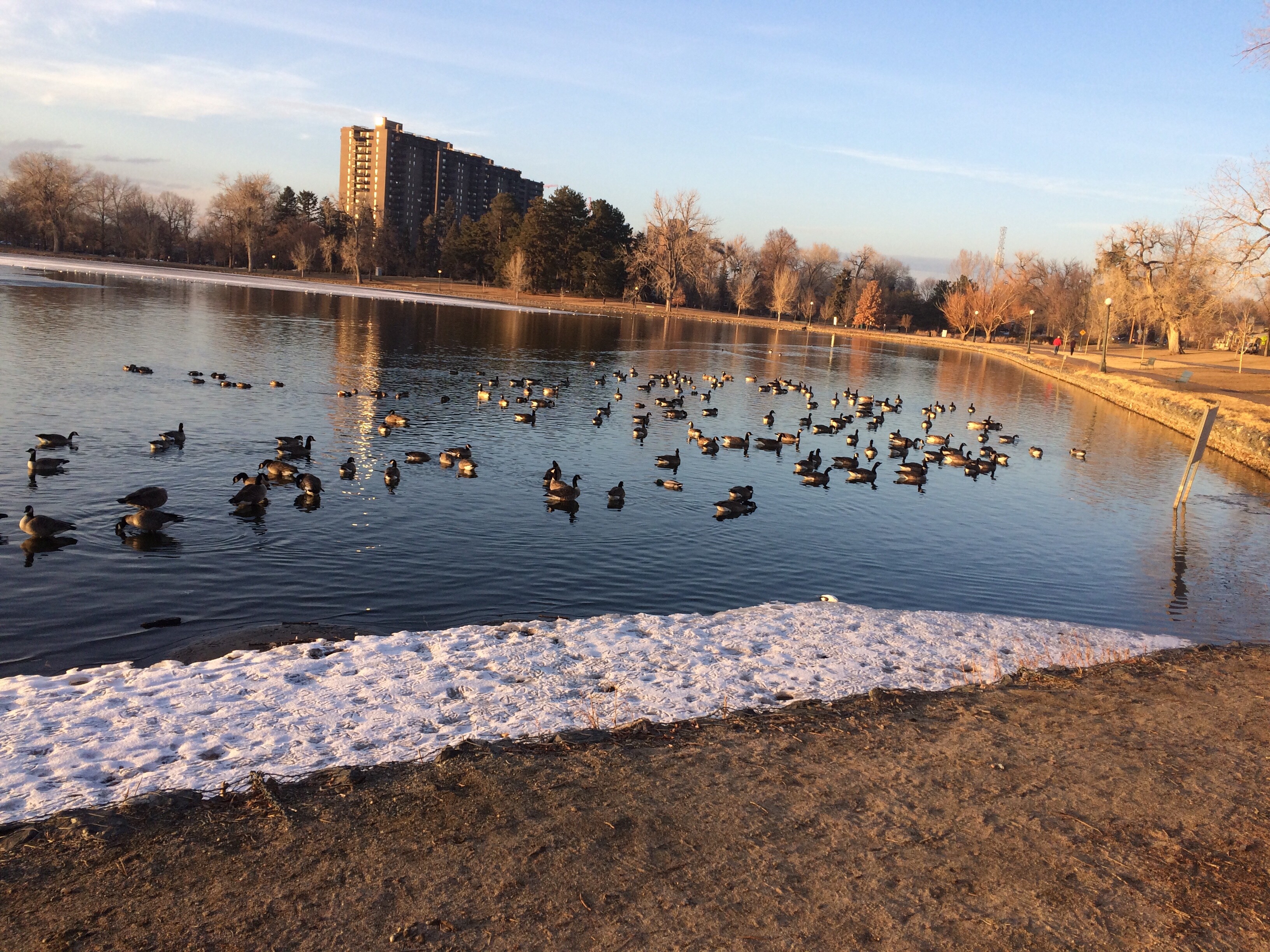

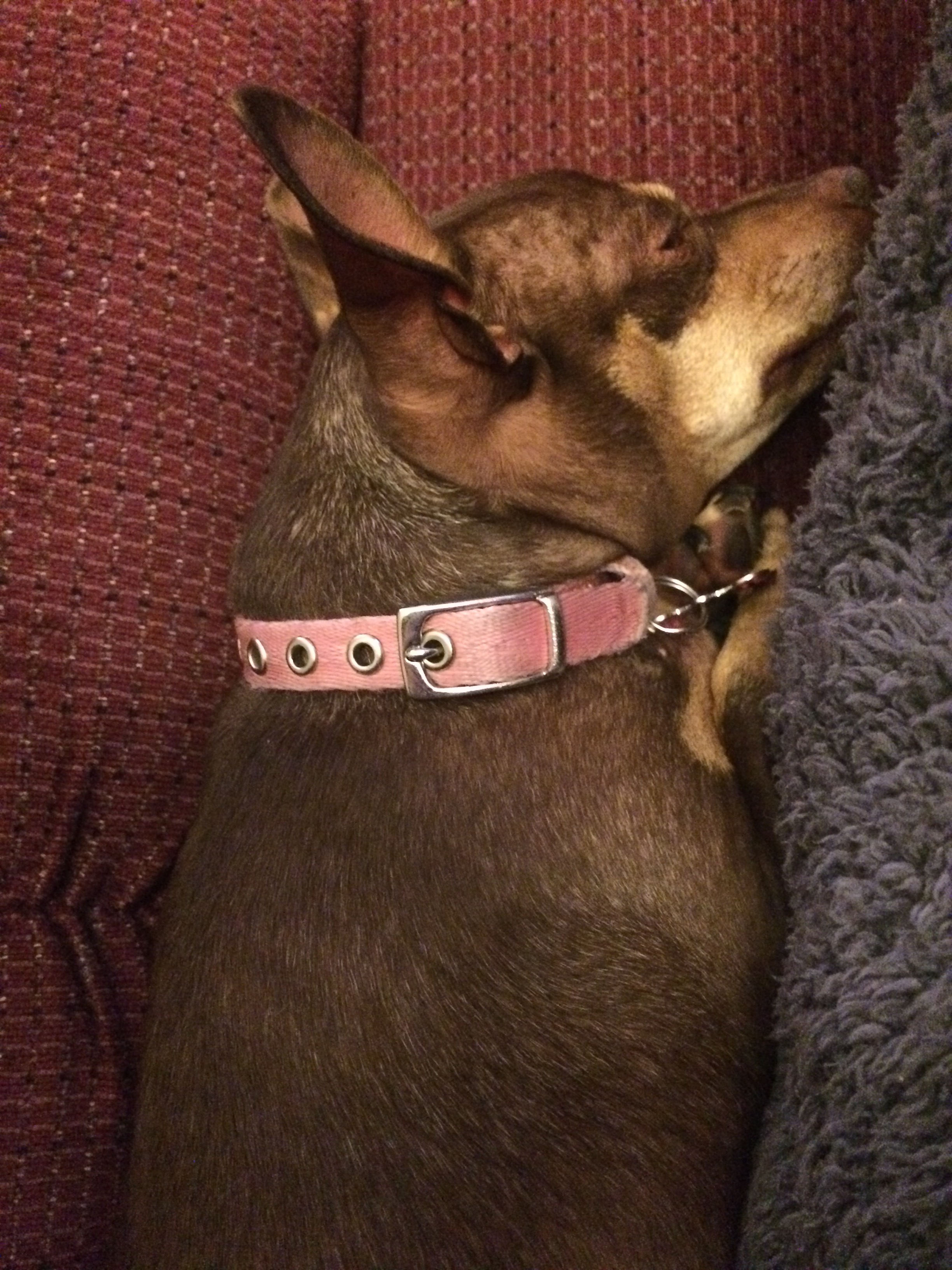 These moments allowed to me before Izzy entered the car and spilled the entire sex ed story, provided by none other than Planned Parenthood and a literal wooden penis named Woody. Yes, they demonstrated how to put the condom on Woody. Yes, “Becca” taught them how to insert a female condom using only her fingers. Yes, they passed around an IUD and pressed it against their skin so everyone in the class could see what it felt like. Yes, the main way to prevent pregnancy is abstinence.
Yes, we live in Denver now, where it’s as liberal as it gets, apparently.
No, this is not the sex ed you remember.
I wonder why my almost-fourteen-year-old thinks nothing about telling me the whole sex ed story? Could it be that she’s my too-honest daughter?
No matter. We made it home and I made dinner. Or rather, I stuck some chicken and potatoes in the oven and called it dinner while I searched for ski condos in Crested Butte. (More than an hour later…) Dinner’s ready!!! Condo is booked!! Friday is done!!!
It’s a Friday in January, and my mouth is running rampant. But at least I’m being honest about it.
On my second daughter’s due date, I woke before dawn on that November Wednesday to check the state of affairs: had my labor begun? Had my water broken? Had Bush been reelected?
Only the third was true, and I waddled out of our mid-level bedroom (close to the bathroom) to trek down to the basement to tell Bruce. As soon as I stepped onto the thick, lush, high-quality carpet we’d spent thousands of dollars on that summer in our basement-finishing saga, I felt a soggy, foot-chilling squish.
And then I heard the water. No, not my water breaking. A pipe breaking. And my candidate losing. And my baby not coming. All on a dreary November morning twelve years back. And I spent the morning after election day carrying books from the basement to the second floor, shifting furniture, wishing for a different president and a drier basement. It was a disappointing day, but not a devastating one. Not a frightful one.
With Bush’s second term, we liberals held our breaths to see what might happen. The wars in Iraq and Afghanistan were in full force, and the ensuing investigations as well. We were three years past 9/11 and still reeling in its shadow. The economy was shaky at best, and its effects played out not long after Mythili (eleven days late) entered the world: Bruce was soon told his job as a contractor for AT&T could end at any moment; no other prospects were in sight; and my miniature in-home childcare “business” began to crumble before my eyes.
It was a tough time for us. For many Americans. Not long after, the housing market crashed around us thanks to limited regulations on banks and uneducated masses. Millions of people lost their homes, their jobs, their livelihood.
It was easy to blame Bush, though he couldn’t wholly be at fault.
Just like the other Americans I have lived amongst for my entire life, Bruce and I persevered. Since he couldn’t find work, I returned to teaching, leaving my two-and-a-half-year-old and nine-month-old daughters in his full-time care. I had just finished my master’s degree, and it was my third year of teaching, so we lived on $37,000 that first year. We had dial up internet, no cell phones, zero debt, used cloth diapers, breast-fed the baby, and never went out to eat.
It wasn’t the easiest of times, and Bush certainly wouldn’t go down in history as the worst president, nor the best. But with all the uncertainty that plagued his presidency, from September 11 to mideastern conflicts to crashing housing markets, I never, ever felt that our entire culture was at risk of losing itself. I brought my daughter into the world two weeks after he continued his presidency, and though I was disappointed at his leadership and frustrated with his international war-mongering, I was never truly afraid. I continued with my life, we continued our parenthood journey and brought our third daughter into the world in 2006, all before a candidate I admired had even mentioned his platform.
Now, here we are: 2016. My second child turns twelve next week, and another election cycle has reared its ugly head.
But this is not just another election cycle. It has been filled with conspiracies and vitriol on both sides. The Democratic party has been at near collapse, and the GOP has come up with a string of completely incompetent candidates, finally settling on the most frightening one of all: Donald Trump.
I am thirty-eight years old, and I have been following elections my entire life, thanks to highly informed and politicized parents (being born into a family of journalists led to this). I have seen negative campaign ads since I was young enough to wake on Saturday mornings to watch cartoons. I still remember campaign promises like, “Read my lips: I will not raise taxes” and my father’s fierce criticism when Bush Sr. was proven a liar once he became president. I participated in two mock elections in my elementary school in my small town in upstate New York: I was one of the five percent who voted first for Mondale and his female vice-president running mate, and one of the two percent who voted for Dukakis when he was up against Bush Sr.
I realized early on, listening to what my parents taught me, that it didn’t matter if no one around us really believed in the same things we did. What mattered was social justice. Equal rights for all people, LGBTQ, people from varying religions, and people of every race. What mattered was equal rights for women, especially in regards to education and career.
So, while I am not a career politician, I know politics. Liberal politics are in my blood, and as much a part of my core beliefs as anything else.
Yes, I am a bleeding heart liberal. That’s why I cried that day on my brand-new soggy carpet when my baby wouldn’t come and Bush was marking her entrance into the world. That’s why I proudly posted my Dukakis poster on the school bus window for the whole world to see, even when all the other kids laughed at me and told me Dukakis would never win.
I care about my candidates. But more importantly, I care about the issues that they represent.
And now we are in a new age of presidential candidacy. We have social media that blows everything out of proportion and turns father against son, sister against brother. We have minute-by-minute clips of every word every candidate ever spoke.
We hear it all. We hear a candidate suggest Muslims should be listed on a national registry. We watch him mock a disabled man. We hear him brag about assaulting women and grabbing them by the pussy. We hear degrading remarks about the way women look. We hear him ramble on in incomprehensible sentences. We hear him speak of deporting immigrants, of building walls against them, of claiming Mexicans are rapists and thieves. We hear him proclaim that the election system is rigged. That Obama is the worst president ever. That his opposing candidate should be imprisoned. We hear him say that climate change was created by the Chinese and is a scam.
Vitriol is the center of this campaign. It’s all over the media, all over social media, and all over the living, breathing world.
It is what my student hears while waiting at a public bus stop and two white girls first accuse her of being a Mexican who should go back to her country, and then, on further examination of her looks, determine she’s an Arab who is also a terrorist that President Trump will get rid of.
It is marked in neo-Nazi, pro-Trump graffiti within hours of his election.
It follows the next generation like a dark shadow, leaving them in shaking, fearful tears as they discuss the stripping of their LGBTQ rights at GSA club; as they wonder if their family will be one of the two million he plans to deport in the first 100 days of presidency; as they proclaim their gratitude for their parents still taking the risk to bring them to this nation that they thought was free; as they navigate the realization that at least half of the people they know now have a presidential voice to support and back their once-silent bigotry.
It follows the teachers, the public servants: We had a special faculty meeting today to help us help the students cope with their fear, their mourning, their plans for action–immigration lawyers, extra counselors, and mental health specialists are just a phone call away. Yeah, you heard me right–we had to bring in extra mental health specialists to help us cope with a man who was just elected president.
Twelve years into my daughter’s life, I am truly afraid for the first time of my decision to become a parent. I am afraid of what the world has become. I am afraid of what will happen to my students. I am afraid that all the steps we have made toward equal rights and protection of women will be destroyed. I am afraid for my friends of color, my Muslim friends, my LGBTQ friends.
I am afraid. I am not angry. I am not bitter.
I am afraid.
I am a bleeding heart liberal, born and bred. And my heart is beating too wildly this week. This month. These next four years.
There is no soggy carpet chilling my steps. There is no rebirth. I have the faces of three daughters whose lives I fear will be plagued with sexism or ended by policies against renewable energy. I have the faces of thousands of students shuffling through my mind who I fear will not have a future in my country.
I am afraid.
I am afraid.
We have just elected this man to be our president. The water has just broken on a new era in America: the era that openly accepts a bigoted leader. And I am drowning.
Please, someone, teach me how to swim.
Modeled after “Indian Education” by Sherman Alexie
Kindergarten
Before she went out to her garage, poured a gallon of gasoline all over herself and lit herself on fire to die a fiery death, I already didn’t like Mrs. Mumby. It was my first year of school and she hated me.
It all started with cutting a picture of Baby Jesus and the moon. She gave us only a few minutes and I rushed through, trying to cut the moon as fast as I could. She snuck up behind me like she always did and before I knew it her gray-curly-headed face was inches from mine. I could smell the after effects of too-black coffee as she spat the words at me:
“I told you how to cut, slowly and carefully. Now come outside.” And she grabbed my upper arm and yanked me into the hallway.
“You need a lesson on listening.” She dug her fingernails into my arm. “Never rush through your work or you’ll be useless all your life.”
The tears were streaming down my dumbfounded face. This was worse than the spanking and the “extra pinch for an inch” she’d given me on my birthday. I was afraid of her and I wanted to finish first to make her proud.
So when my mother had to stay home from work two days later because my teacher had killed herself, I didn’t know what to think of school. It sure as hell was one mean place.
First Grade
My mother spent six weeks drawing Venus Fly Traps for a book she never received credit for, and that $650 was just enough to drive us for a camping trip to Disney World where we were allowed a singular souvenir. And what did I pick with my $3? A huge pencil, two feet long that I could barely wrap my just-turned-seven fingers around, with vibrant drawings of Mickey Mouse and Donald Duck all around its core.
Sadly, spring break came to an end and my parents had to go back to working at the small town newspaper, where between them both they earned $10 an hour and could barely put food on the table, let alone give us girls a trip to Disney. My sister and I had to return to school, where the mundane Mrs. Healthferdy’s main goal in life was to have a silent first grade classroom. I wanted to play games and do science experiments, but she wanted us to copy the date exactly the same way every day: Today is Monday, April 27, 1985. BOR-ING!
But I was so excited to use my pencil that I didn’t even care! I proudly pulled my souvenir out of my backpack and started writing the day, not making a peep, just like Mrs. Healthferdy wanted. I was all the way to 1985 when she came up behind me, leaned over, and brushed my cheek with her bad-dye-job blond hair.
“Karen, you cannot use this pencil. It is much too distracting to the other students.”
I briefly glanced around the room, where the other first graders were also painstakingly writing out the date. No one was even looking at me, let alone my prized possession. But I certainly didn’t want another trip to the hall like Mrs. Mumby had offered me so many times, so I relinquished the pencil, never returned to Disney, and still don’t have a singular souvenir.
Second Grade
It wasn’t that I had spilled six cups of boiling water on myself, causing a second degree burn and a night in the emergency room. It wasn’t that my mother freaked out and let me stand there in a two-inch-thick sweatshirt for two minutes too long. It wasn’t that it was the day before Halloween, my favorite holiday, where I’d miss the costume parade at school.
It was Mrs. Gridley, my gym teacher. Snarky. Mean. Uncompromising.
On November 1st, it was time to go back to school. I was covered in bandages from my left arm all the way to my belly, and even had a small red mark on my chin where the water had splashed. November 1st, a Friday. Gym class. Which began each day with Mrs. Gridley, all four-feet-ten-of-her, screaming at us to raise our arms up higher for pushups. And I couldn’t raise my left arm at all. I was on a series of pain medications for the most painful thing I’d ever experienced.
But I didn’t have a doctor’s note.
“I have to do gym tomorrow if I don’t have a doctor’s note,” I pleaded with my parents.
“Are you kidding me?” My father shot back. “Just lift up your shirt and show her the bandages. You don’t need a note.”
I was desperate and afraid. I rushed into my sister Elizabeth’s room. Eighteen months older than me, she was much more knowledgeable about the world, and most importantly, knew how to write in cursive.
“Can you please write a note pretending like you’re the doctor?” I begged her.
And on a tiny notepad, in precarious, light pencil, she scrawled a note in her fourth grade cursive handwriting. It was barely legible, barely visible under Mrs. Gridley’s thick bottle-bottomed reading glasses the next morning.
“What does this SAY?” she demanded, peeking her eyes over her glasses at me.
“I—I can’t do gym today. I—I burned myself.”
“Well, I can barely read this. Is it from the doctor?”
“Y-yes…” I looked down, horrified at the idea of having to pull up my shirt, to expose to her and the rest of the world a stomach full of blisters and scars.
“Well, go sit down then and do your other homework.”
And that’s the first time I ever got away with something with a teacher.
Third Grade
“What do you mean, you’re leaving??” we all recited the same chorus. Mrs. Emerson, my sister’s favorite teacher to date, and now mine, had taken a principal job at another school in a different town. Mrs. Emerson, who gave me all the most challenging spelling words and math sheets, who let me curl up in her walled-off reading nook with a book when I finished my work early (and I always finished it early), who let me sit with my best friend, Kellie, even though we stole whispered conversations every chance we got.
Finally! A great teacher! And she was leaving right after Christmas?
At our class Christmas party, all the kids with the stay-at-home moms brought treats. Venison someone’s dad had hunted. Rice Krispie treats decorated with Red Hots. Gingerbread cookies that crumbled into brown bits on the floor.
We had a Secret Santa, and I pulled my crush’s name! I was so excited to buy him a book about Ziggy, his favorite comic.
It was the saddest, most bittersweet day. At the end, Mrs. Emerson went to the tree and started opening presents that students had brought. Just like all the other school years, I thought only a few students would bring her a gift. But as she opened up one picture frame or bottle of perfume or ornament after another, I began to realize that every student in the class had brought her something.
Every student but me.
I began to sweat. I put my palms under my butt and moved to the back of the crowd on the carpet. My parents didn’t have a lot of money, but neither did any of the other kids in that blue-collar, no-work town. And she was the best teacher ever! I was mortified. I felt selfish and sick.
I wanted more than anything to have the guts to go up to her after the last bell and tell her she was my favorite, tell her how much I’d miss her, tell her how sorry I was that I didn’t buy her a gift. But my small pulled-in-hallway kindergarten self took over, and I bolted out the door and into the freezing cold New York winter, barely able to breathe by the time I ran down the hill and into my babysitter’s living room.
Six weeks later, when everyone else in the class received a thank you card from Mrs. Emerson for the nice Christmas gift, she sent me a letter too, thanking me for being such a great student.
She was still my favorite teacher.
with windows wide: write.
because you’ve missed my poems, love.
since yesterday’s dawn
girls in sun’s shadow
as she announces her move.
life: cycle in, out.
you know you’ve missed me
my “seven-likes” followers
’cause i didn’t write
you count me daily
amongst the regular loves
that make us a life
and i was just born.
(it was like i was just born
the day i met him)

’cause seventeen years
can’t be measured in mountains
or wildflowers


or whining children.
but in the steps we oft take
on our way back home
and in sunsets. Sun!
lighting my way across love
across city, life.

cutting down this ‘hood
into what it’s meant to be:
scraped, demolished, lost.
circular i am
because that’s how tires spin:
neverending globe

that brings us back home
wherever that home may be.
anywhere but here.


 Step Write Up