Inquilinos

My Rohingya refugee who could not read or write in Burmese (but learned somewhat decent verbal English from the militia who murdered his parents) had to quit school, after just three months, to work full time at a chocolate factory.

My Honduran and Salvadoran refugees live lives in limbo waiting for court hearings that are mostly clouded in misery with threats of deportation.

My son awaits the opportunity to work while his cousin, his only nearby family, has to move from state to state working roofing jobs with no options for permanency because of his lack of papers and English skills.

Meanwhile, 20,000 people stood in line in 8-degree weather this morning to support our president, just down the road from my house, claiming his stance on immigration is one of the most important policies they support.

These white people (it’s always fucking white people) are simply fulfilling their American dream: If it works for me, it’s fine. Fuck everyone else.

And he isn’t my son. I was reminded of this last night when DHS came and told me that we can’t send so much money home to his destitute family, that he cannot leave the state for more than seven days (forget our three-week family vacation), that he must take extra English classes and study a vocation and be an independent tenant.

Not an eighteen-year-old boy whose vision was so focused on running for a train to escape abuse and poverty that he couldn’t see much beyond that journey. He just knew that here was the goal, here with all the money in the world… here with all the opportunities in the world… and screaming, raging racists waiting behind every third door, anxious to keep those things from people like him.

I didn’t know the Spanish word for tenant, so after the meeting, when I was explaining all the depressing news to him, I pulled up Google Translate and couldn’t help but be immediately disturbed by its interpretation: inquilino.

The word sounds wrong to me, like a sour slice of lime in my mouth, a cottony accusation. So similar to inquietude. On the same list as inquiline: an animal that lives habitually in the nest or abode of some other species. Its origins in Chile speak of servitude… submission… slavery.

“We can’t have you taking our money for a vacation. This isn’t a handout.”

I’m not asking for a handout. I already had the entire trip booked and paid for, and he could easily fit in the backseat of my Honda Pilot and lay his eyes on Yellowstone, Glacier National Park, and Puget Sound, places he may never be able to see otherwise, but… OK.

I won’t use your fucking handout to take a sliver of his summer for three weeks of adventure and joy.

I won’t ever see my Rohingya refugee again because he will be working twelve-hour shifts for minimum wage for the rest of his life so that people can buy a box of chocolates for their Valentine.

My husband could lose his job at any moment because he works for a corporation, like all other corporations that are part of the white American dream, that overpays its CEOs and lays off its workers to cut costs.

But the economy is great, right? And with Democratic infighting led by billionaire Bloomberg, it sure feels like that crowd of 20,000 standing in the cold is going to win this election. So we are in for another four years of heartbreak.

We are all inquilinos. Tenants in houses not owned by us, in jobs not guaranteed to us, in a country that owns us because we are not allowed to own it.

Inquilinos. Inquietude. Indefinite. Inmigrantes.

And it would be nice if we could just be human.
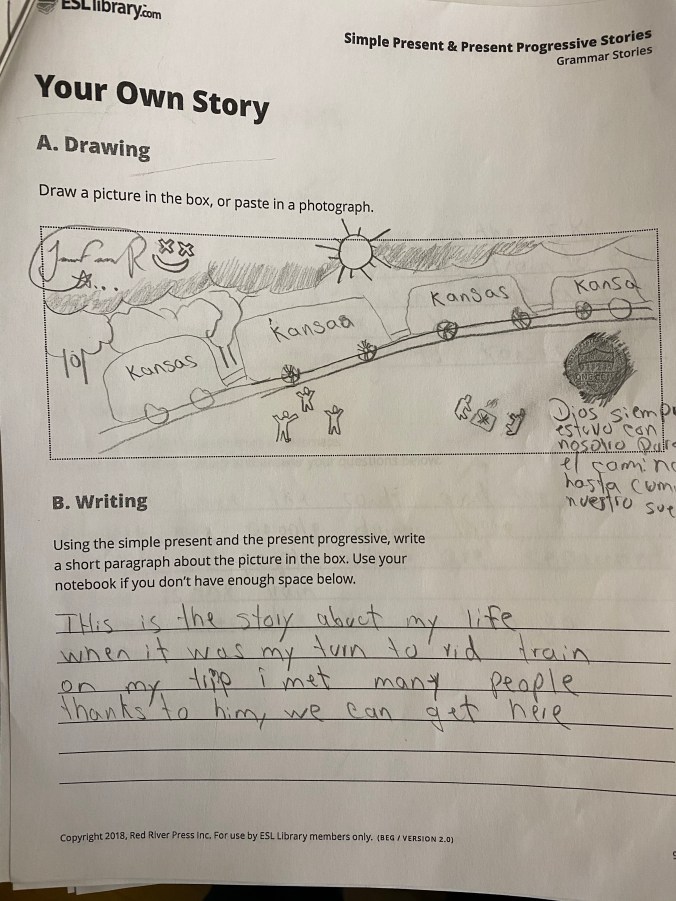


La Bestia Beckons

we will never know

how sketchy the ride will be

until we arrive

Balancing My Burdens

As a high school English teacher, I have heard hundreds of stories, and I’m not just talking about the melodramatic novels, plays, and memoirs we are sometimes forced to share with our students.

The burden of our students’ stories is something that all teachers must carry when we enter this profession. We must balance this burden in the midst of administering tests during most of our planning days for a month, attending staff meetings where we are told that we don’t deal with student trauma well enough right after attending staff meetings where we are told we’re not pushing them towards the test fast enough, right after being in class with students who are off-the-walls doing handstands (literally) or thinking about suicide (literally), right before being in class with students who don’t speak a word of English and all my paras are–you guessed it–testing, and these new Arabic-only students have come here with hearing impairments, broken hearing aids, and no money.

I have tried to balance this constant bombardment of burdens with my other role, my most important role in this life: being a mother to three daughters who will soon fully enter the male-dominated maelstrom we call a society.

And?

Most days I feel I fail at both. Some days I drown the sorrow with wine. Other days all I can feel is the freezing fresh air of a ski slope and a million tears of joy. Every day I feel the comfort and strength of the man I love, one who doesn’t contribute to the maelstrom.

Today is definitely one of the darker days. One of the days when I know that I have brought more of a burden than the average teacher onto myself by taking in this beautiful, kind, brokenhearted boy, who, amidst a series of relatively good news in recent weeks, had to share his whole sordid life story with the immigration lawyer today, had to explain the scars on his wrist, his thumb, his forehead, and the weight of his mother’s words behind those scars, had to hear that seeking asylum is an unwinnable case (never mind that just before the meeting he showed me a video exposing his hometown as the most dangerous city in the world to live, overrun by gangs) and that it will be two years if he’s lucky, three if it all goes well, and a 20% chance of never, that he will get. A. Work. Permit.

Not a Green Card. Not a driver’s license. Not an invitation to take a citizenship test.

A work permit.

Then to drive this teary-eyed, always-singing boy home for him to play his Spanish love songs all night long, to pluck along with his new guitar (a gift from my father, another man who doesn’t contribute to the maelstrom), for him to happily heat up some of the sandwiches he collected from the food bank to fill his unfillable teenage-boy stomach.

Then to have my middle child walk into the kitchen after her babysitting job and burst into tears.

Not because the triplets were whiny, not because the three-year-old threw toys at her again, not because babysitting isn’t her favorite thing.

Because they told her, after three weeks and mostly taking over the job from her baby sister (who solicited it to begin with) while Rio has play rehearsal, that they no longer wanted Rio to do it because she’s better.

Because she and I, this middle Mythili, haven’t been getting along lately because she’s fifteen and hates her mother, because she’s been calling me out for being too loud, too embarrassing, too forward, too judgmental, too ME, and because in this moment of inconsolable tears over thinking about what to say to Rio, Mythili and I are on the same painful page.

Because Riona has been hearing her whole life that she’s… too quiet. Too afraid to try new things. Too low to be in the regular group but too high to qualify for services. Too old to learn how to walk. Too immature to fit in with her sisters. Too messy.

Because Riona, after two hours of play rehearsal after eight hours of school after walking to and from school after doing her chores, made this iconic picture of her favorite things: the TV show Friends, an artist’s brush, a sunset background, and six–not five–cats, each with a symbol inside representing the members of our family: a pot for our papa chef, a heart for her mama, a music note for our five-weeks-in singing son, a star for our oldest dancer/actor/gymnast Izzy, a pencil for her artistic Mythili, and a paint palette for herself, the aspiring art teacher.

This is just one day, one story. One of the hundreds of stories that will make their way in and out of this heart within this cat, this heart between Bruce and me.

And I wonder which one will break me. Crying over my kids. Or crying over my kids.

I Just Have One Question

On the phone with the immigration lawyer four weeks ago: “I just have one question. What can we do at the school to get this boy out of a homeless shelter?”

“He needs someone to offer him a home and then we can begin the process of going through family court and applying for an SIJS visa.”

Five minutes later, calling my husband (which I NEVER do) in the middle of a school day:

Bruce: “What’s up?”

Me: “I just have one question.” Loooong pause.

Bruce: “Yeah…?”

Me: “Would you be willing to take this boy into our home?”

Bruce: “This boy who’s been in your class for three weeks and we know nothing about?”

Me: “… Yep.”

On the phone with the social worker, one day later:

Social worker: “Our ultimate goal is to place him with a Spanish-speaking family, although it doesn’t always work out that way. He told me that you might be willing to take him, and just so you know, I already Googled your house and everything I could find out about you. And I just have one question.”

Me: “Yes…?”

Social worker: “How do you feel about taking in a teenage boy when you have three teenage daughters living at home?”

(This was the easiest of these questions to answer).

In an email to the school psychologist, counselor, registrar, and social worker: “I just have one question. How does one take in a student in a situation like this?”

Response: “We don’t know.”

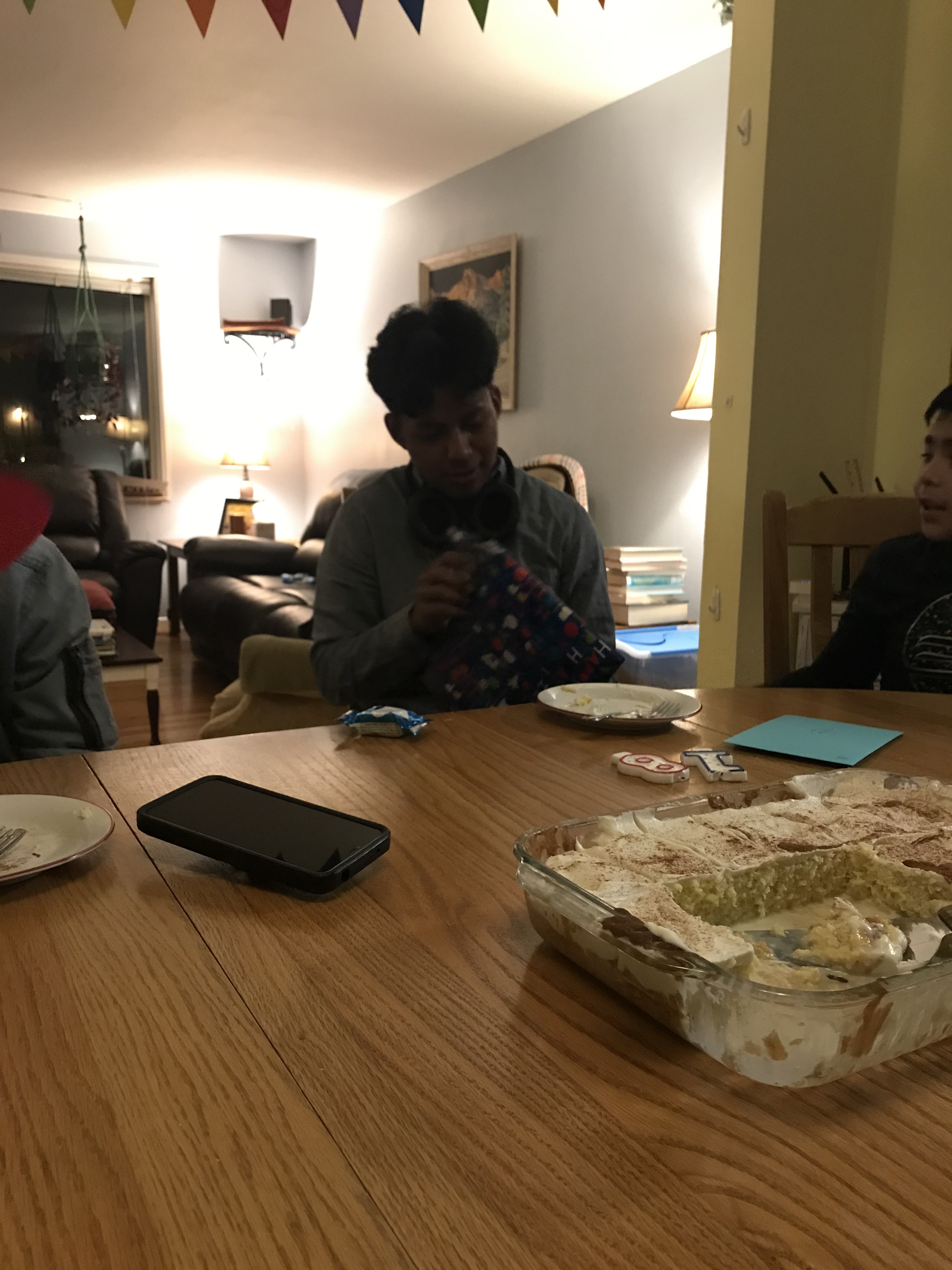
In my living room, three weeks later, meeting with the Uaccompanied Refugee Minor team of five adults–an interpreter, a bilingual social worker, a coordinator from Lutheran Family Services, a Guardian ad Litem lawyer, and a caseworker from the Department of Human Services. My puppy jumps from couch to couch, hovers on the floor with toys he begs them to throw, sniffs in their on-the-floor bags. Fabian holds the laser pointer and fiddles with the dog’s rampant scavenges for its source in the depths of the hardwood floor.

Social worker: “The primary goal of this program is to reunite you with your family. Let’s talk about all the family members you have in the U.S.”

So begins a lengthy discussion about every reason why his four family members cannot take him. One with a crime, one with a house too full, one in prison, and an uncle in Connecticut he doesn’t know.

Social worker: “Let’s talk about the uncle you don’t know. What if you went to visit?”

Fabian: “It’s too far.”

Social worker: “We could buy you a plane ticket. Pay for a hotel.”

Fabian: “…”

Social worker: “We don’t have to decide today. You can think about it. It’s always an option for your future. OK?”

Fabian: “OK.”

Fifteen minutes later, the meeting is coming to an end.

Social worker: “Now you both have the chance to ask any questions that you have.”

My quiet son, with red eyes and pulling his hands away from his downturned face, looks up and says, “Solo tengo una pregunta.”

We wait for the interpreter to repeat his words.

Fabian: “I just want to know how many times you are going to keep asking me to reunite with my family. Because I was in a homeless shelter for four months and no one in my family did anything for me, and I don’t want to reunite with them.”

Every mouth in the room: Silence.

I just have one question: What would you do?

Knowing that his journey across four borders and a lifetime of woes has ever-gratefully placed him in your living room. Knowing that you will lose sleep over this, waking in the middle of the night to police sirens thinking that ICE is coming, worrying that he will hate you, that he’ll turn back and re-cross those borders, that he won’t fit into your family. Knowing that when he sits in your classroom with all the others, they might make somewhat-joking, somewhat-bitter commentary about “your son.” Knowing that your daughters will get jealous over him being allowed to watch a movie on a weeknight or having a specially-made dinner and a piñata for his birthday. Knowing that people in your life are going to question every aspect of this choice (“College is coming up… can you afford this?” “Are you sure he’s not a criminal?” “Are you worried about having him in a house with three teenage daughters?”).

Knowing that for every day of your life, from the moment when he raised his face and asked his singular question, you will never forget its weight on your soul, on your humanity.

I just have one answer: love. It is the only response that is worth listening to out of every possibility. It is the only way to get through each of the borders that we must cross, each of the dark memories that plague us all, each of the questions we have always asked about what we could do.

We could love each other just a bit more.

Cracked

sometimes darkness wins

in the midst of a school day

until we find light

replaceable glass

that shatters understanding

as we question all

What I Heard Today

“Hiking? In the forest? No. Only to look for firewood to cook our food. Not for fun.”

“Yes, I’ve ‘visited’ Mexico. I was there for two months waiting for the coyote.”

“In a room the size of this kitchen there were forty of us. They gave us blankets just like that [pointing to tinfoil]. And when they had to wake someone up to deport them, they woke all of us. And they came in every fifteen minutes to wake someone.”

“Hermano, mira. Hay una lavandería aquí en la casa.”

“My 23-year-old brother wanted to come, but he can’t run fast enough.”

“He can’t run fast enough?”

“To get on the train. I saw so many… broken legs, arms. Even a body with its legs completely amputated. You have to be able to run.”

“I crossed the Rio Grande on a raft.”

“I’ve never seen a dishwasher. We had to wash our clothes and dishes by hand.”

“Eggs, beans, and rice for lunch and dinner. Coffee for breakfast.”

“My cousin bought me the plane ticket, the phone, everything. And the detention center had all of his information, so when I arrived at the airport, the police were waiting for him.”

“$250 here for strep antibiotics? In my country it’s free. Being sick here is a luxury I guess.”

I guess it is.

Minutes

“Did you see that three blocks down, they’ve torn down a house and are building a mansion just like this one?” I complain on the drive up Florida Ave., noticing another mansion in place of a 1940s war home. “It’s happening. Right in our neighborhood.” Our neighborhood of 1960s NON-war, perfectly-good homes.

“Mama, all you do is complain. Do you realize that? You complain about everything.

I think for a moment. We’ve been in the car for five minutes, and this is my first complaint. Give me SOME credit.

***Three hours later.***

My youngest has her exhibition night. She presents a video with her BFF about the endlessly inevitable impacts of Westward Expansion on Native peoples. She has drawn a calming coloring page with polygons for her math class. She has developed a filter to determine how best to eliminate toxins from drinking water.

And now she is participating in a Socratic seminar, sitting in a circle with her classmates, discussing “technology,” the parents hovering on the outskirts.

In the blink of an eye, the topic moves from the dangers of texting while driving to the dangers of guns. A very well-spoken and adamant eighth grader sitting two seats down retorts, “Guns don’t kill people. People kill people. My father is in the military, and soldiers have learned how to handle guns respectfully. With control.”

It is 19:22 on a Thursday night. I have sat through two 90-minute classes and two meetings and one long-short drive, fixed a put-together-leftover-dinner, walked the dog, walked to this “perfect” school, and begged my husband to join me for this one last event, only to realize the intense permeation of these ideas.

***Three hours earlier***

“Do you see it, girls? Right there. The original house is gone. Only the scaffolding for a mansion in its place.”

“And what’s wrong with that?” my oldest, money-hungry oldest, demands.

“The best part of living in this neighborhood is how real the people are. How middle class they are. NOT rich. Not taking everything out from under the rest of us.”

But all the people taking everything out from under the rest of us actually surround us. They are in my youngest’s classroom. They are five miles away, intentionally driving an RV into a hijabi woman, mother and aunt to the most precious students one could ever imagine the joy of having in a classroom. They are this thirteen-year-old’s mother, who intervenes in the Socratic seminar when some students suggest that in other countries, there are no school shootings. That in America, maybe we should focus on mental health rather than providing guns to all citizens.

A bulldog, she shadows her daughter, raises her voice, raises her hefty body in a darkened stance, and indirectly threatens the eighth graders. “We as human beings… We are ALL human beings, right? You as a human being have the responsibility to get help if you have mental issues. You have the responsibility. No one else. Guns don’t kill people. People kill people.”

I have to turn away. Suck in my breath. Stare at the wall. Clench my fists. Her teacher visibly notices my discomfort, walking towards me but not saying a word.

When I arrive home, all the news of the day is a heavy weight. My two girls who graduated nineteen months ago, who walked across Eritrea for fear of persecution, leaving their parents and home behind in search of a better life, who came to our country because their aunt lived here, who couldn’t tell me till the end of the year that the words of The Good Braider were so true for them, the protagonist counting her minutes on her cell phone, working extra hours to buy more minutes, were so true to them because they had to do the same to call home to their mother… And now?

And now some bastard who saw a hijabi Black woman walking home in the middle of a Wednesday from an ENGLISH CLASS rushed across two lanes to murder her?

But guns don’t kill people. People kill people, right?

“You’re not friends with that girl, are you?” I ask my baby daughter.

“God, no, Mama, she’s just awful.”

“OK, I’m just making sure because …” And I begin my rant about guns, the same rant they’ve heard their whole lives, the same rant that causes my middle child to hold up her hand and shout, “Enough with your opinions, Mama, it doesn’t really matter,” and then I hold up my ever-evil, ever-heartbreaking social media page where my close high school friend has to report that her Muslim son was threatened by a classmate to be shot that very afternoon, and I shout back, “It ABSOLUTELY matters, and this is why.”

It’s true. I complain about everything. I complain about injustice, and I will complain about it every minute of every day until the day I die. Injustice in the distribution of wealth. In immigration atrocities. In gun violence. In violent death from the gun of a soldier in the Middle East to the tires surrounding me in ever-so-fucking-golden-Denver.

I wish I could buy more minutes, too, just like Viola in The Good Braider. Just like Jumea and Salihah, who crossed mountains and oceans and discrimination to be given a chance that has been taken from them.

I wish I could buy more minutes of their smiles. Of how hard every immigrant I know works to build those mansions. To make this American Dream a reality. To put this darkness into perspective.

These are my minutes for today. My notes. They may sound like complaints, but they are tinged with the hope that someone will listen. Someone will donate. And someone will see that people don’t have to kill people.


Scarred for Life

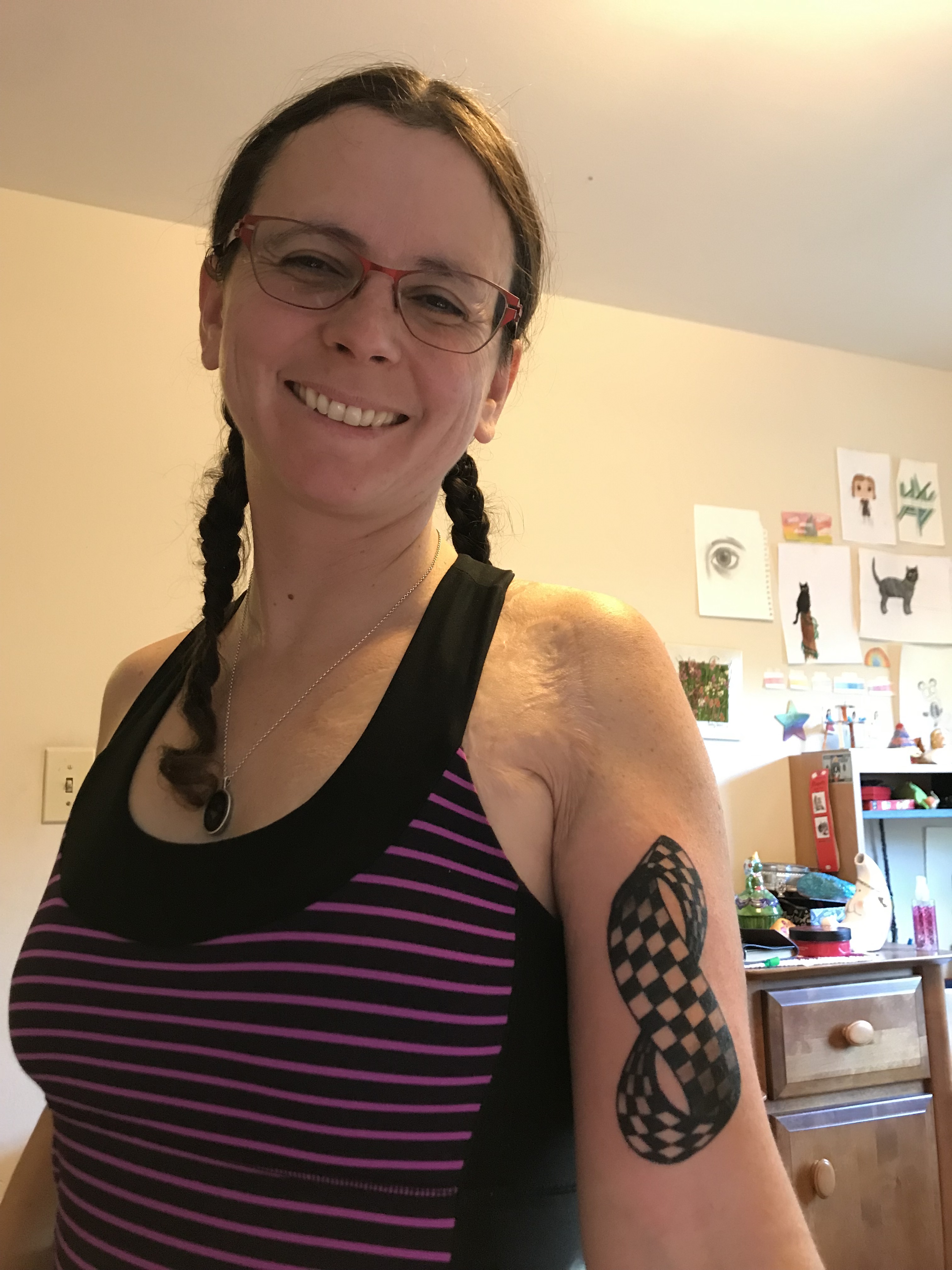
I was eight when the plastic surgeons took their scalpels and shaved a thin layer of rectangular skin from my upper right thigh to carefully morph it onto my shoulder and, twenty stitches and forty-seven staples later, make me a new scar over my burn scar.

For the remaining years of my youth, every time I wore a swimsuit, a tank top, an open-necked dress, I had to answer questions. “What happened?” “How old were you?” “What were you doing?” “How much did it hurt?”

Even though I know my mother worried that the questions would always lead to blaming  her, no one ever asked me, “Where were your parents?”

Obviously, they had done the best that they could. After a few moments of shock when the six cups of water came tumbling down onto my ballerina-shoe sweatshirt, they ripped off the thick cotton and lifted me towards the sink, flushing me with cold water. They called the neighbor who was an EMT. They placed me in an ice-cold bath to try to soothe the bubbling blisters. They drove me to the hospital, to doctor appointment after doctor appointment for six months. They scheduled the surgery. My mother took off work for two weeks to care for me in and out of the hospital–her only vacation time of the year spent fretting over the major surgery her eight-year-old child had to undergo. The extra three days in the hospital because I just wouldn’t heal. The forty-five minutes I screamed after the surgery because the hospital was undergoing a major renovation and no one could find me a nurse to administer pain meds.

But no matter the sacrifice, no matter the recovery, no matter the gymnastics lessons I took that fall to stretch the skin, no matter the special silicone-filled vest I had to wear for months to press the new skin onto the old, that scar would always be there.

Primarily on my shoulder, but truly spilling beyond their surgical tools till all the way below my belly button, I was scarred for life.

Its bitter reminder stung me on my wedding day when I knew I could only pick a dress that would fully cover my shoulder.

On each of my children’s birthdays, when their anxious, hungry lips opened up a new wound in my left nipple that wouldn’t heal for six weeks of excruciating, needle-through-the-veins pain each time they nursed.

On every cock-eyed look I’d received throughout my life when people noticed the scar more than they noticed me.

I was eight years old when I had the best birthday of my life. My parents spoiled me that year because the surgery would prevent me from swimming in any of the five Finger Lakes for an entire summer, a punishment equal to hell for an upstate-New York kid. They let me have not one (the usual), but three friends spend the night. I got a Smurf watch and two Slinkys and a bouncy Gummi Bears toy that we played with for hours. My mom made a strawberry cake with strawberry frosting because I was obsessed with pink. They borrowed the neighbor’s VCR and let us stay up late watching movies. They made my night magical.

Despite everything–the ugliness of the scar, the ugliness of the pain–the scar became a part of me. So what if every time I went to the beach I’d get a look or too? At least I had a story to tell. At least it wasn’t worse. At least it was the worst thing that had happened to me as a child.

When my fiancé proposed to me more than ten years later, there was only one date I had in mind for my wedding day: 8.8.98. The number reflected everything–twenty years old, infinity, the life-changing events of my eighth year of life.

And though my mother always fretted over my scar, and though I feared making the choice I made yesterday for my entire adult life because of my fear of never healing and that cursed scar, I have no regrets.

It is dark. It is light. It felt like a cat scratching me a thousand times. But it did not feel like pouring six cups of boiling water onto myself. It did not feel like giving natural birth to three 9-pound babies. It did not feel like surgeons pulling forty-seven staples out of my skin graft.

It felt like infinity. Like the perfect figure 8.

Scarred for life. Just like I always have been and always will be.


Teen Driver Woes

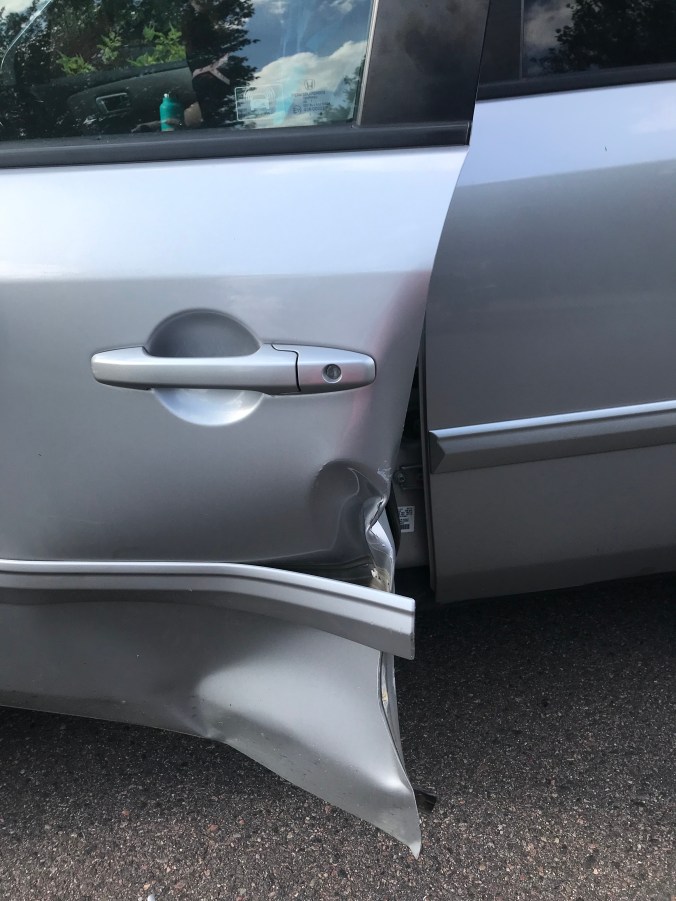
welcome back, Pilot

we’re sorry we wrecked you, girl

please forgive our luck

A Credible Threat

At 12:39 a.m., my husband’s phone rang. A text message beeped. He rolled over and turned it off, not revealing to me the message, though I tossed and turned for the next fewer-than-five hours of “sleep” until my alarm startled me into a flood of my own messages. Realities of life in America in 2019.

One person, an 18-year-old child, lost and confused, dead before the day was over, shut down every major school district in a massive metropolitan area today.

This child, infatuated with the Columbine massacre that has been the backbone of her school upbringing, made “a credible threat” to “a school” and kept all the parents, teachers, officials, and students in a state of shock for the remainder of the day.

A girl, a lost girl brought up by school lockdowns, a mass shooting every day of her young life (of all of our lives), school shootings that have taken the lives of teens and six-year-olds, schools surrounded by armed police officers and security guards, and social media filled with conspiracy theorists and bullying…

Was she a credible threat, or was it us?

Is it us?

When will guns ever be considered a credible threat? When will gun stores who sell shotguns to 18-year-old out-of-state children be considered a credible threat? When will assault rifles be considered a credible threat? When will her online banterings (cries for help), the banterings of every filled-with-angst teen, be considered a credible threat?

One “shoe bomber” entered a plane. We remove our shoes in security.

Thousands of children died in car accidents. We put them in car seats.

Thirty babies died in baby swings. We recall the swing.

Are these credible threats?

Just as Sol Pais grew up with the Columbine tragedy as a backstory to her school experience, I have grown into my teaching career, my parenting life, with its everyday reality. I was a junior in college when the front pages of both newspapers in Denver were filled for weeks with the news of,  Why? Who? How? All the major networks sent reporters that day for an emergency special. All of America, seeing the horrific scene played out on television, sat in numb disbelief.

Twenty years later, hundreds of school shootings later, there might be a few headlines for a day or two. A growing number of protests. A teary-eyed president’s remarks. An ignorant president’s remarks.

Yet, we have done everything but what we need to do to prevent the credible threat of another mass shooting.

We have lockdowns and lockouts at least four times per school year just for practice. Our kids huddle like rats in cages under desks in a dark corner of the classroom, always acutely unaware if this will or will not be the day they die.

We have more security guards and armed police officers walking the hallways. Some schools even arm teachers.

We watch videos to start the school year showing active shooter training for our district staff.

We have metal detectors, clear backpacks, and every exterior door locked to outsiders.

We have to talk to our kids, all of our kids–our students and our own–on a regular basis about reporting threats to Safe2Tell, about keeping an eye on suspicious students, adults, about what guns can and will do.

But…

The most credible threat in the world, the simplest solution, has never even been considered.

What if we just stopped selling guns? Assault weapons?

What if this 18-year-old child barely knew about Columbine because, after all the horrifying media attention after it occurred, our senators and representatives went back to Congress and represented the victims, rather than the NRA, and passed a bill that could save every credible threat like this from ever happening?

What if, at 12:39 a.m., I could dream a peaceful dream, and not have to think about what I’ll say to my daughters today and my students tomorrow?

There is only one credible threat here, and it is not an 18-year-old child.

It is ourselves. Our government. Our inability to bring the life, liberty, and security that we so proudly proclaim we offer in this “dreamland” of the United States.